A league apart: Inside RCB, RR and the IPL's billion-dollar bet
How sports and capital are converging to make the T20 franchise league a global investment magnet
By
Prefer us on GoogleLast Updated: Apr 08, 2026, 10:49 IST13 min
In January 2008, Manoj Badale reached Mumbai’s Wankhede Stadium to submit Emerging Media’s bid for an Indian Premier League (IPL) franchise. Alighting from his Honda, the UK-based venture capitalist snuck past a fleet of limousines whose owners had come in with competing bids, and a throng of journalists waiting to score photos and bytes from them. “They assumed we were from the press,” Badale had told Forbes India in an earlier interview, joking about how he sauntered into the Board of Control for Cricket in India (BCCI) headquarters without any fuss.
In the boardroom later that afternoon, once the sealed envelopes were opened and the highest bid announced, Badale had a sinking feeling—Mukesh Ambani’s Reliance Group had put in $111.9 million, nearly double of what Emerging Media had offered. Seven franchises were allotted one after the other with descending order of prices, and Badale had almost given up, when Emerging Media’s $67 million was called out. Jaipur was the only remaining franchise, and the consortium managed to scrape in as the last winning bid.
Badale might have started his journey in the IPL as a proverbial backbencher, but 19 seasons on, it’s him who’s turning heads as much as 15-year-old Vaibhav Sooryavanshi, the trailblazing opening batter of his team. In March, Rajasthan Royals (RR), in which he held a 65 percent stake, became the first IPL franchise to cross the billion-dollar mark in value, when a US-based consortium led by tech entrepreneur Kal Somani and backed by members of the Walmart and Ford families bought the team for $1.63 billion (about ₹15,290 crore). The Jaipur franchise, which in its early years had adopted the ‘Moneyball’ template of fielding a data-led, low-budget team—made famous by American baseball outfit Oakland Athletics—witnessed a 24.3x jump in value from its original sale price.
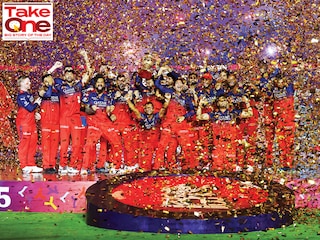
A few hours after RR’s price was declared, reigning IPL and Women’s Premier League (WPL) champions Royal Challengers Bengaluru (RCB), upstaged its statistical pyrotechnics by fetching an even higher cheque. The Diageo-owned franchise was picked up by a consortium—it comprised the Aditya Birla Group (ABG), the Times Group, US-based Bolt Ventures and PE behemoth Blackstone—for $1.78 billion (about ₹17,000 crore), at 16x its 2008 sale price of $111.1 million, making it the most expensive IPL side ever.
In 2021, when RPSG Group Chairman Sanjiv Goenka bought the Lucknow Super Giants, one of the last two teams to be inducted into the league, for ₹7,040 crore (about $950 million), reams were written on whether the maths tallied. With RR and RCB breaching the billion-dollar mark, the debate appears to have been sealed—IPL seems to have completed its transition from a cricket league to a global investment magnet.
Among the new RCB owners is Bolt Ventures, the private investment platform of David Blitzer, billionaire investor and a key figure in private equity (PE) fund Blackstone, who has a sports portfolio that spans at least six leagues across the US and Europe, and includes marquee teams like Philadelphia 76ers in the NBA.
“Anybody who’s been a premier sports investor over the last 10 to 15 years has done extremely well on the back of that. Now, globally, the most attractive sports asset and growth avenue in the world is the IPL. So, it’s a natural extension for them,” says Satyan Gajwani, chairman of Times Internet, now the co-owner of RCB.
Adds Moona Ssahni, founder & CEO of Monaargy Consultancy, and former CFO, RR: “There’s a clear shift in the investor base—from individual or passion-driven ownership towards serious institutional capital, global funds and strategic investors, who view IPL franchises as long-term assets.”
Gajwani and the Times Group had earlier dabbled in sports through the ownership of cricket news website Cricbuzz, broadcaster Willow TV, and stakes in the Major League Cricket as well as London Spirit of The Hundred, UK’s T20 franchise league. They had separately put in a bid for RR as well, but eventually stitched up the four-party consortium for RCB barely a week before the sales were closed. While Gajwani—who will serve as vice chairman, and Aryaman Birla of ABG, the chairman—declined to disclose individual stakes, and only confirmed there’s no single majority shareholder, sources in the industry estimate Blitzer’s investment at around $750 million, with ABG and the Times Group contributing roughly $450 million and $400 million, respectively.
“The winning bids are huge numbers and won’t give you good returns, if you consider them in the short term,” says Rajesh Sharma, founder of NBFC Capri Global who had put in a bid of about ₹14,000 crore ($1.4 billion) for RR. “You have to take the lens of the next 10 to 15 years and anticipate the growth that IPL is expected to see during that period.”
That aside, IPL has set a cap on player salaries in the league—₹151 crore for the 2026 season, going up to ₹157 crore in 2027—protecting bottomlines. How player salaries can cripple finances is evident from the balance sheets of some of the European football clubs: According to a recent survey, nine out of top 10 teams in English football’s top four divisions expect to post pre-tax losses for 2025, with player wages accounting for most of their earnings.
Besides, IPL franchises rent local stadiums from respective state associations during the season for roughly 20 percent of their ticket revenue, making their set-ups asset light and freeing their books of capital expenditure.
“Both RCB and RR are profitable, as are all the eight older franchises, and both have an Ebitda margin of around 30 percent. In sports, you rarely hear of any franchisee making profits of that margin. This is why IPL as an investment class has been able to attract investors, not just from India, but from US and Europe as well,” adds Talikoti.
Bhairav Shanth, co-founder of sports marketing and consulting agency ITW Universe, which has been involved in a number of commercial transactions in the league, confirms that most IPL franchises generate around ₹700 crore to ₹800 crore in revenue with almost 80 percent of it secured before the tournament through long-term media rights and front-loaded sponsorship deals. “RCB, specifically, reported revenues of $56 million in FY25, which is a 73 percent increase over a three-year period,” says Shanth. The new buyers and investors are eyeing such revenue potential.
“Structurally, IPL franchises are unique. The model provides relatively predictable cash flows through central revenues, which creates financial stability and downside protection, not entirely dependent on on-field performance,” says Ssahni, formerly of RR. She adds that, from an investor standpoint, this is clearly a long-term play, where the expectations would be compounding returns over a seven- to 10-year horizon.
Gajwani admits that global expansion would be a key question that the new RCB board would deliberate upon once they formally take over. But he dismisses claims that they landed a bargain at $1.78 billion, when, pre-sale, experts pegged RCB’s value at anything between $1.8 billion and $2 billion.
“I don’t think we got a steal. Diageo is happy with the outcome, we are happy with the outcome… this price is a high multiple of revenue and Ebitda for both the franchises. Anybody who’s doing this has to have a high conviction on the future growth potential,” he says.
The scarcity of the asset class, too, commands a premium—there are only 10 IPL teams, with no word from the BCCI on expansion plans. “When something scarce generates predictable, recurring cash flows, buyers overpay because there is a natural moat,” adds Shanth.
“These valuations of $1.6 billion to $1.8 billion imply revenue multiples of around 20x to 22x, which are tech-sector multiples applied to a cricket franchise.”
But even at close to triple the value of what it went for in its previous five-year rights cycle—₹16,347 crore—they don’t compare to those of the top sporting leagues around the world. For example, the media rights of the NFL, the world’s richest sports league, signed in 2021, add up to $110 billion over 11 years. With the viewership growing exponentially—with a 515 million audience across linear TV and digital for the opening weekend of the 2026 edition—and talks to increase the number of matches in the next media rights cycle to 94, from the current 74, there’s enough headroom for the value to grow. But here’s the catch.
Last year, Star and Viacom formed a joint venture, leading to the creation of JioStar, a unified streaming platform. As the IPL goes into a new media rights cycle in 2028, this consolidation is expected to bring headwinds. “I would think it will only see modest growth in rupee terms and given the rupee’s depreciation against the dollar, it may actually degrow in dollar terms compared to the last cycle,” says Shanth of ITW.
A few media experts Forbes India spoke to also anticipated a flattish growth of the rights, unless the ecosystem sees the entry of new-age platforms like Netflix and Amazon Prime to add the competitive edge. Or even YouTube, which, as the US-based Sports Business Journal writes, already has 2 billion-plus users consuming 40 billion hours of sports content annually.
“We understand media rights will face uncertainty in the next cycle,” says Gajwani. “But media rights are a function of two things: Supply-demand, which may get affected. The other is the underlying asset resilience. Supply-demand dynamics will ebb and flow; maybe in the next cycle, it’ll be different. But if you take a medium- to longer-term view, the asset is extremely resilient… and pricing will ultimately reflect that.”
This is where questions will emerge on how well a franchise has been able to translate brand fame into revenues. For example, the popularity of RCB has been built on the likes of players like Chris Gayle, AB de Villiers and Kohli, of who the former India captain is still identified with the side. RCB, through the 12th Man Army, has also built a structured, official fan community that is as visible as it is audible during matches at the Chinnaswamy Stadium. But how far has the team been able to monetise either?
Agrees Gajwani: “The IPL has probably more room to grow in terms of local fan-based revenue and fan community development. The 12th Man Army is an amazing asset, but I think it can do more.” This is where the experiences of the likes of Blitzer—who owns a team in every key American league, including the NFL, where average team valuations jumped 25 percent to $7.1 billion last year—will come into play. “I do believe that global franchises have more success on game-day experience revenue—tickets, merchandise, experiences around the venue, local revenue development measures… our job will be to bring some of those learnings.”
RCB has emerged as a pathbreaker in fan engagement with RCB Unbox, its annual pre-season event launched in 2022 and hosted at the Chinnaswamy Stadium. At the event, fans get a dekko of the stars during practice sessions, and the event culminates into a series of music performances. This year, franchises like Mumbai Indians and Chennai Super Kings followed suit with their inaugural fan events—MIX and ROAR, respectively—underlining a shift in fan engagement. “The question is why did it take them 18 years to do that?” asks an expert closely associated with the IPL ecosystem. “It reflects how slowly the teams are adapting to the need to put an arm around your fans to be able to make money from them.” The objective is clear: How to convert a spectator into a fan, and team loyalty into revenues.
For RCB, the consortium has signalled a continuation of their ‘Play Bold’ brand identity. “RR faces a more complex question: Does American ownership push for a more globalised brand, or does the Jaipur-rooted identity remain the core?” asks Shanth of ITW.
For RR, match-day revenue could be one of the levers. With a current capacity of 23,000 at the SMS Stadium in Jaipur, there is an opportunity to expand capacity, and drive higher per-fan spends through hospitality, F&B and in-stadium engagement. And given Rajasthan’s strength as a tourism destination, the franchise can look to build sports tourism and curated fan experiences around the team.
Where does the IPL go from here? Most experts Forbes India spoke to concur that it will only grow bigger, but none sees a 100 percent buyout in the recent future. “The RCB and RR deals will give confidence to current owners to hold on to their stakes as the value balloons in the future for global investors,” says Francis of Brand Finance India. “But, for some, it will be an opportunity to bring minority stakeholders into play.” The Sanjiv Goenka-led RPSG Group, for example, is said to have been exploring a sale of up to 15 percent stake in the Lucknow Super Giants.
In its very first match in 2008, Brendon McCullum, the Kiwi batter playing for the Kolkata Knight Riders, had set the league on fire by scoring an unbeaten 158 runs off 73 balls. IPL is still igniting fireworks, but this time, off the field.
First Published: Apr 08, 2026, 11:08
Subscribe Now