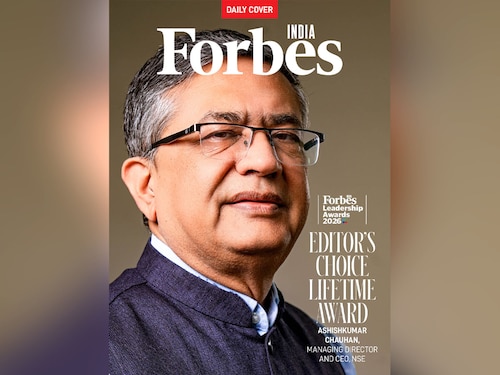
On a humid afternoon in Mumbai in 1992, a young engineer-turned-banker at IDBI was told to move to his Cuffe Parade office building’s 19th floor from the ninth. “Some project,” his bosses told the youngster vaguely. No explanation, no details, no grand vision.
What awaited upstairs was not another routine project, but the seed of an institution that transformed India’s capital markets. That task was to set up the National Stock Exchange (NSE), which turned out to be the largest stock exchange in India. Ashishkumar Chauhan—an IIT-Bombay and IIM-Calcutta graduate who was just 24 then—was one among five members chosen to lay its foundation framework. He was the youngest by nearly a decade in the team, the only engineer and the only Gujarati (most traders and brokers spoke in Gujarati on Dalal Street).
The timing was dramatic. ‘Big Bull’ Harshad Mehta’s stock markets scam had shaken investor confidence and punctured people’s trust in capital markets. Given the uncertain landscape, the idea of NSE was dismissed as a pipedream. “People thought this was just another government experiment after a scandal,” Chauhan recalls. That doubt, though, he lets on, gave the team the freedom to build quietly.
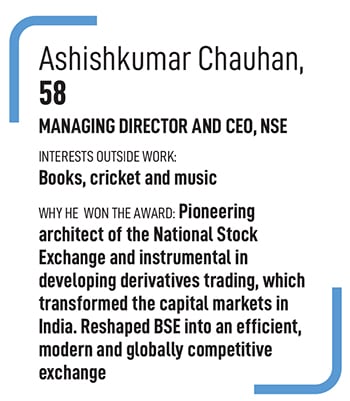
Thirty years since then, Chauhan, considered as the “father of derivatives” in Indian finance, re-joined NSE for his second stint in 2022 (he had left the exchange in 2000) as managing director and CEO. The institution he had helped build from scratch three decades ago needed rebuilding, not in terms of technology, but trust. Though the challenges were similar to his early days, Chauhan’s comeback carried the weight of expectations.
NSE has, in the recent past, faced issues such as corporate governance lapses and transparency crises. Chauhan did not believe in staging dramatic rescues. Instead, he preferred invisible changes. “My methodology is slow work without noise. It should look like life as usual, but you are changing things continuously,” he explains.
That meant tackling technology glitches one by one and ensuring systems ran without failure. It involved incremental upgrades, testing, rolling back, testing again, because with a giant like NSE, sudden overhauls could spark chaos. It comprised governance repair through small, everyday acts.
Stepping out of the shadows of uncertainties and scandals, NSE, under Chauhan, is now making heady progress towards its initial public offering (IPO) plans. It is one of the most closely-watched IPOs in the country’s capital markets. In January, NSE received the Securities and Exchange Board of India’s (Sebi) no-objection certificate to proceed with formal preparations to go public. The IPO was stuck due to investigations related to the co-location scam. Sebi’s investigation in 2015 revealed that some brokers and NSE were involved in sabotaging the system for securing gains during market trade. The exchange had first filed for an IPO in 2016, but it had to withdraw later.
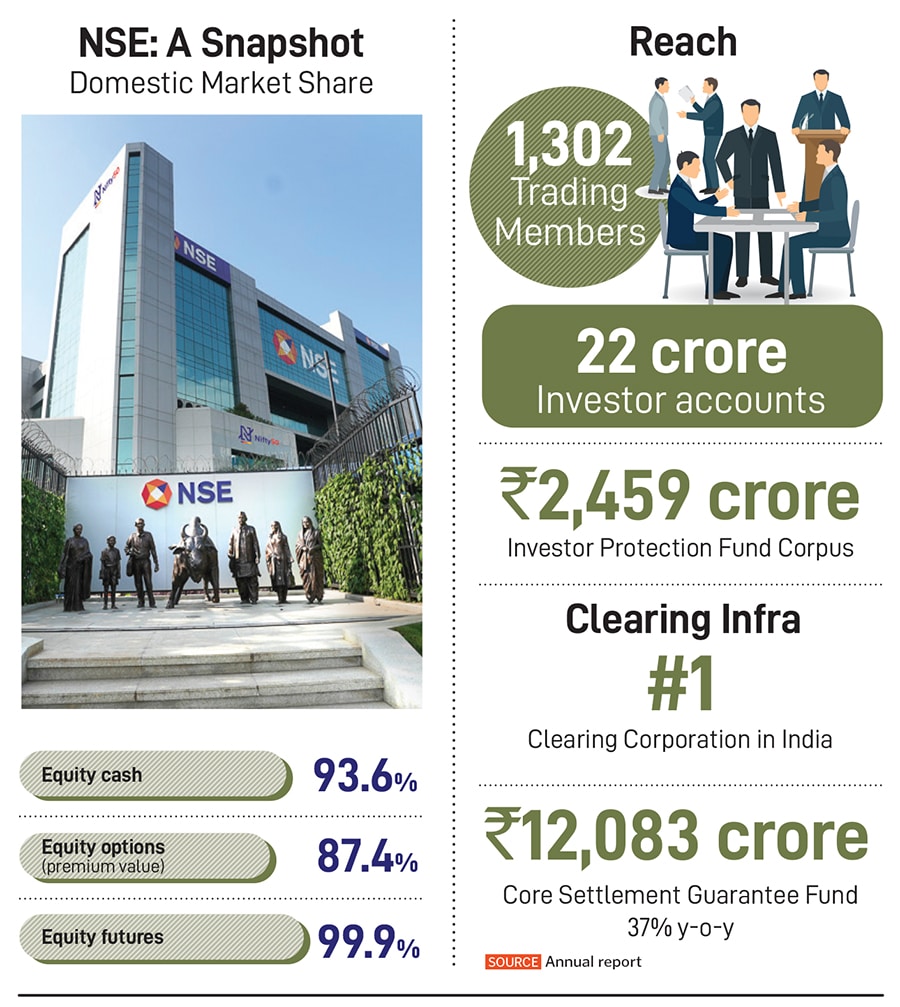
NSE is India’s largest stock exchange in terms of equity turnover for almost three decades, according to Sebi. It was the world’s largest derivatives exchange by trading volume (contracts) in 2025, as per Futures Industry Association. Globally, NSE was ranked third in equity segment by the number of trades (electronic order book) in 2025, according to the World Federation of Exchanges.
![]()
The integrated business model of NSE spans listings, trading services, clearing and settlement, indices, market data, technology solutions and financial education. Beyond being a marketplace, it also oversees compliance by trading, clearing members and listed companies with Sebi’s and the exchange’s rules and regulations.
The stock exchange’s response time stands at around 100 microseconds, enabling it to process roughly 50 to 60 lakh transactions per second.
“The success of NSE was the first major achievement in the history of stock exchanges in the world and the harbinger of taking IT to the next level. The NYSE, Nasdaq and other exchanges followed suit,” says Chauhan, who calls himself “lucky”, though his journey reflects more than chance.
Born in Ahmedabad, Chauhan was the second child of Manilalbhai and Muktaben Chauhan. He has an elder sister, Beena, and a younger brother, Sunil. The family’s roots trace back to Bavla village in Ahmedabad, Gujarat. His father was a civil engineer on irrigation projects, while his mother worked as an inspector at sales.
![]()
Second Homecoming
The co-location controversies, governance lapses and personal scandals had shaken NSE’s credibility since 2017. “Don’t do it. You have earned more than you will ever spend. Why walk into the lion’s den where you can get killed?” Beena, who lives overseas, had warned her brother before his second stint.
Family opposition wasn’t the only hurdle. Even prospective employees recoiled. Chauhan recalls hiring a secretary who, after three months of deliberation, called the human resources team on the day of joining: “I cannot join this company. It’s too scandalous.”
Board members hesitated too. Corporate governance was in tatters and reputational risk hung heavy. Chauhan believed someone had to restore faith in the institution. “What we manufacture as an exchange is confidence,” he says. “And how do you bring trust when distrust has built up?”
“I never thought I would return to NSE,” confesses Chauhan. When he returned in 2022, the task was not to build a new ship, but to salvage it.
![]()
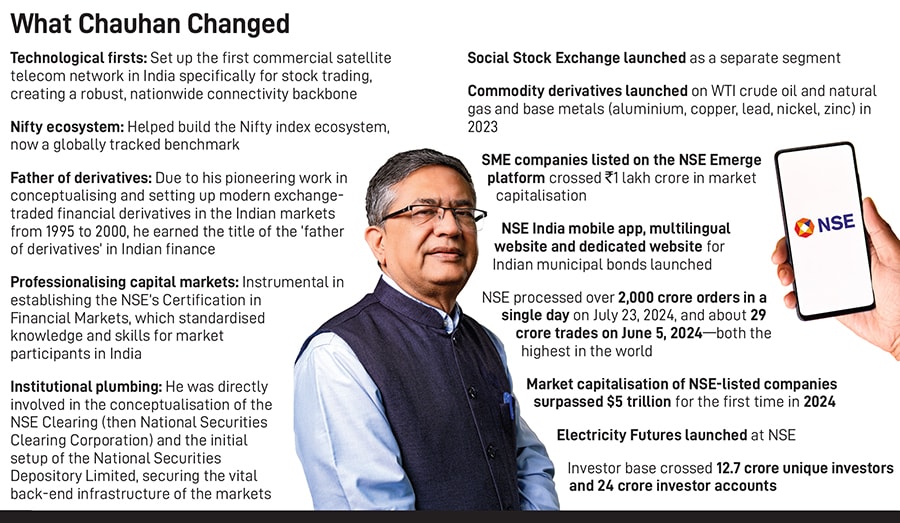
Chauhan, though, believed in himself and he has been proven right today with record-breaking trades, innovative platforms and a renewed interest. In 2024, NSE-listed companies collectively crossed the $5 trillion market capitalisation mark for the first time. The SME segment on NSE Emerge surpassed ₹1 lakh crore in market capitalisation.
Chauhan’s tenure is equally defined by innovation. The Social Stock Exchange was launched as a separate segment, creating a new avenue for social enterprises and non-profits to raise funds transparently. The investor base of NSE expanded dramatically, crossing 12.7 crore unique registered investors in January. And the number of accounts crossed 25 crore in February.
Operationally, NSE set global records too. On June 5, 2024, it executed 29 crore trades in one day. On July 23, the same year, the exchange processed over 2,000 crore orders in a single day—the highest in the world.
Product innovation has remained a hallmark. In 2023, NSE introduced commodity derivatives on WTI crude oil, natural gas and base metals, including aluminium, copper, lead, nickel and zinc, expanding its offerings to global benchmarks and industrial essentials.
“Ashish bhai has played a pivotal role in the transformation of India’s capital markets. He has guided the journey from dhandho to demat, from payment crises to reliable settlements and from open-cry trading to electronic platforms. His contributions have been truly foundational by helping convert what was once perceived as a gambling den into a trusted centre of excellence,” says Nilesh Shah, MD, Kotak Mahindra AMC.
Chauhan was also instrumental in developing the Nifty index ecosystem, which has become one of the world’s most-tracked benchmarks. The 50-share index completed 30 years this March.
“As we celebrate three decades of the Nifty 50, we are not just marking the history of an index. We are recognising a broader journey—one of India’s capital markets
and the institutions that support them. Over these 30 years, the Nifty has become a mirror of corporate India, a barometer of investor sentiment and a compass for the direction of our markets,” says Tuhin Kanta Pandey, Sebi chairman. He adds that the journey has been made possible by the collective efforts of many stakeholders—exchanges, regulators, intermediaries, market institutions and millions of investors.
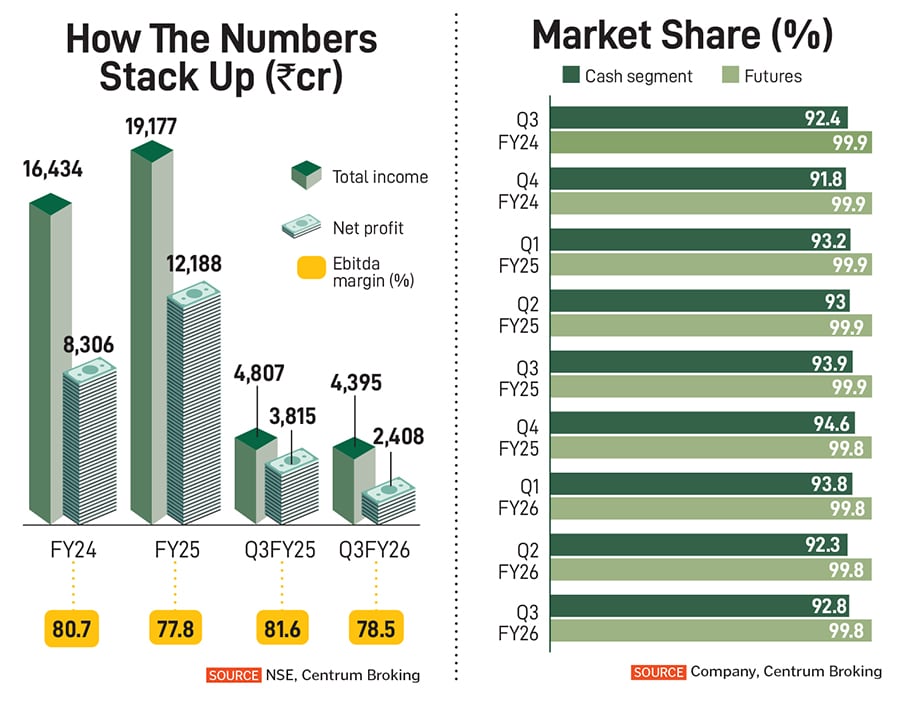
The numbers tell the story of NSE’s transformation. The total market capitalisation of NSE-listed companies reached ₹464 lakh crore ($5.1 trillion) in February, making India the world’s fourth-largest equity market, a 128-fold increase from ₹3.6 lakh crore in 1994-95.
Globally, NSE ranked second in new listings (15.3 percent global share) and third in cash market trades (12.7 percent) in 2025. NSE continued to be the largest derivatives exchange in world, ranking number 1 globally in equity derivatives by number of contracts traded with a 51 percent global market share in 2025.
However, behind the numbers lies a narrative of grit, improvisation and relentless execution of Chauhan. “Ashish bhai is a thorough professional. He can teach technology to IT company CEOs, market and investor psychology to mutual fund CEOs, and spiritual subjects to students. He is one of the finest individuals one can meet,” says Shah.
![]()
Laying the foundation
Between 1995 and 2000, Chauhan’s trailblazing efforts in conceptualising and establishing modern exchange-traded financial derivatives transformed India’s markets. He is a man of many firsts. Chauhan had set up the first commercial satellite telecom network in India specifically for stock trading, creating a robust, nationwide connectivity backbone. He is also credited with setting up the first screen-based trading in India, mobile trading, mutual fund distribution through exchanges, markets for SME shares, the Nifty index and derivatives trading.
Through his innovations, mostly through technological interventions, he laid the framework for India’s modern stock exchange. When NSE began operations as an exchange in 1994, it introduced electronic or screen-based trading, replacing the age-old open outcry system with a modern, transparent and efficient mechanism.
When he was drafted into the NSE’s founding team, his seniors leaned on him for everything—from fetching tea, scouting office premises and getting office interiors done to drafting the articles of association and importing computers. “I was like a handy boy for the group,” he recalls. “Being young, you don’t think too much. You just get the work done.”
Behind the errands, however, lay the real challenge: Designing IT algorithms, satellite telecom systems and network infrastructure for a project that had no precedent
in India. Chauhan, who had never worked in IT before, found himself building the backbone of what would become the country’s first fully automated exchange.
Later, the exchange not only transformed India’s financial landscape but also became a test of India’s IT capability, inspiring confidence globally and paving the way for contracts worth billions of dollars. “NSE was more than an exchange. It was a testament that India could deliver complex, fault-tolerant systems at scale,” says Chauhan, who was also instrumental in launching the NSE’s Certification in Financial Markets.
He played a decisive role in building the institutional infrastructure of India’s markets. His involvement in the conceptualisation of NSE Clearing and the establishment of the National Securities Depository Limited secured the vital back-end systems that guarantee transparency, efficiency and trust.![]()
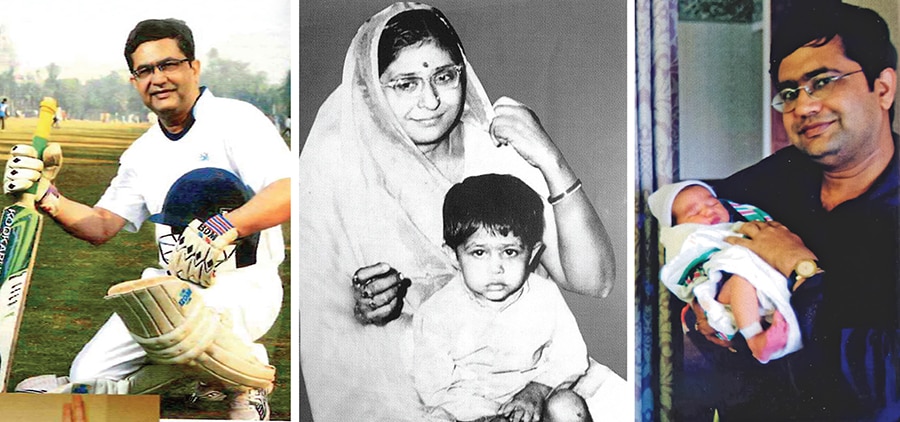
(From left) Chauhan after an IPL match in South Africa; with mother Muktaben; with his newborn son Shawn
Resurrecting BSE
When Chauhan took charge as managing director & CEO of the BSE in 2012, he inherited a 140-year-old institution steeped in legacy but struggling to stay relevant in a rapidly digitising financial world. What followed was nothing short of a resurrection.
Chauhan transformed the BSE into a modern, IT-driven, professional organisation. He introduced systems, processes and oversight that revitalised operations and instilled discipline. Under his leadership, BSE witnessed large operating revenue growth since FY12, while a prudent dividend policy and frequent buybacks streamlined its balance sheet.
Technological upgrades made the BSE the fastest exchange in the world, with a response time of just six microseconds. He also completed the long-delayed IPO of BSE in 2017, which was oversubscribed more than 51 times with over 10 lakh applicants.
Chauhan’s vision expanded BSE’s scope, making it India’s first universal exchange by introducing equity, currency, interest rate and commodity derivatives. He revolutionised mutual fund distribution with BSE Star MF, now India’s largest digital platform for mutual funds.
His tenure saw the creation of new platforms like BSE EBIX Insurance Distribution, Electronic Bond Platform for debt raising and e-IPO for equities.
Beyond exchanges
Between 2000 and 2009, Chauhan served as chief information officer of Reliance Group, driving technology upgrades across India’s largest conglomerate—from telecom and retail to oil & gas, petrochemicals, logistics, health care and education. He built sustainable IT platforms that became the backbone of diverse businesses.
In a unique dual role, Chauhan also stepped into the sporting arena as the CEO of Mumbai Indians during its formative years in the Indian Premier League.
He is a member of the University Grants Commission, the Chancellor of the University of Allahabad and also the chairman of the board of IIM-Calcutta. He is also a board member at the Data Security Council of India, on the advisory board of Bharat Gen AI project as well as associated with other institutions of repute. “Ashish bhai is a role model for the younger generation,” says Shah.
For over 35 years, Chauhan has stood at the centre of India’s biggest transformations: Stock markets, telecom, oil & gas, cricket, retail and education. And he has quietly let his work do the talking.