India reopens China gate
Country amends FDI policy to allow non-controlling investments from neighbouring nations. Experts call it a step in the right direction to bridge trade deficit
Last Updated: Apr 06, 2026, 16:52 IST3 min

After a six-year break, India is cautiously opening its doors to China-backed foreign direct investments (FDI). Easing Chinese investment rules will help Indian firms forge partnerships for new technology access to balance imports, reduce India’s trade deficit and widen horizons for FDI sources.
According to recent data, India’s trade deficit with China crossed $100 billion for the first time between April 2025 and February 2026, reaching $102 billion. China is India’s largest trading partner as the latter imports intermediate goods such as electronic components, telecom equipment, machinery and API from it.
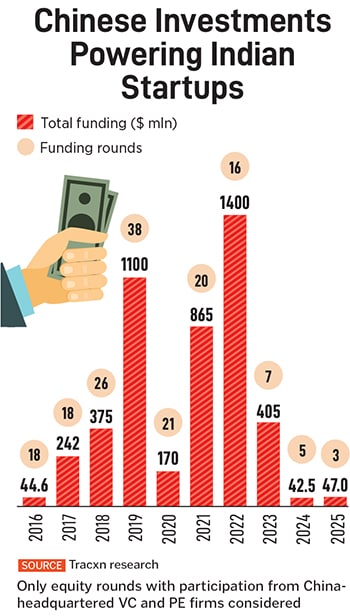
The new regulation seeks to ease the imbalance of trade versus investment in India. Chinese FDI in India between 2000 and 2020 was estimated at $2.4 billion or 0.45 percent of the total FDI India got in the period. After the introduction of Press Note 3 (PN3) in 2020, Chinese FDI fell to $67.35 million (0.34 percent of total FDI) in 2021-24.
The Union Cabinet’s decision to allow non-controlling investments from countries sharing land borders with India of up to 10 percent under the automatic route will benefit sectors that have attracted capital from China, including consumer electronics, technology startups, power equipment and infrastructure, and new sectors such as electric vehicles (EVs) and solar components.
On April 17, 2020, the Indian government amended the FDI policy through PN3, stating that an entity or beneficial owner of an investment from a country sharing land borders with India can invest in the country only under the government route. This was done to prevent opportunistic acquisitions of Indian companies during the Covid-19 pandemic. Also, any transfer of ownership of existing or future FDI in an Indian entity resulting in beneficial ownership needed the government’s nod for entities of such countries.
The move had deeply impacted investments from global venture capital (VC) and private equity (PE) funds in Indian tech companies. China-based investors, including Tencent Holdings, Steadview Capital, SAIF Partners, Fosun, and strategic investors such as Alibaba Group, Meituan Dianping, Ctrip, Didi Chuxing, Foxconn Technologies and China Lodging Group have funded several startups in India.
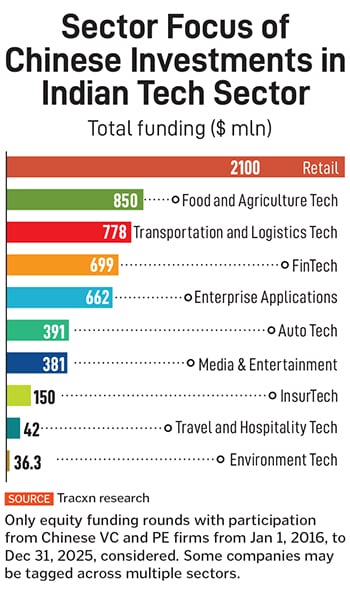
Data from Tracxn shows retail, food and agritech, transport and logistics, fintech and enterprise tools to be top sectors that got capital from Chinese VC and PE firms in 2016-25.
The Cabinet, on March 10, approved the change in the FDI policy requiring approval under PN3 for critical sectors. This aims to unlock FDI inflows from global funds for startups and deeptech, said the government. It added that the rules will offer clarity and improve ease of doing business.
The amendment allows for expedited clearance of investment in specific sectors—capital goods manufacturing, electronic goods manufacturing, electronic components, polysilicon and ingot-wafer—within 60 days. In such cases, a majority shareholding of the investee entity should rest with resident Indian citizens or entities.
The easing of Chinese FDI will help these sectors and growth stage tech startups. “We are awaiting clarification on the note that has the SOP for investments. The decision is going to help fund managers and general partners who get the capital, founders who get the flow and sectors ranging from tech, manufacturing, hardware and energy technology, including battery manufacturing,” says Rajat Tandon, president, Indian Venture and Alternate Capital Association. He adds that the change will help foster confidence among Chinese investors to continue to invest in India.
In the current global environment, supply chain diversification and self-reliance are critical. “Countries are striving to position themselves as indispensable nodes in global value chains. A calibrated FDI policy, balancing openness with security, can enhance India’s attractiveness as a manufacturing destination and enable it to integrate deeply with global supply chains,” says Neha Aggarwal, partner, Deloitte India.
She adds that India should adopt a risk-calibrated and sector-specific approach, including robust screening mechanisms for funds from sensitive jurisdictions, clear standard operating procedures for approvals and compliance, and prioritise strategic and manufacturing sectors over critical infrastructure areas. “The focus should be on investments that contribute to capacity building while mitigating strategic vulnerabilities.”
First Published: Apr 06, 2026, 17:05
Subscribe Now