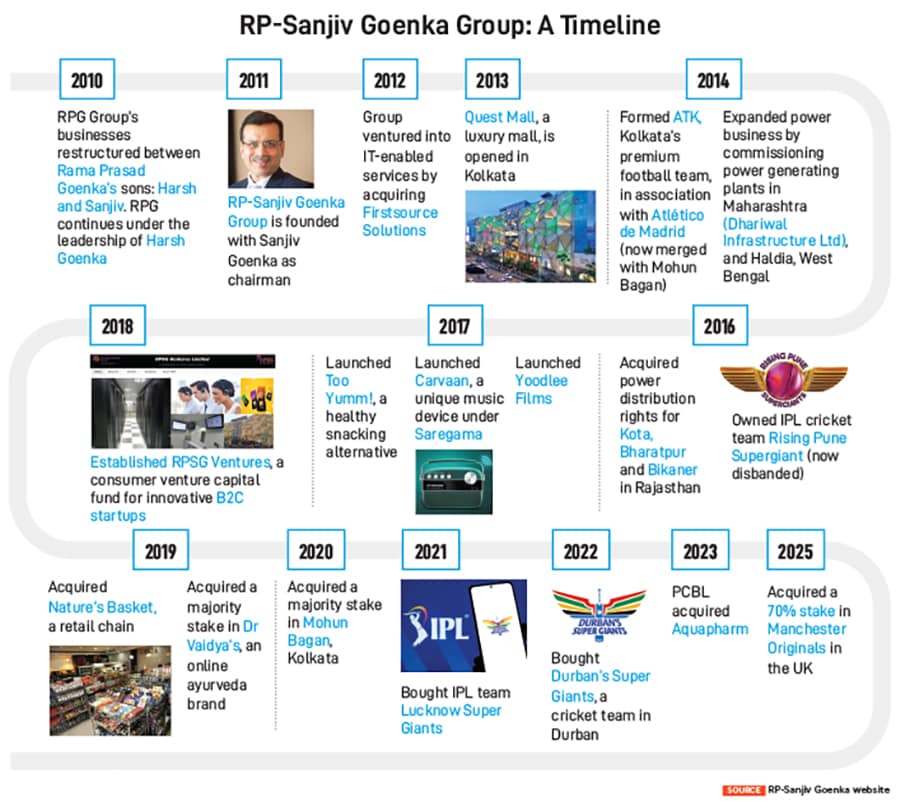
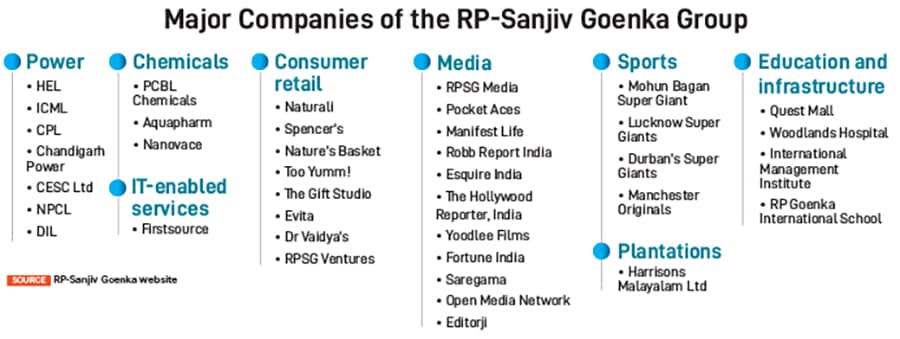
However, the most dramatic transformation has been the strategic pivot from a predominantly business-to-business (B2B) entity to a consumer-facing company which Goenka says required a “different mindset and skill base” and which needed “different kinds of people”. This shift was executed through a mix of acquisitions and organic growth.
The group inherited Spencer’s Retail, but Goenka enhanced its premium appeal substantially. This was achieved by acquiring the gourmet food chain Nature’s Basket for ₹300 crore in 2019. This move provided an immediate foothold in the high-value gourmet segment and in metro cities. The current retail strategy centres on an omnichannel approach, utilising both physical stores and quick commerce platforms, such as ‘Jiffy’.
![]()
Entry into the FMCG sector was launched with the healthy snack brand Too Yumm! In 2017, the group achieved market visibility through high-profile brand endorsements of the likes of cricketer Virat Kohli, and actors Varun Dhawan and Ananya Panday. This was followed by the acquisition of ayurvedic wellness brand Dr Vaidya’s in 2019, venturing into health and personal care.
The group has also focussed on content creation. The historic music label Saregama is a key asset which has moved past its legacy business of physical music carriers and embraced the digital content boom, using its massive music catalogue to drive growth. With over 30 titles produced, Yoodlee Films, the group’s film production house, has a significant presence across major languages—from Hindi and Tamil to Malayalam and Punjabi. The group also publishes popular magazines like Open, Fortune India, Esquire and The Hollywood Reporter, India. With the acquisition of Pocket Aces, it has ventured into the short-form and new-age digital media.
Beyond such diversification, Goenka has also placed high-stakes bets in sectors like IT-enabled services and professional sports.
The acquisition of Firstsource Solutions, a global provider of business process management services, gave the RP-SG Group a significant and global presence in the IT sector. This takeover, along with geographic diversification, gave the group high-value revenue streams from international clients in a takeover that Goenka describes as a “good acquisition”.
The group’s most high-profile consumer engagement came through its investment in professional sports. Starting with the successful ownership of the Indian Super League (ISL) football team, the iconic Mohun Bagan, the group made its biggest smash in 2021 by acquiring the Lucknow Super Giants (LSG) franchise in the Indian Premier League (IPL) for a massive ₹7,090 crore.
![]()
Beyond being a passion project, it was a direct investment in the massive financial ecosystem of Indian cricket. And the recent international foray, with a 70 percent stake in the UK-based cricket team Manchester Originals, underlines an ambition to explore global sporting assets.
Does Goenka have his eyes on other sports properties? “I’m very excited about the potential and prospect of sport. But I’ve learnt to keep my eyes, ears and mind open, because you don’t know what opportunity presents itself,” he says.
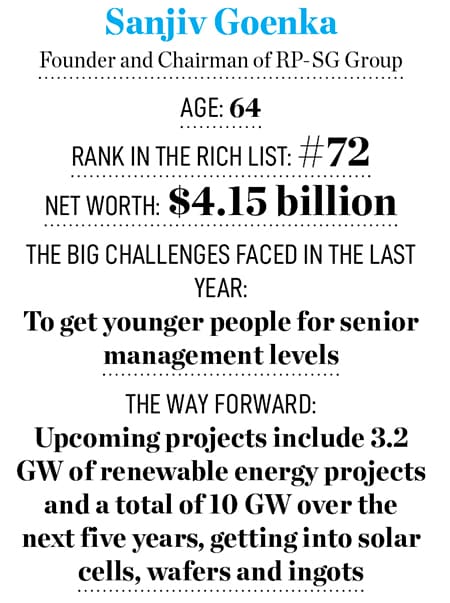
In over a decade, the RP-SG Group has grown exponentially in revenue and profitability with an eye on consumer-driven and future-ready sectors. As the group continues to aggressively chase future milestones and financial goals, the next generation of Goenkas are already at the helm—son Shashwat Goenka is vice chairman of the RP-SG Group and daughter Avarna Jain is chairperson of RP-SG Lifestyle Media and vice chairperson of Saregama. With immense pride and admiration for their capabilities, Goenka says “they’re far more capable than I was at their age and with their experience”.
In an interview with Forbes India, Goenka speaks about business, wealth, sports, family and food. Edited excerpts:
Q. You have created a path of your own in the last 15 years. Was the start of it daunting or exciting? And how has it worked out for you?
It didn’t matter whether you co-owned something with your brother or you owned it yourself. It made no difference. Frankly, at the end of the day, you have a certain mission in mind, and it’s about striving towards getting to that. And every now and then, you reinvent yourself, you revise your aspiration. And you reset your goals. So, it was about moving away from government intervention-intensive businesses [and] into consumer-facing businesses. That’s why we went into FMCG, cricket and the IT sector. Over the last couple of years, renewable energy space is picking up, as is the distribution of power. So those are the two areas we’ve started growing in aggressively. It’s just about revising targets for yourself and scaling up.
What appeared like an achievement 10 years ago doesn’t appear like one anymore. So, it’s a question of being nimble, changing, responding and growing. Initially, we focussed a lot on efficiencies. We grew organically and inorganically. And when you compete based on efficiencies, costs, processes and technology, you can grow faster and lead the market. Firstsource has been a good acquisition for us, but we’ve not even scratched the surface. There’s a long way to go. Over the next three to four years, the plan is to treble profits. And for almost all the companies, we’ve set challenging targets, which we believe are achievable.
![]()
Q. How does a performance-oriented culture benefit a business, over a legacy-driven approach?
So, there is no tolerance for non-performance. It’s not about being the best place to work. But being the most challenging place at work, a humane and compassionate place at work. At the same time, it should challenge you to perform and have no tolerance for consistent non-performance. There could be situations when you make wrong decisions or where the environment is not right and that’s perfectly all right. But if you’re not performing consistently over a few quarters, then something is wrong in either your application or your ability.
Q. What was the most significant challenge in transitioning from the B2B to B2C sector?
It’s a different mindset and skill base. You need different kinds of people and a different orientation. Frankly, if you set yourself the target and decide to do it, it takes you three to five quarters, and you can do it. You make mistakes and you learn from your mistakes. But for fear of making mistakes and for fear of failing, if you don’t take steps, then you’re, in a way, limiting your future.
Also Read: I don't respect money, I respect values: Harsh Goenka
Q. You have in your own way, reacted to the 90-hour work week debate in the country by making a post on social media. As chairman of a leading conglomerate, what is your take on the debate around work-life balance?
To me, it’s not necessarily about how many hours you’re at your desk. It’s about the kind of output you give. It’s not about optics, it’s about delivery. I’m a great believer in where you need to work and when you need to work. If you need to work long hours, you do that. When you can afford to take it slightly easier for a couple of days, you do that. We have a policy where we say that you can’t come to work at 12 o’clock and leave at 4 o’clock. At the same time, you don’t need to come at 8 [in the morning] and leave at 8 [at night]. There is a certain minimum discipline that’s required in any organisation. But more importantly, what we evaluate is what you’re delivering. Are you delivering your key result areas? Are you excelling or failing? Those are far more important.
Q. You have in the past drawn a clear distinction between being a billionaire and being successful. How do you then define wealth?
Numbers beyond a point are just numbers. Success is about achievement. And to me, it is about how you define achievement, and that changes again. So, at a personal level, of course, wealth is important. Anyone who says it isn’t, I wouldn’t agree with that. But in this Viksit Bharat, this Narendra Modi Bharat, India has changed. India’s position in the world and Indians’ respect has changed. He has redefined aspirations. What appeared great 10 years ago doesn’t appear great anymore, it appears modest. And I’m sure what appears good today, will be considered poor five years from now.
So, wealth is also about distributing back to society. I have a philosophical approach towards this. God has given you wealth. You enjoy it, you’d be a fool not to do so. But I think, there is an underlying message, and there is a test for you. What are you giving back to society? In our own quiet way and without publicity, we try and do our own thing. We’ve opened a school in Kolkata [RP Goenka International School], which in three years is regarded as the city’s best school and among the best schools in the country. It is satisfying when you do something which is a success, but it’s even more satisfying when you’re making an impact on people. We are now building a state-of-the-art hospital. These are charitable ventures and nothing from there comes back to us. Everything gets ploughed back. The aspiration is it should be one of India’s best hospitals.
We built a Mahalakshmi temple several years ago. It started with a dream. It was the same dream that my father and I had on the same day at the same time, coincidentally. People think it’s silly when I say this, but that’s a fact. So, wealth is also about giving back and helping people in need without expecting any recognition. And wealth is also for ploughing back into capital creation.
Complete list: India's 100 Richest 2025
Q. You have expressed how the second generation of entrepreneurs or inheritors face unfair comparisons with their predecessors. How would you suggest they proceed in face of such scrutiny?
It’s a very big challenge. Even in your own organisation, people start comparing you to your predecessors. And I faced this initially, ‘RPG [RP Goenka, his late father] wouldn’t do this, [so] why are you doing this?’ But I’m not RPG, right? You’re comparing the RPG of today with the Sanjiv of today, and the difference is of about 40 years in experience. So, if somebody compares me with my son, it’s a hugely unfair comparison. It’s like comparing a Virat Kohli with a young promising batsman or comparing a Mayank Yadav to Jasprit Bumrah. Mayank is hugely talented, but it’s an unfair comparison. The apt comparison would be [with] what Bumrah was when he started off in his career. So, speaking for my kids, I can say that they’re far more capable than I was at their age and with their experience. [They are] multiple times better.
Q. What is the one piece of business advice you give to your children as they steer their own ventures to success?
They don’t come to me for advice anymore. All those things are days of the past [laughs]. But, on a more serious note, the one thing that my wife and I try to tell the kids is to ask themselves the question: ‘Are you doing the right thing or the wrong thing?’ And 90 or 95 percent of the time you yourself will come with the right answer. It is so simple. It just takes a couple of minutes of thought and self-introspection. And people may say you’re right or wrong. But once you become a little more confident of yourself, what matters is your own view.
![]()
Q. There has been a delay in the ISL tournament this year because the All India Football Federation says it has not received any bid for the commercial rights of the ISL. The government has to now intervene to ensure the players are not at a disadvantage. As chairman of a football club, do you see this episode as a major setback for Indian football and your club?
I’m not going to comment on this. FSDL did a brilliant job of running it for the last several years… the league went off without any hitches, and the FSDL was absolutely fantastic. I would say that without hesitation.
Q. Are you planning to invest in other sports properties apart from football and cricket?
I think we made a success of football. We have yet to make a success of cricket. Yes, we’ve reached the playoffs twice in the IPL. We’ve reached the final once in the South Africa League. We had a modest performance in Manchester in the hundreds. I’m excited about the potential and confident about the prospect of sport. But I’ve learnt to keep my eyes, ears and mind open, because you don’t know what opportunity presents itself.
Q. Has the lack of a sporting background been a major hinderance when owning a sports team?
It isn’t. You learn about the sport in every way that you learn about any other business. And when you have a business, you have a managing director, a CEO, a COO and a CFO, who run the team. In the sports business you have the coach, the director of, say, cricket, and you have the captain. So, the decisions are fundamentally made by them. My role comes at the time of the auction, where you are trying to understand what are the gaps that you need to fill. And as an entrepreneur, you take that call—will you bid up to X for this player, or will you let them go at Y?
Beyond that, you have no control over the performance. The coach, mentor, director of cricket and the captain take those calls. It’s not that you never ask them anything. Of course, you would, but the fundamental call is theirs. They have the knowledge and experience.
The most knowledgeable person on cricket today is Nita Ambani. She is unbelievable with her knowledge and decisions. She is a role model for every sports entrepreneur to follow. For me, it’s being guided by Tom Moody, Justin Langer and Rishabh Pant. In cricket, you’re empowering your coaching staff and your captain. Your job is to motivate them. If they’ve had a bad performance, you would ask them why. Performance impacts valuations, performance impacts fans. There are many people who are fans because of a player or because they have trust in you [as the owner]. Of course, the player will have a larger proportion of fans. It’s about faith and confidence in the ability of somebody to put together a good team and about inspiring the players to perform. And when they’re not doing well, giving them a pat on the back, and saying, ‘It’s okay’. But if you have a consistently bad performance, the team is losing six games in a row, then the question to be asked is: ‘Do you need a reset of the team?’ And just because you’re dealing with celebrities, it doesn’t mean that you would not ask them to be accountable.
![]()
Q. You have described yourself as a foodie. What’s a dish that reminds you of your family or childhood?
I think if you are born a Goenka, you’re born a foodie. My year-old granddaughter sits with me and eats my breakfast instead of having whatever her breakfast is. She has got only four teeth, but she finds a way of chewing it. I think it’s genetic. Some more, some less. Like my brother, I think he thrives on food. He’s one of the biggest food bloggers, in a way, and everyone wants to impress him. I was somewhere at a function 10 days ago, and the people doing the catering said, ‘You are Mr Harsh Goenka’s brother… we have to try and impress you’. So, I said I am getting some reflected glory this way [laughs].
It’s in the blood. I frankly don’t understand these different kinds of diets. I can’t deal with it. I like all the cuisines—my authentic Marwari food, Bengali or Italian food. I literally love food, and I have my share of mithai every day.
Q. What’s your favourite mithai?
Too many. But at this point, I’m enjoying the khaja made at my home the most.