Why RCB's brand value fell after the IPL win
Changing ownership, stampede after maiden title win in 2025 mar current valuation, but it may only be a matter of time before RCB and the league turn around
Last Updated: Dec 10, 2025, 11:08 IST6 min
“Cricket often leaves you scratching your head,” former cricketer Jimmy Anderson had once said. The English pacer might have been referring to the glorious uncertainties of the game, but the sentiment resonates just as strongly off the field. Especially now, when the valuations of the Indian Premier League (IPL), the richest T20 franchise league in the world, are sliding while that of two of the marquee franchises have recorded double-digit dips.
According to a report released on December 9 by Brand Finance, a global valuation consultancy, the league’s brand value in 2025 stands at $9.6 billion, a steep 20 percent year-on-year decline in a season in which it has generated over 1.5 million direct and indirect jobs in India alone. The downturn, said to have been caused by restive geopolitics like Operation Sindoor, spans nearly every franchise, with the Gujarat Titans (GT) that has seen a marginal rise of 2 percent being the only exception. The slide also echoes an earlier D&P Advisory report, which estimated that the league’s overall value in 2025 was down by around 8 percent.
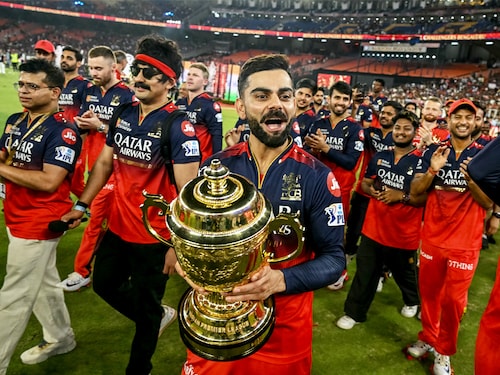
What’s worse, 2025 saw crowd favourites Royal Challengers Bengaluru (RCB) and Chennai Super Kings (CSK) post double-digit drops in brand value. CSK’s 24 percent decline (valuing it at $93 million) is perhaps unsurprising after a turbulent campaign marked by a mid-season captaincy change and a finish at the bottom of the table. RCB, however, is the anomaly—while it climbed a spot in the ranking, swapping places with CSK to reach No 2, its brand value ($105 million) fell 10 percent despite the team winning the tournament for the first time in history. Some of this, says Ajimon Francis, the managing director of Brand Finance India, can be attributed to the stampede that ensued during the team’s victory parade outside the M Chinnaswamy Stadium in Bengaluru, killing 11 people.
“Valuation is a combination of many factors, one among them is the intangible factor of perception as well as how the future will pan out for the teams,” says Francis. “We could see a negative sentiment currently, not just due to the stampede, but also the reaction from the team management thereafter. We had to factor in those, asking ourselves that, while sponsor interest is now robust, whether they will stay away from the team in future due to governance and ethical reasons.”
Also Read: IPL 2025: How the brand game gets bigger and better
RCB is also approaching a critical transition phase where the team owned by liquor behemoth Diageo is up for sale. The process that is expected to be completed by March 31 could also have dampened sentiments, although it still remains the second-most valued team due to its large fanbase and a strong digital presence.
Says Bhairav Shanth, co-founder of ITW Universe, a global sports and media consulting firm: “The uncertainty [about the sale] is the reason why the value might have gone down a bit. But, fundamentally, as a brand, I don’t think RCB has lost its lustre. It still makes great business sense to invest in RCB, and once the uncertainty over the ownership settles, the valuation should be rising again.”
Shiv Burman, the founder of sports marketing agency Burman Sports, too, disagrees with the premise that external factors are chipping away at RCB’s brand value. Referring to the $1.2-2 billion that is being discussed about the potential sale of the team, he asks: “How is a franchise then looking at a 20x revenue valuation in the market? People involved in the sale have done a deep financial dive and assessed the potential market, so if that is the figure being discussed for potential buyers, that is likely to be the correct valuation.”
But it’s equally true that much of the cult and fandom for both CSK and RCB emanates from two of its talismans, former India captains MS Dhoni and Virat Kohli, respectively, none of whom have a long playing career ahead. “RCB played under Rajat Patidar last year, but the brand narrative was centred around Kohli,” says Francis of Brand Finance. “Players like Kohli play a significant role when it comes to fan engagement, which is another of the key metrics when it comes to brand valuation.” While Dhoni, 44, has retired from international cricket and has often been subject to intense retirement speculation even in the IPL, Kohli, at 37, although has a longer runway, isn’t likely to anchor the team’s brand over the long term. So, while Kohli as a brand is unlikely to fade away anytime soon, even after retirement—he still ranks No 1 among all Indian celebrities with a brand value of $231.1 million (Kroll Celebrity Brand Valuation 2024)—how that will impact RCB as a team is a question that remains to be seen.
“When it comes to IPL’s brand value, the key thing that has changed recently is the ban placed on real money gaming (RMG), a sector whose marketing spends were a key contributor in IPL spends, both on-ground and on-air,” says Shanth of ITW. For perspective, Dream11, the market leader in RMG during IPL 2025, held sponsorship rights for five of the 10 available front-of-jersey slots, the most premium real estate on a team’s shirt. According to media reports, the RMG ban wiped out anywhere between Rs1,500 crore and Rs2,000 crore in advertising and sponsorships from the IPL ecosystem.
“Besides, there is a growing consensus that the heady growth of the media rights valuation for the league may not continue into the next cycle, which starts from 2027,” adds Shanth. A major factor behind that could be the merger of Star Sports and Jio—which held the TV and streaming rights, respectively, for a cumulative Rs48,930 crore between 2023 and 2027—that will now take the heat off the bidding war. If that happens, it might also reduce the topline for IPL teams as around 45 percent of BCCI’s central revenue pool, the lion’s share of which comes from broadcasting rights, is evenly distributed among 10 IPL teams, guaranteeing each team around Rs500 crore annually.
But that the IPL is a prized entity for JioStar is evident from the fact that while the broadcasters are looking to exit the media deal with the International Cricket Council citing financial losses, there is no discussion on the IPL. “Clearly, that property is working for the broadcaster. And if it’s working for the broadcaster, I feel the value of the IPL will only grow,” says Burman of Burman Sports. “India is at an inflection point when it comes to looking at how people interact with sports and sports experiences. And the market may be now only getting ready to do some serious fan-focussed activations that can grow its brand value.”
Which is why the loss of RMG companies, despite their identity being endemic to the sports ecosystem, is unlikely to adversely impact IPL valuations over the long term. “Even before the RMG ban, we have seen waves of new entrants and their bans. In 2021, the BCCI had banned IPL teams from making deals with crypto players. We’ve also seen the exit of Vivo following the ban on Chinese companies,” says Francis of Brand Finance India. “IPL as a brand gives you almost 84 to 85 percent coverage of the Indian populace through a 100-day window. That is an amazing draw for any brand, and the RMG void will soon fill up.”
First Published: Dec 10, 2025, 11:24
Subscribe Now