IndiGo crisis: What analysts say, status check on flights
Moody’s flags operational failures, as Jefferies and UBS stay positive and JM Financial turns cautious. Airline says it has stabilised operations, refunded affected customers
IndiGo said it was rapidly progressing toward stabilising its network, stating that it had refunded Rs 827 crore for cancellations up to December 15.
Photo by Ritesh Shukla/Getty Images
Advertisement
IndiGo’s week of mass flight cancellations has triggered a wide range of reactions from analysts, with Moody’s, Jefferies, UBS and JM Financial offering different readings of what the disruption says about India’s largest airline. While some view the crisis as a temporary operational shock, others believe it exposes deeper operational issues and cost structures. The disruptions, which peaked with around 1,600 cancellations on December 5, have exposed what Moody’s calls “significant lapses in planning, oversight and resource management” at InterGlobe Aviation, IndiGo’s parent company. On December 9, the airline confirmed that its operations had stabilised and it has resumed flights across its network, operating more than 1,800 services a day.
Credit rating agency Moody’s on December 8 said IndiGo’s inability to prepare for Phase 2 of India’s revised Flight Duty Time Limitation (FDTL) regulations, known to the industry for over a year, was the primary driver of the collapse in operations. The rules redefine working hours from midnight to 6 am as ‘night duty’ and limit permissible landings, making them among the strictest globally. IndiGo’s lean, high-utilisation model “lacked the resilience needed” for such a shift, Moody’s wrote, adding that the resulting disruption is credit-negative because it risks revenue loss, refund payouts, operational penalties and “could ultimately affect continuity of senior leadership” as show-cause notices are now issued to CEO Pieter Elbers and COO Isidro Porqueras.
Moody’s also downgraded IndiGo’s human-capital issuer score to reflect the impact of slower pilot hiring and flagged reputational risks that could spill over into international code-share arrangements, even though long-term fundamentals of the company’s Baa3 rating remain intact.
JM Financial: Maintains ‘Reduce’, warns of long-term stock
JM Financial, in its report on December 7, maintained a ‘Reduce’ rating on IndiGo. The brokerage described the episode as a function of “mismanagement” and warned that the airline is likely to face both structural cost increases and potential regulatory consequences. JM Financial wrote that the policy changes exposed “planning lapses” and noted that IndiGo had under-forecast captain requirements, delayed command upgrades and failed to adjust rosters despite repeated warnings from the regulator.
It estimates an 8 to 9 percent earnings impact for FY26 if disruption spans 15 days, and says the stock has yet to fully price in the risk of penalties, regulatory scrutiny or potential management changes. The firm added that the disruption “is likely to lead to a higher CAGR [compound annual growth rate] in CASK [cost per available seat kilometre] ex-fuel-ex-forex [excluding fuel and foreign exchange] in future years subject to regulatory actions”.
Jefferies: Maintains 'Buy' rating
Global brokerage Jefferies, however, reiterated a 'Buy' rating on December 8 for the airline, with a target of Rs 7,025. The firm argued that IndiGo retains scale advantages and strong execution capability once operations stabilise. However, the brokerage acknowledged that IndiGo’s cost curve is turning adverse, with rising employee expenses and lower pilot utilisation under the new duty norms. Jefferies expects a return to normal schedules by mid-December, and for IndiGo to “regain operational stability and sustain its market leadership into 2026”, framing the episode as a painful but temporary setback.
However, Jefferies removed InterGlobe Aviation from its 2026 India model portfolio as part of a broader rebalancing unrelated to the recent flight disruptions. As part of the reshuffle, Jefferies added Godrej Properties, Bharat Petroleum Corporation Ltd (BPCL), JSW Energy, AU Small Finance Bank, Axis Bank and SamvardhanaMotherson to the portfolio. Along with InterGlobe Aviation, the firm has removed ICICI Bank, NTPC, Tata Steel, Crompton Greaves Consumer Electricals, and Belrise Industries from its 2026 model portfolio.
UBS: Maintains 'Buy' rating
UBS also maintained a ‘Buy’ call, but cut its target price to Rs 6,350. It said IndiGo had not been adequately prepared for the transition to the new rules and that the airline will need more pilots in coming years, which will lift operating costs. UBS added that a weak rupee is making leases, maintenance and fuel more expensive. Even so, UBS pointed to IndiGo’s rapid international expansion as a revenue buffer that can soften the effect of domestic operational volatility.
IndiGo operations buckle under FDTL pressure
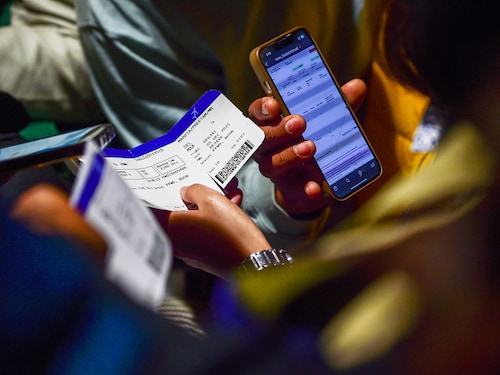
IndiGo, which has more than 65 percent market share in India's domestic industry, saw one of the most severe operational breakdowns in Indian aviation last week, after its network collapsed under the revised FDTL rules that came into force in November. The airline failed to realign its employee duty rosters in line with the stricter night-duty limits and expanded mandatory rest periods, creating an acute shortage of captains. What began as delays on December 2 quickly escalated into nationwide flight disruptions, with around 1,600 cancellations on December 5. IndiGo runs about 2,300 flights daily. Over the week, the carrier cancelled more than 4,500 flights, stranding thousands of passengers at airports and triggering widespread complaints about baggage delays and poor communication.
IndiGo shares also fell 17 to 18 percent. The stock opened weak again on December 9, starting the day at Rs 4,913, down from levels near-Rs 5,900 at the end of November.
DGCA issues show-cause notice, cuts IndiGo schedule by 5 percent
The Directorate General of Civil Aviation (DGCA) issued a show-cause notice to IndiGo’s CEO and COO on December 6 after the airline failed to operate the winter schedule it had been approved for. The regulator’s review showed that IndiGo had permission for 64,346 flights in November 2025 but operated 59,438, recording 951 cancellations. Although IndiGo was cleared to deploy 403 aircraft, it was able to operate only 339 in October and 344 in November, even as its departures rose by 9.66 percent compared to the previous winter.
Citing these gaps, the DGCA concluded that IndiGo “has not demonstrated an ability to operate these schedules efficiently”. It ordered the airline to cut its winter schedule by 5 percent, a reduction that amounts to roughly 115 flights per day, particularly on high-frequency routes. IndiGo has been directed to submit a revised schedule and provide regular compliance reports on crew availability, utilisation and fatigue management, with the first updated roster due by 5 pm on December 10.
IndiGo refunds Rs 827 crore
In a statement released on December 8, IndiGo said it was rapidly progressing toward stabilising its network, stating that it had refunded Rs 827 crore for cancellations up to December 15 and had arranged thousands of hotel rooms, ground transfers and baggage deliveries for stranded passengers. The airline added that it remained fully compliant with FDTL norms and continued to work with authorities to restore stability.
In its latest statement released on December 9, CEO Elbers said the airline has fully stabilised operations. In a video message, he apologised to customers, acknowledging that “thousands could not travel” and said the airline had “let you down” during the crisis.
He said IndiGo’s immediate priority had been to move stranded passengers and clear pending refunds, noting that lakhs of customers had already received their money back and most misplaced baggage had been delivered. The carrier has now restored over 1,800 daily flights, up from just 700 on December 5, and resumed services to all 138 destinations in its network. On-time performance has also normalised ahead of the airline’s earlier estimate of mid-December. “Please keep the faith in us,” he said. “We’re still the airline you have known us to be.”