If we stop appreciating beauty, we lose out on living: Shobhaa De
The author of The Sensual Self talks about her new book, young people on dating apps, and why she scoffs at the idea of an autobiography
Last Updated: Dec 12, 2025, 18:42 IST9 min
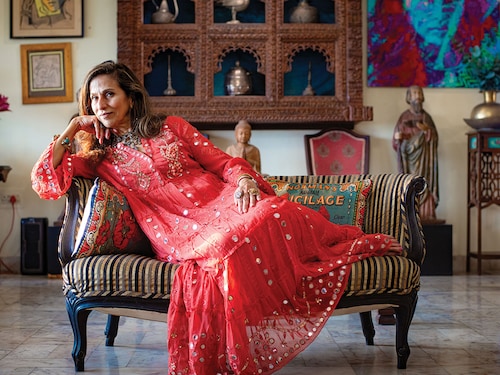
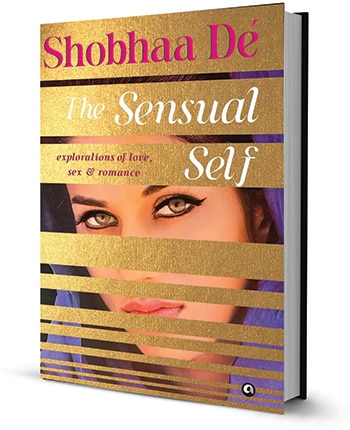
Shobhaa De’s 28th title, The Sensual Self, has hit the shelves, and like all her books in the past, has gotten people talking. The book is De’s rulebook to owning your sensuality, irrespective of your age and stage in life, in an unabashed and non-judgemental manner. In her inimitable style of writing, taking instances out of her own life and from those around her, she once again talks about things that are still considered the subject of nudge-nudge-wink-wink banter in hushed tones. And yet, as 77-year-old De tells Forbes India, these conversations are far more important today than ever before, given how younger generations are all too aware of their own needs while struggling to build meaningful connections with others. Edited excerpts from an interview:
Q. Your first book was out in 1989, Socialite Evenings. Your 28th book The Sensual Self, came out a few weeks ago. How have you evolved as a writer and how have your readers evolved?
My readers have certainly evolved; I don’t know about myself. I’m too close to it to be able to analyse my own journey in clinical terms. Each book is different, has its own rhythm and reason for being written. So, it’s hard to say from the first book to this book exactly what the process has been.
But I could tell you that the readers have evolved for sure because my own contemporaries, they were kind of stuck in their own frames of reference. And so many years ago, maybe the books were shocking for contemporary society, certainly for my contemporary journalists; the critics couldn’t handle it.

Q. So, what was your reason for writing this one?
I would honestly think of it as a search, which has been on for a very long time. It is a search for my own sense of not just sensuality, but my own appreciation of all that is beautiful in the world, which includes sensuality, but is not restricted only to it.
Sensuality is a much deeper subject and is not a lightweight topic. So, writing the book was tough because I was talking as much about the personal and trying to make it more universal. Because I feel we have lost touch with what is truly sensual in our lives. And it’s sad, because in India we have such a strong and beautiful tradition. There is a sensual past, which we may have overlooked in our rush to get somewhere, you know. The current generation is one that is always in too much of a hurry. And I’ve tried to bring [sensuality] back into my own life, because maybe I’ve been in too much of a hurry too.
I’ve tried to question all of that and say that if we stop appreciating beauty in all its forms and in all its senses, we in a way lose out on living.
Q. Do you think there are a lot of expectations from ourselves, from the other person? Have the expectations that people had from each other and themselves in the past evolved or changed, and that is one of the factors?
I don’t know about expectations changing that much, but the roles have changed a lot, because women today are very much in charge of their own lives, at least in urban India. When I was growing up, it was perhaps the first generation in which many women were out there in the workforce, who were earning their own money and, therefore, were not exactly answerable to anybody. We decided what to do with our time and money, pretty much.
The current young generation is completely self-sufficient, even emotionally self-sufficient. They don’t even need partners or parental support. They don’t need friends unless the friends are part of a grid they want to be a part of. Otherwise, everything is extremely transactional. It’s a phase; I’m certain that it’s not going to be a permanent thing because of the search for human interaction, emotion, love, tenderness, poetry… for admiring the sunset.
Time has played a very big part in this change, because we seem to have more time to recognise our own needs, even physical needs, and to invest in them. But the time for love, the time for anything romantic, for any gesture that is not immediately translatable into something tangible, is considered a waste of time.
Also Read: “Zomato was convinced there was one thing they’d never do: Food delivery”
Q. How do you think the rules of engagement have changed between the genders?
They have fundamentally changed. There’s hardly any eye contact. If you go out and observe young people, the biggest engagement is with their phones, and nothing can compete with the power of that phone in their hands.
I’ve seen couples sit across one another and they’re texting; they’re supposedly on a romantic date, because the trappings are all there—there may be red roses on the table, the staff could be waiting around to get them chilled wine or cut a cake—but they are not interested in each other or the cake or the flowers. They’re only busy scrolling or texting. It’s really a pity.
To engage with another, you have to immerse yourself in that moment with the other. You have to tune into that other person, listen to what they’re saying and absorb it and try and give back something equally meaningful by way of a conversation. Where has conversation gone? There’s hardly any. Even in my own age group.
There is something called the art of conversation, which certainly my parents’ generation were acutely aware of. Social conversation is one thing, but engaging even with your partner in a way that has some meaning, where you’re exchanging not just the world news and headlines, but something more than that, which is personal.
Q. Today we have a lot of young people on dating apps, where the first, and perhaps the only impressions, that people give and receive are from their appearance. Given the transactional way in which people swipe left or right, what does it do to someone’s self-esteem?
It’s extremely challenging and very hard, and I see a lot of very lost young people dealing with that kind of emotional failure or [the feeling] that they’re just not good enough. Rejections are based on something so cosmetic, and it’s so superficial. It’s not you who’s being rejected, it’s what you’re projecting on those apps. And that may be a far cry [from what you are]. But how much of yourself can you actually reveal on those apps? And most people are also terrified that those apps may not be completely legit. It could lead to stalking, or something worse.
Q. In an interview some years ago, you had mentioned that we don’t have the same persona with everyone. You mentioned how you have your true, genuine self with your family, whereas for the rest of the world, it’s a different kind of persona. On dating apps young people might be hesitant to put out their real persona. But if you can’t put your true self out there, then can you make genuine connection?
That connection to start with is artificial; face-to-face is something else. If you were to even be introduced to someone through a family friend or through your own peer group, you physically meet someone. And good things happen or they don’t happen. At that point, you’re certainly in a better position to judge.
I also think maybe the young watch many more American [TV] serials or go on to a lot of foreign sites that offer this kind of advice. But our culture is completely different. The reference points are so different. So, if you’re going to take all your cues from what may be relevant in New York or Paris or Rome or Scandinavia, [they] do not apply to us.
I believe it may sound regressive, but even the young are going to go back to their dadis and nanis and maybe contemplate a slight fine-tuning of their own expectations. My heart goes out to the young today, because they don’t have the mechanisms to cope with all the demands and challenges on them.

Q. My next question would be about your own life. Which phase of your life would you love to relive, and is there a phase that you just wouldn’t want to go back to?
I am not a big one for nostalgia; I’m very much a creature of the now. For me, this is the moment… I’m talking to you and I’m in this moment.
I’m not even a creature of the future. I don’t think about myself two years from now, five years from now. What am I going to be doing? Am I going to be writing another book? Will I be travelling? I live very spontaneously, and I feel what I feel at that point. God has been really kind, and [I’ve had an] extremely enriching life on my own terms. Would I want to go back to any of it? Absolutely not. There’s so much to look forward to.
Q. Is there something that you would tell your younger self? Something about life that she did not know, or do you think she was absolutely fine?
No, no! My younger self was far from being fine. I would just say to my younger self, [I wish] you could take many more risks. I was already a risk taker; I was pretty wild by my parents’ standards and I was always bucking the system. Maybe I should have rocked it a little more, done something that was truly adventurous and brave, which I didn’t think of doing then.
But looking back, had I done it then, I [could have been] picked for the national team athletics. I was a champion athlete at school and a hockey and netball player. But to be picked for the national games and to go to that camp in Patiala would have been a big deal. I could have been PT Usha had I gone, right? But my parents absolutely didn’t want me to take that course and go on my own to Patiala. Had I been wilder, more reckless, defiant and rebellious, I should have just said, no, this is what I want to do; borrowed money and just gone to Patiala and tried to prove myself.
Similarly, I used to paint a lot when I was still living with my parents and used to win amateur painting contests all the time. My sister had given me paints and an easel to encourage me. But not my parents; they thought I was wasting my time and put a stop to it. Had I pursued it, maybe I could have been a female MF Husain!
But these are things that, when you’re much older, you look back on with amusement and a sense of indulgence. No regret and no bitterness at all.
Q. A lot of your writing is autobiographical in a way. Will you write an autobiography at any point in time?
I’ve written versions of my life and I’m happy with those. I don’t find my life that amazing that I would want to document it, like I was born here and I went to school there and then I met so and so and that one had a profound influence on me. I mean, who cares? Had I invented penicillin or something, had I done something of that kind, which has a global impact on humanity, then my life would be worth chronicling and documenting.
I keep getting offers from these wonderful networks, where they want to do a biopic [on me] and I keep shrugging and saying, what on earth for? I’m not that much in love with myself.
First Published: Dec 13, 2025, 10:50
Subscribe Now(This story appears in the Dec 12, 2025 issue of Forbes India. To visit our Archives, Click here.)