“Zomato was convinced there was one thing they’d never do: Food delivery”
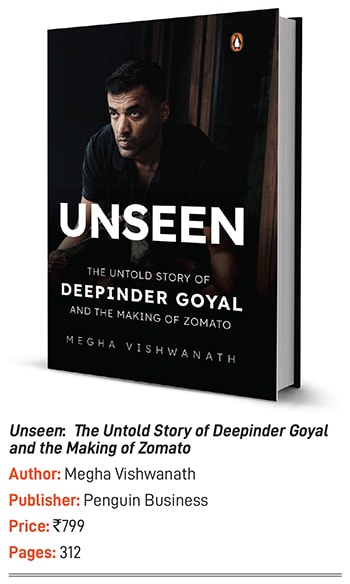
Megha Vishwanath’s book Unseen provides an insider’s account of how Deepinder Goyal built Zomato. Excerpts:
By Forbes India
Last Updated: Dec 08, 2025, 09:46 IST4 min
Flipkart received its first institutional investment of $1 million from venture capital firm Accel Partners, swiftly followed by a notable $10 million infusion from Tiger Global Management. redBus made waves and raised $2.5 million from the likes of Inventus Capital Partners and Seed Fund. mKhoj raised $7.1 million from KPCB and Sherpalo in 2008, pivoted to mobile ads, and rebranded as InMobi in 2009. Overall, the startup ecosystem in India was signalling the dawn of a digital-first era in India.
Food-tech itself was still a nascent category, but it would only be a matter of time before it would become trendy, and several startups gradually emerged.
HungryZone (previously Hungry Bangalore) was backed by Indian Angel Network and was later acquired by UK-based JustEat in 2011. Mumbai-based Burrp.com had just been acquired by Network18’s subsidiary Infomedia18 in 2009. Pune-based TastyKhanaand Times Internet Limited’s TimesCity.com were also picking up steam.
Could Foodiebay be the next big thing?

From the outside, it seemed like Deepinder and Pankaj must have been obsessing over this pivotal question while strategising, mapping their next moves and drawing up elaborate plans. But that wasn’t how they saw it.
From the founders’ point of view, Foodiebay wasn’t merely about seizing an opportunity; it was about crafting an experience and building real connections. And fundraising was never part of the plan.
From a restaurant point of view, these new websites like Foodiebay were a new customer acquisition stream, an entry into the digital world. One of the early restaurant owners to list on the platform was Sagar Sindhwani, founder of Yumz.
One night, Sagar noticed that his restaurant’s menu on Foodiebay was outdated. Frustrated, he shot off an email to the Foodiebay team, urging them to address the issue. Moments later, a reply came back: Five minutes.
Confused, he stared at the screen. Then, five minutes later, Deepinder himself walked into Yumz. The restaurant was near his home and rather than sending an automated reply, he had shown up in person to fix the issue. That late-night interaction turned into a long-standing relationship.
From then on, Foodiebay’s team and client meetings often took place at Yumz, and Sagar watched the company grow from three people to seven. Yet, despite their growing rapport, Sagar faced his share of challenges with the platform.
And that love didn’t last forever.
Years later, as Foodiebay evolved into Zomato, he saw both the advantages and the pitfalls of relying on an aggregator.
His restaurant gained visibility and customers, but it also increased dependency.
The breaking point came on New Year’s Eve 2015, when a system crash left all his online orders in utter chaos. Frustrated, he decided to tap into his hotline and called Deepinder, only to hear that technical glitches were to blame.
Over time, Sagar began to feel that tech was tightening its grip. He was no longer able to forge personal relationships with his customers. He decided to take matters into his own hands, hiring his restaurant off not just Zomato, but also one of its rivals Swiggy. Between 2016 and 2022, the challenges of running independent delivery caught up with him and eventually, he shut down Yumz.
In 2023, when he re-entered the restaurant business with Gullu’s, he decided he was coming back to Zomato. He reached out to Deepinder personally, letting him know. Despite the years of tension, the ups and downs, Sagar admitted he always had a soft spot for Zomato. And for Deepinder.
This love-hate relationship between aggregators and restaurants is one that continues to play out across the industry.
For all its foresight on staying ahead of the tech curve, Zomato was convinced there was one thing they’d never do: Food delivery.
This reluctance largely stemmed from Deepinder’s sour experience with Foodlet’s food delivery service back in 2005. That disappointment from his past had calcified into conviction. In hindsight, it was less a rational assessment of the market and more a reflex. The logic was retrofitted to the emotion.
He also perhaps convinced himself that online orders were inherently flawed and often come with hidden delays and inefficiencies. Though mainstream restaurant chains like Domino’s, Pizza Hut, McDonald’s and KFC offered online ordering and could pull it off, the system fell apart for restaurants with diverse offerings. Back then, even when customers placed an order online, the restaurant would still call them to confirm their order details which seemed to defeat the entire purpose.
They genuinely thought the issues surrounding food delivery significantly outweigh the benefits. In a blog post from February 2011, the Zomato team posed a question doubting the viability of food delivery platforms: ‘Ask yourself—when was the last time you ordered food 1 hour before you started feeling hungry? Probably never...’
To them, food delivery was more of a marketing gimmick than a real value-add. The company decided to focus on what they did best—building a genuinely useful platform for restaurant discovery. While Zomato was exploring newer product verticals, it continued to expand and penetrate its restaurant classifieds service across the country.
It was only a matter of time before Zomato too would bite the bullet and face the inevitable—delivery was the future.
First Published: Dec 08, 2025, 09:40
Subscribe Now