Can Karbonn mobiles fight back?
After being relegated to the margins, the maker of Karbonn mobiles is back with a four-pronged attack. Will the gambit pay off?
By
Prefer us on GoogleLast Updated: Dec 02, 2019, 12:45 IST6 min
At 52, Ray Kroc was taking the boldest and riskiest bet of his life. After two decades of being a salesman—selling paper cups and milkshake machines—part-time pianist and real estate agent, the plucky American had opened his first McDonald’s franchisee outlet at Des Plaines, Illinois, in 1955. The unlikeliest candidate anybody would hedge money on, Kroc had survived the First World War, and had seen his father amass and lose his fortune in speculation and stocks.
Six years later, in 1961, Kroc went on to buy McDonald’s. “Achievement must be made,” the unflinching entrepreneur wrote in his autobiography Grinding it Out, “against the possibility of failure, against the risk of defeat. Where there is no risk, there can be no pride in achievement, and consequently, no happiness.”
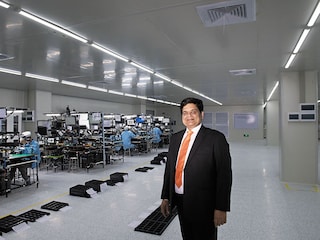
Cut to India. At 50, Pardeep Jain is doing a Kroc. “He has an inspirational story of never giving up in spite of multiple failures,” says the managing director of the Jaina Group, which had hit a high in early 2014 when the maker of the Karbonn mobile cornered a 10 percent market share, making it the third biggest smartphone brand in India.
Five years later, fortune has swung to the other end. Karbonn, along with other homegrown handset players like Micromax, Intex and Lava, has been muscled out by Chinese smartphone players such as Xiaomi, Vivo and Oppo. Jaina Group, which boasted of a revenue of ₹3,456 crore in fiscal 2017, hit a new low of ₹1,243 crore two years later.
Though much has changed since the glory days of Jaina Group, Jain is determined to fight back. The strategy is simple, yet unique. Jain has loaded his armoury with a battery of four brands—Karbonn, Gionee, Sansui and Nakamichi—in a bid to transform the company from a mobile handset maker to an electronics consumer durable entity. Another related part of the new business strategy is to turn contract manufacturer for big handset brands through a joint venture with DBG Holdings of Hong Kong. The company reportedly has bagged orders from South Korean biggie Samsung for some of its devices.
The smartphone space vacated by Karbonn is being filled by Gionee, the Chinese brand whose India rights Jain bought last year. “So there is a Chinese brand to take on Chinese rivals,” he says, adding that the brand has a retail reach of over 42,000 outlets across India. “While the urban market is crucial, there is a huge untapped market beyond tier II,” he contends.
What Jain is also betting big on is the opportunity that millions of feature phone users provide whenever they upgrade to smartphones. By tying up with Sansui—the Japanese consumer electronics durable label that had been selling in India for three decades with Videocon—Jain is trying to hedge his bets by moving away from phones. Nakamichi, a high-end Japanese electronics player, gives him a play at the premium end of the market. “The four-pronged strategy is well designed to take the group to the next level of growth,” he says.
Marketing experts are impressed with the fightback strategy. “Necessity is the mother of invention,” says Jessie Paul, founder of Paul Writer, a marketing advisory firm. The smartphone market, she points out, is no longer conducive to Indian players in any segment, and Jaina Group needs to look elsewhere for survival. While Sansui is a great opportunity to take a brand with good recall and leverage their trade network and manufacturing skills, Nakamichi gives Jaina a play in the higher end of the market. “They have identified the weakness of Videocon as an opportunity and are moving in with a range of similar products,” she says. As a survival strategy, Paul lets on, it is clever and quick-thinking.
Paul lists out the big opportunity that Jaina is gunning for across the product categories. Take, for instance, the refrigerator market which is dominated by a few brands like LG, Samsung, Videocon, Godrej and Whirlpool.
“If they are able to displace Videocon, then they will immediately be among the top few,” she contends. While TV as a category—especially smart TV—is being disrupted by smartphone players like Xiaomi and OnePlus, the opportunity lies in capturing the new, emerging market which is price-sensitive and not brand-conscious. “The Jainas have assumed that their trade networks built from their cellphone business combined with the Sansui brand will be sufficient to win,” she adds.
What would also come into play is the way the new strategy is executed. For example, it would be crucial to see if Jain is looking at just the individual market segments such as the smartphone and the TV, or if he is looking at a wider smart-screen play. Similarly, it would be worth watching if they are looking at consumer electronics such as TVs, fridges, and washing machines as standalone market opportunities or as an integrated internet-of-things (IoT) play, says Kumar. While a strong distribution network could help push piecemeal products to an extent, it is only a well-knit digital home strategy that could make an initial success repeatable and sustainable, he adds.
Jain, meanwhile, knows that the fightback won’t be easy. But he is not ready to give up. “I am willing to grind it out,” he says. Kroc, it seems, is not only inspiring him to struggle but also making him love the grind.
First Published: Dec 02, 2019, 12:45
Subscribe Now