Image: Vaishali DinakaranWe’d been back home for just three days, having completed a 2,000-km drive from Arvidsjaur in North Sweden to Berlin in Germany. It had been a rather long work trip up north. As we moved south, travelling away from a cold, harsh winter into what appeared to be spring, the sunshine made the prospect of a pandemic a little more tolerable. The plan was to follow the advice: Get home, stay indoors for two weeks, and even after that, continue to observe ‘social distancing’. Which is why when my husband Ronny’s phone rang, and I heard him yell, “What do you mean, ‘Come downstairs?!’” I was startled.
The two of us grabbed our jackets and ran down and out the building. Standing on the far side of the yard were Ronny’s mother, Irene, and his uncle, Willy. They’d motored over to see us, and make sure we were in good health, and had placed a little bag of essentials—bread, pasta, a large box of multivitamins—on our doorstep. They were standing far enough away to not violate the rules of kontaktsperre—no contact. So there we stood, first shouting pleasantries at each other, and then admonishing them for leaving their homes for a socially-distanced visit. No hugs, no kisses, just lots and lots of space between us. The new normal.
The ausgangsperre or “lockdown” in Berlin isn’t a complete lockdown. Of course, malls, theatres, concert halls, and educational institutions are closed. And the recommendation is for people to work from home if they can, which a lot of people are able to manage. No more than two people can be out in public together, and you have to maintain a distance of at least 1.5 metre from others on the streets.
When I look out of the window of my apartment in suburban Kaulsdorf, I can see some activity. There is a steady stream of traffic going by for two reasons: One is because there’s a hospital less than a kilometre away, and then, there’s a bus terminal and a local train station, or S-Bahnhof, nearby. At any rate, other than having a batch of groceries delivered, and in a moment of sheer exhaustion, ordering a pizza, I haven’t encountered anyone other than Ronny.Please maintain a 1.5 m gap, reads a sign on the floor of a supermarketThe fact that my office is usually wherever my laptop happens to be is something that I’ve been used to for a while now. So even while all work-related travel has been cancelled, there are still articles to be written for various publications, a motorsport section to be put together for a magazine, and some leads to follow. But even this semblance of normality doesn’t really feel normal. Given that I’m on my computer a lot, things are tricky. Endless news—essential, non-essential and morbid—are all just a new browser tab away. I find myself constantly tracking the number of Covid-19 cases in Germany, in India, in France, in Italy. And then breaking it down further into cities, and still further into recoveries and deaths. Into statistics of every imaginable sort. Every time I log onto Twitter, I feel like I’m seeing Tweets from more people who have either lost a loved one, or lost their jobs. By the end of two weeks, I’m feeling miserable, and the effects of cabin fever are setting in.
There’s honestly nowhere that I really need to go. But given that my two weeks of self-isolation are up, I can go for a short walk. So I’m relieved when my neighbour Miriam suggests we walk to the Kaulsdorfer Seen—twin lakes about 2 km away. The sun is out, and the weather is a pleasant 23°C. When we leave the built-up portion of the neighbourhood behind, and cross into a grassy field, for a moment I forget everything grim and morbid. Miriam’s throwing sticks for Lotte, her dog, to catch, and we continue down the mostly deserted path to the lakes, where we’re in for a surprise. The weather seems to have made people forget the global health crisis. A fair number of sunbathers are at the lake, many of them nude—Germany is famous for FKK (Frei Korper Kultur, which translates to free body culture). Social distancing seems to have been thrown to the wind, so we hightail it back home. I later learn that not all Berlin parks are similar. My friend Eleanor Turner tells me that at Gorlitzer Park, a famous haunt of the city’s drug dealers, she spotted, “drug dealers not only wearing face masks and maintaining social distance, but also have set up a makeshift hand-washing station for the public.”Family visits in the time of social distancingThe next time we leave the apartment, it’s to go to a nearby supermarket for groceries. It’s the Thursday before Easter, which means normally it would be crowded. But now the aisles are sparsely populated. There’s hand sanitiser for customers to use before entering the store. The cafe and baked goods section are empty. And there are stickers on the floor for people to stand 1.5 m apart. But I’m relieved to see that people are only buying what they need, and there’s no dearth of anything. Not even toilet paper.
Read More
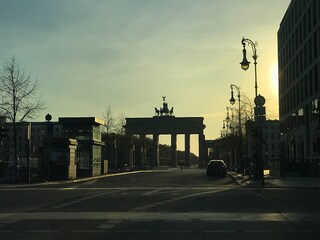
It’s Saturday evening when we decide to drive through the city. I’m curious to see what Berlin looks like on Easter during a lockdown, and also I’ve realised the Indian store in the heart of the city is open for three hours each evening, and I’m out of my favourite brand of tea. I’ve never seen the city like this before. The lawn outside the Reichstag—the German parliament building—usually packed with tourists, now has a few people sitting on it. I’ve never been to the Brandenburg Gate before without nearly getting thwacked with a selfie stick, but now it’s nearly empty. The new normal.
Berlin is the most energetic city I’ve lived in, besides Mumbai. And to suddenly see it stripped of this is strange. The stillness is peaceful, but discomfiting, like watching a movie on mute. It isn’t a movie that I’ve seen before. And I don’t know how it ends.