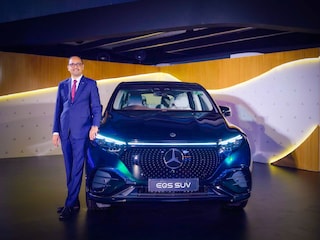
Mercedes-Benz India isn’t losing sleep over rival BMW, which is catching up fast, even as its own sales declined last year. The biggest luxury carmaker in India delivered 19,007 cars in 2025, a decline of 2.8 percent from the previous year, while BMW volumes surged by 14 percent to 18,001 units.
“I’m not worried at all. We’ve seen this before. What’s happening today is largely an entry-segment price war. We don’t want to participate in that. We will choose value over volume, just as we did in 2012–13,” Santosh Iyer, Managing Director and CEO of Mercedes-Benz India, said in an interview.
Iyer was referring to the years after BMW and Audi entered India in 2007, breaking Mercedes-Benz’s long-held dominance with an aggressive product push and sharp pricing. By 2012, Mercedes had slipped to third place, ceding ground after years of a near monopoly. The company then responded by launching a wave of new models and price resets in 2013. Within two years, the strategy paid off: by 2015, Mercedes-Benz had reclaimed the top spot in the luxury car market.
“Price wars damage residual values, erode brand trust, and hurt customers who already own the car. You can see brands that are still struggling with those consequences. We don’t see that as a sustainable strategy,” said Iyer.
Entry models contributed just 13 percent of total sales in 2025, down sharply after a 20 percent year-on-year decline.
“No. We want to grow there—but not at any ‘cost’. We still offer products like the GLA with a four-cylinder engine and 4MATIC (the carmaker’s all-wheel drive system). Some competitors have decontented vehicles to hit lower price points, which is great for customers. There’s no right or wrong here. It’s a strategy that may work for others. As a brand, we don’t want to compromise product substance just to gain share.”
A focus on top-end models helped Mercedes clock its “best-ever year in terms of revenue”. Iyer did not share details on revenue, saying numbers would be available only after the fiscal year closes.
“But given the higher penetration of top-end vehicles, it’s obvious that revenue has grown. Volumes are down only by a couple of hundred cars. And that’s entirely in the entry segment, not the top end.”
The top-end vehicle portfolio—comprising the S-Class, Mercedes-Maybach and AMG models—grew 11 percent year-on-year and accounted for a quarter of total sales. High-performance AMG vehicles alone expanded by 34 percent.
The growth in top-end models, though, does not automatically translate into higher profitability as input costs rise. “We have to be profitable across car lines also for investments and many other reasons.”
EV Charge
Electric vehicles (EVs) followed a similar pattern, with sales rising 12 percent from a year earlier. Close rival BMW, on the other hand, clocked 200 percent growth in its EV portfolio.
Mercedes, however, says it leads in the top-end EV segment.
Nearly 70 percent of Mercedes’ EVs sold in 2025 were top-end models priced between Rs 1.25 crore and Rs 3.1 crore, led by the EQS SUV, now the brand’s best-selling luxury EV in India.
EV adoption hit a speedbump after the government cut goods and services tax (GST) on ICE vehicles. Is demand coming back?
“Over the past two to three months, you could clearly see demand soften. A large part of the EV story rested on total cost of ownership, which involves lower GST, road tax benefits, and overall affordability compared with combustion engines. Once GST on combustion engines was brought down, internal combustion vehicles started looking more attractive again,” said Iyer.
Many OEMs—both in the mass market and luxury—have responded by cutting EV prices.
“As those corrections happen, EV demand is slowly starting to come back. This is not a one-way shift. It’s very much a wait-and-watch situation.”
Electrification, though, is being pursued with flexibility. Mercedes-Benz India now sells petrol, diesel and electric vehicles in parallel, resisting pressure to force customers into EVs. Hybrids, Iyer noted, no longer enjoy a tax advantage and add cost without guaranteed demand.
“Flexibility is the name of the game,” he said. “If you lock yourself into one technology, you create risk.”
Luxury Outlook
Mercedes-Benz expects the broader luxury car market to remain flat or grow in low single digits in 2026, constrained by rising prices and cautious consumer sentiment. It is estimated to have grown by 2 percent in 2025.
Iyer gives two reasons why the market has been stuck at the 50,000-odd volume mark. “First, sentiment. Luxury is not an essential purchase; it’s a discretionary, sentiment-driven one. After several years of double-digit growth, the market has paused.”
“Second, prices. In the mass market, prices have actually come down by 8–9 percent. In luxury, prices have gone up. That inverse dynamic matters.”
Quarterly price increases, Iyer said, have become unavoidable but are being softened through longer-tenure loans and financial incentives to keep monthly payments stable.
Mercedes-Benz will continue to focus on “value over volumes”, he said.