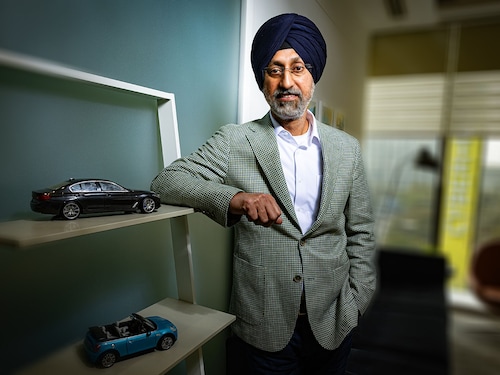
Fresh off its strongest year ever in the country, BMW Group India is sharpening its ambitions. The German luxury carmaker sold 18,001 units in 2025, its highest annual sales ever. Sales rose 14 percent from a year earlier, far outpacing industry growth, which is expected to be in the 7 to 8 percent range.
Electric vehicles (EVs) grew about 200 percent, cementing BMW’s position as the country’s largest luxury EV brand for the third year running. They have now overtaken diesel in the company’s portfolio, says Hardeep Singh Brar, president and CEO, BMW Group India.
The momentum in 2025 was broad-based. Long wheelbase models (that have more space in the rear seat) now make up half of BMW’s India sales and sport utility vehicles (SUVs) account for 60 percent. The company also notched its highest ever quarterly sales in the December quarter, with a growth of 17 percent to 6,023 units.
In an interview with Forbes India, Brar explains why BMW believes it can reach its EV targets ahead of schedule and how the company is positioning itself to claim the No 1 spot in India’s luxury car market as early as next year. Edited excerpts:
The BMW iX1, which we launched last year around Rs50 lakh, has been a key contributor. More than the price point, the car delivers everything customers aspire for in a BMW. There was range anxiety in the mass market, and we addressed that with a real-world range of over 500 km. It also offers all the features one expects in a luxury car. Importantly, it comes with a long wheelbase. Electrification and long wheelbase products have been core strategies for India, and both have worked well for us and have fundamentally driven our growth.
Q. You had earlier planned for EVs to form 30 percent of your sales by 2030. Where do you stand now?
We may reach that target sooner. We are already at about 21 percent EV penetration, and more EVs are coming, including the iX. At this pace, we could reach that target a couple of years earlier than planned.
Q. You’ve been leading in EVs from the start…
Yes. Industry-wide EV penetration is around 4 percent, luxury is about 9 to 10 percent. Excluding BMW, others are closer to 6 to 7 percent. We are clearly driving EV adoption in the luxury space.
Q. So EVs will remain a focus going forward?
Absolutely. To give you some context, last year our sales mix was roughly 60 percent petrol, 30 percent diesel, and 8 to 10 percent electric. This year, EVs have already overtaken diesel.
Currently, petrol is about 61 percent, EVs are at 21 percent, and diesel has come down to around 18 percent. Diesel has declined sharply—from 30 percent to 18 percent in just one year. This mirrors the broader industry trend, even in the mass market. And it’s good from an environmental standpoint.
EVs also make far more sense from a cost-of-ownership perspective. If you’re spending about Rs10 per km on petrol, an EV costs roughly Rs1-1.5 per km. That’s a compelling economic argument. It’s good for customers, good for the environment, and good for the economy because it reduces fuel imports.
EV penetration in the luxury industry fell after GST changes as ICE (internal combustion engine) became more attractive in terms of price. Did BMW see a fall as well?
No, in fact, it has increased for us. EV penetration was around 17 to 18 percent in the first eight months and has gone up to about 23 to 24 percent post-GST 2.0. So, we don’t see this as a challenge.
Q. Why is it rising for BMW only? Attractive pricing?
It’s largely driven by higher awareness. While petrol and diesel prices have come down by 6 to 7 percent, EVs are still competitively priced—often close to equivalent petrol models. Customers find that attractive, so despite changes in fuel pricing, they continue to choose EVs. The overall value proposition is simply better.
Q. BMW has been aggressively pricing its cars while the closest rival (Mercedes-Benz) is focusing on top-end. Your strategy seems to be paying off. What does that tell you about India? Is it inherently a price-conscious market, even the luxury segment?
Luxury in India effectively starts at around Rs45 lakh. At Rs50 lakh, the iX1 isn’t an entry-level product, but customers do evaluate total cost of ownership. Earlier, there were concerns about maintenance costs in luxury cars. With the iX1, maintenance is minimal. You can go years without visiting a service station—there’s no oil, no filters. Add to that the low running costs and excellent rear-seat space. For many buyers—especially those who also use chauffeurs—rear-seat comfort matters. So, the combination of good range, low ownership costs and excellent backseat space works beautifully.
Q. But BMW is all about driving pleasure…
Yes, but the Indian consumer wants both. They love to drive on the weekends and have a chauffeur drive them around on weekdays. That’s why we focus on both: It’s a beautiful machine to drive and the long wheelbase means the rear seat is comfortable enough… the customers don’t mind sitting there.
Q. You’ve narrowed the gap with Mercedes-Benz. By when do you see BMW becoming the No 1 luxury carmaker in India?
Our focus is on customer experience. Numbers will follow. We have grown about 14 percent this year, while the overall luxury industry has grown much slower. So, the gap is closing quickly. Once we get to know how much the gap has closed, I think we will surely look to be number one next year.
Q. The luxury car market doesn’t seem to be expanding meaningfully. Why?
Luxury cars have traditionally operated at high price points. For a customer buying a Rs20-25 lakh car, a direct jump to Rs75-80 lakh is difficult. With the iX1 coming in at around Rs50 lakh, we’re seeing many new customers enter the luxury space. That’s why first-time luxury buyers rose to 43 percent last year.
BMW is playing a role in expanding the luxury market. We are currently the brand bringing in the most customers from the near-premium and mass segments. The closer you are to the mass market, the easier it is to grow. The further away you are, the harder it becomes to justify a Rs40-50 lakh jump for customers.
Also Read: How Mercedes Benz's strategic patience made it India's largest luxury carmaker
Q. But does aggressive pricing risk diluting the luxury quotient?
I don’t think so. Luxury today starts at around Rs45 lakh. At one point, it started much lower, and over time that entry point has moved up. We are not offering cars below that threshold—the iX1 is still priced at around Rs50 lakh, which is higher than the entry price point. There is no dilution as long as you don’t compromise on quality, features or size. Dilution happens when brands strip down products or reduce quality to hit a price. If you are offering the same quality, larger cars and more features at those price points, it doesn’t dilute the luxury quotient.
Q. And you’re able to price your cars aggressively because of localisation?
That’s right. About 95 percent of our cars are built in India, and within that there is 50 percent localisation.
Q. Any plans to ramp up localisation?
We are looking at it. We can’t give you a number right now because it’s an ongoing process. We continue to evaluate further localisation component by component. Only about 5 percent of our cars are fully imported, which is a pretty good number.
Q. Which segment is doing well for you?
Growth depends on where products are in their lifecycle. Models like the iX1 and X3 drove strong growth last year. Next year, we will launch 27 products—10 new models (six all-new and four facelifts) and 17 variant and profile changes. This will drive momentum in 2026.
Q. Of these, how many are EVs?
Three will be EVs.
Q. Charging infrastructure remains a concern. How are you addressing that?
Despite offering 500+ km range, some customers still worry. We’ve installed fast chargers roughly every 300 km on key highways. These are high-capacity chargers ranging from 120 kW to 720 kW, capable of charging a car in 30 minutes to an hour.
We also ensure these chargers are monitored, maintained and protected. It’s not enough to install chargers; they must work reliably. Customers can see live charger status through the app, plan routes, check availability and pay through a single gateway.
Q. Sedans are shrinking industry-wide. How are they doing for BMW?
For the overall industry, the sedan share is now down to 10 percent. But for us, it’s growing. Sedans still account for about 37 percent of our sales—nearly 7,000 out of 18,000 cars. While SUVs are growing faster, sedans still grew about 4 percent for us last year.
Q. How has Mini performed?
Growth was modest last year due to fewer launches, around 3 percent. This year will be stronger. A Mini Convertible launched in December sold out within 24 hours. Mini and motorcycles will see significant momentum, including new high-capacity motorcycles above 1000 cc.
Q. Who is a typical Mini buyer?
Most Mini buyers already own luxury cars. About 40 percent are existing BMW customers. Mini is often bought as a second car or gifted—on birthdays, anniversaries or graduations. It’s a young-at-heart customer who wants to stand out, reflected in Mini’s bold colours and design.
Q. Are EVs also second cars?
It’s a mix. About 43 percent are first-time luxury buyers, but a lot of people already own a big car and EVs then become a second family car. The iX1 works well as both a primary and secondary vehicle.
Q. What about expansion beyond metros?
We currently cover 40 cities with 97 touchpoints. Next year, we’ll add 10 cities and about 18 touchpoints. Demand from Tier II and III cities is rising, and better highways have made access much easier.
Q. What does 2026 look like?
We expect double-digit growth. Sustaining 14 to 15 percent annually is challenging, but we aim to remain in high double digits. The iX1 has helped expand the luxury market by lowering the entry barrier without diluting the brand.