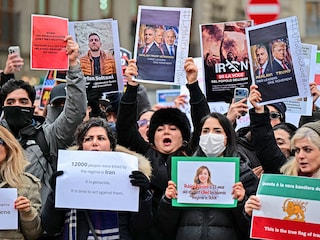
Iran’s nationwide unrest has left at least 2,677 people dead, with 1,693 additional reported deaths still under investigation, according to the latest update from the US-based Iranian Human Rights Activists News Agency (HRANA), as of January 16. HRANA also reported 2,677 severe injuries and said the number of detainees had reached 19,097.
In light of the unrest, the United Nations Security Council held an emergency meeting on Iran on January 15 in New York. Meanwhile, US President Donald Trump has threatened military action, warning Tehran against executing detained protesters.
What led to mass protests in Iran?
The unrest began on December 28 when shopkeepers took to the streets in Tehran after a sharp fall in the value of the Iranian currency, the rial, against the US dollar on the open market. University students later joined the protests, which spread to other cities. Demonstrators began calling for political change, with crowds chanting slogans against Iran’s Supreme Leader Ayatollah Ali Khamenei.
HRANA said it had confirmed protests in 187 cities and towns across all 31 provinces since the unrest began and recorded 618 protests in total.
Iran's currency collapse and rising prices fuel anger
The protests unfolded against a worsening economic backdrop. The rial has hit record lows over the past year, while inflation has surged to around 40 percent, driving steep rises in the cost of basic goods such as cooking oil and meat. Sanctions linked to Iran’s nuclear programme have added pressure to an already-strained economy.
Support grows for exiled former royal figure
Support for Reza Pahlavi, the exiled son of Iran’s late former shah, appears to have grown during the unrest. Pahlavi is the eldest son of Iran’s last monarch, Mohammad Reza Shah Pahlavi, who was overthrown during the 1979 Islamic Revolution. He has lived in exile and has no formal role in Iran’s current political system. However, some Iranians and opposition groups outside the country view him as an alternative to the Islamic Republic, with his name resurfacing during periods of political unrest.
Iran’s violent crackdown and rising arrests
Iranian authorities responded with a violent crackdown. On January 7, Iran’s judiciary chief Gholamhossein Mohseni Ejei warned courts to show “no leniency” towards what he described as “rioters”, according to Reuters. Several media outlets have since reported the use of water cannons, rubber bullets and live ammunition against protesters.
HRANA’s latest breakdown of confirmed fatalities includes:
- 2,478 protesters
- 16 children (under 18)
- 163 people affiliated with the government (military and non-military)
- 20 civilians not involved in the protests
HRANA also reported 115 cases of forced confessions broadcast and said the detainee count includes 169 people under 18, and 52 students.On January 11, videos emerged from the Kahrizak Forensic Centre in Tehran showing families searching for loved ones. The BBC reported 180 shrouded bodies and body bags from ground footage. Another video shared on January 12 showed around 50 bodies.
On January 13, an Iranian official told Reuters that 2,000 people had been killed, blaming “terrorists” for protesters’ deaths.
Internet shutdown continues
Widespread internet outages have been reported in Iran from January 8, limiting communication with independent journalists and restricting access to footage and eyewitness accounts from inside the country.
Internet monitoring group NetBlocks said Iran has experienced an internet shutdown lasting more than 168 hours, warning the disruption was affecting access to essential services and family communications, while making verification harder. US media reports have also suggested the shutdown has extended beyond internet restrictions, with disruptions to telephone lines, including landlines, in some areas.
Some Iranians have used Starlink, Elon Musk’s satellite internet service, to connect. However, Iran bans Starlink terminals and authorities have reportedly tried to trace them.
Iran restricts many international news organisations from operating inside the country. State broadcasters and official agencies follow government guidelines, while independent Iranian journalists become vulnerable to harassment or prosecution for reporting anything that criticises authorities. Iran has also blocked many major social media platforms and Western news outlets. While some citizens use VPNs to bypass restrictions, the continuing communications blackout has sharply reduced the flow of videos and eyewitness accounts, making independent verification of events inside the country increasingly difficult.
Trump warns Tehran over violence
US President Donald Trump on January 2 said the US was prepared to intervene in response to Tehran's violent crackdown against protesters. In a post on Truth Social, he wrote: “We are locked and loaded and ready to go.”
He followed this by announcing on January 12 that countries that continue doing business with Iran would face a 25 percent tariff on trade with the US.
On January 13, Trump further urged protesters in Iran to continue their fight against the regime. “Iranian Patriots, KEEP PROTESTING – TAKE OVER YOUR INSTITUTIONS!!!” he wrote on Truth Social. He also told Iranians to “save the names of the killers” and warned: “They will pay a big price.” Trump added that “help is on its way” but did not explain what form that help might take.
Protestor execution in Iran?
On January 14, Euronews reported that the family of Erfan Soltani, a 26-year-old clothing shop employee detained from his home on January 8, had been told he was due to be executed that day. A relative living abroad, identified only as Somayeh, told the Associated Press that the family went to a prison in Karaj, near Tehran, believing the execution would take place, but later learnt it had been postponed.
The same day, Trump told CBC that the US would take “very strong action” if Iran carried out executions. “If they hang them, you’re going to see some things,” he said.
A day later, the US President took a more cautious tone, telling reporters in the Oval Office that he had been assured the violence was easing and executions were not planned. “We’ve been told that the killing in Iran is stopping, and it’s stopped and stopping, and there’s no plan for executions or an execution,” he said. Despite this, on the same day (January 15), the US Treasury Department announced sanctions on five Iranian officials for being responsible for the “deadly suppression of protesters”.
Iran denies execution plans, blames “terrorist groups”
Iran’s Foreign Minister Abbas Araghchi in an interview with Fox News on January 14 denied claims that Tehran plans to execute protesters. “Hanging is out of question,” he said when asked.
Read More
Separately, Araghchi said in a letter to the UN Security Council that the unrest had turned into what he described as a “planned effort by terrorist groups”. He accused outside powers of interference and pointed to deaths among government forces during the turmoil.
Iran’s judiciary also commented on the case of Erfan Soltani, after reports circulated suggesting he faced execution. Authorities said the charges against him did not carry the death penalty.
Meanwhile, Iran’s Revolutionary Guard commander Mohammad Pakpour repeated claims carried by Iran’s state news agency that the US and Israel had instigated the unrest, without providing evidence. He said those countries would “receive the response at an appropriate time”.
Iran’s airspace closure and evacuations
Following threats from Trump of military action, Iran temporarily closed its airspace from January 14 to 15. The shutdown lasted for more than four hours and appeared to lift shortly after 7 am local time, with several domestic flights already in the air at the time.
Iran’s Civil Aviation Organization issued a Notice to Air Missions ordering the airspace closed to most aircraft, allowing only certain international arrivals and departures with official permission. Flight tracking data showed only a small number of aircraft over Iran as the order took effect, while international carriers diverted routes around the country until the restriction expired.
Indian airlines issued travel advisories after the closure disrupted flight routes. The Press Trust of India reported Air India cancelled at least three US-bound flights and warned of delays on some services to Europe after the Iranian airspace shutdown disrupted key routes. Air India said flights were using alternative routes “in view of the safety of our passengers”, while IndiGo and SpiceJet also flagged potential disruption.
Some US and UK personnel were evacuated as a precaution from sites in West Asia, while the British embassy in Tehran was temporarily closed. India, Spain, Italy and Poland advised citizens to leave Iran, following similar US warnings.
The first evacuation flight from Tehran to India is expected to depart on January 16.