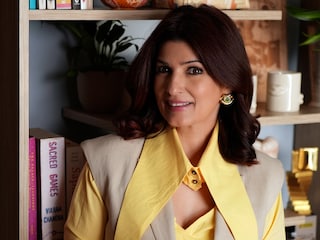
Books have been an integral part of Twinkle Khanna’s life. So much so that her friends in boarding school claim that she often missed lunch because she was busy reading them. “In that case, I would not be that size… I was big,” she says self-deprecatingly.
Amid a cup of coffee in her cosy, beach-facing Juhu office—filled with books and movie poster frames—the author-columnist speaks about the challenges of writing, why stories of older women fascinate her, reinventing herself after quitting showbiz as an actor, hosting a talk show, Two Much, and why artificial intelligence (AI) cannot write for you.
I never thought I would do a sequel. After Mrs Funnybones, I did a collection of short stories and wrote a novel. And then I did my master’s and followed it with another collection of short stories. It was during that tour that I realised how much this book meant to so many people. I think somewhere, at least for me, maybe because I grew up reading literary fiction, I took the Funnybones voice a little bit for granted. The book has reached labour rooms, war zones, it’s speaking to people and giving them comfort. I realised there is tremendous value in it… in what I had not been seeing all this time.
Q. What is the most exciting thing in Mrs Funnybones Returns for readers?
For readers, it’s also a way of seeing a decade of India, of women. How that has changed, and how my perspective has also changed. The things that we were talking about earlier and what we’re talking about now… and whether there has been a significant change in women’s lives. If you read the newspapers, you’ll say education is better and women have bank accounts. But have they entered the workforce as much as they should have? They haven’t. Has the social structure of their life, their relationships changed? It hasn’t. So, it’s an insight because it covers a decade.
Q. You use a lot of wit and sarcasm. Is that your style or does it depend on what you are writing about?
In the columns, definitely, I use humour to get the point across because if you make somebody laugh at something, then they look at it in a different light. It’s also more palatable. You can say a lot of things and get away with it, which you would not be able to if you were just putting it down straight, especially when it comes to politics. So, I would say it’s my disguise, it’s my armour, and it lets me get the point across. In some fiction, I definitely use a more reflective voice because that’s the way that story needs to be told. So, my voice automatically alters when it comes to Mrs Funnybones. There is only one way to write it. There are certain columns which are serious in Mrs Funnybones as well, but by and large, it just happens.
Q. Writing is a rewarding experience, but it can be torturous as well. Do you experience a writer’s block, and how do you deal with it?
It’s absolutely not rewarding while you’re writing. Absolutely not. You are taking your head and banging it against a wall, hoping something shakes and you get some new ideas. I’ve been writing for about 14 years. For the first few years, I would sit at my desk, and I had this theory that even if the muse is going to somebody else, if I just sit here, I can catch the muse on its way and bring it back to my desk. Now I’m too old and when I sit at my desk, my neck starts hurting. Now I walk… I keep walking. And when I’m walking my dog and I’m seeing people walk by or I’m doing some gardening, the ideas will all come together. I have to do my research, I have to look at all my notes, and then I have to leave it. Then I just walk, and it comes together after which I sit at my desk. So, this is a tip for older writers. We just cannot sit at our desks anymore. Our bodies are not going to let us. So, perhaps this works.
Also Read: It's always a good time to have a sense of humour: Twinkle Khanna on Tweak India
Q. Do you keep going back to your work, reworking it?
Oh yeah. Earlier, when I started writing columns, I had maybe 11 drafts, but now it’s about three to four. The first draft is, I would say, absolute nonsense. It’s just whatever ideas I have… they’re disjointed. What I do well, though, is find a common thread between very disparate things. Once I wrote a column… it was about a photograph of space and Hema Malini, and I can find that thread. So, I think that is the only gift I have—I can find something common between two subjects.
2. Actor Kajol (left) with Twinkle Khanna. The duo hosted a talk show, Two Much, this year (credit: Image: Ashish Vaishnav/SOPA Images/LightRocket via Getty Images
Q. You did a master’s in writing from London. How did that help you? And would you recommend a workshop or course for aspiring writers?
I did two courses at Oxford during the pandemic—one was for beginners in non-fiction and another was advanced in fiction. And then I went back to university and did my master’s. In terms of how I work towards a column, nothing has changed. The framework, the process, the skeleton… everything is the same as earlier. When it comes to storytelling otherwise, whether it’s short stories or novels, it has completely changed. The Oxford courses were fantastic, they gave me technical skills, and the master’s—because we had to workshop so much with other students, our own work, other writers—gave me the ability to dissect writing and see all the scaffolding behind the walls. So, how do you construct a narrative, what are the techniques you use, how do you work with time across a story. I would highly recommend it because along with this entire structure, you have something to rely on. Now you know you can fix it this way. You have techniques, and you learn what is the most efficient way to tell a story, but no one can teach you how to write. That’s part of your unique perspective.
Q. You write a lot about societal issues and women are mostly the central characters in your books. Is that deliberate?
If I said that I don’t think men are that interesting, I don’t know what you’d say. But I’m fascinated by older women. I feel as the world starts making them invisible, I find them more and more interesting. I feel they have so much experience, there are so many layers. They have gone beyond binaries. There is no right, wrong, white, black. You know, the grey in their hair is the grey in their life, and I find that fascinating.
Q. Are you trying to be a voice for these women and their everyday struggles?
I’m not trying to be a voice for them. I am fascinated by them, and I believe that their stories should be out there. Why are we, you know, always focusing on youth? And I think it was Ursula K. Le Guin who said that beauty, when you’re young, is just a by-product of hormones… I am paraphrasing, but as you get older, you earn it, and that is the real beauty. Why do we neglect that and just look at the one that is purely because of hormones?
Q. Your first book, Mrs Funnybones, was a bestseller. Have you re-read it recently? If you were to write it today, what is the different thing that you would do?
When Mrs Funnybones came out, it did very well, but I kept thinking I want to do something different. I never sit down and say this is perfect. I don’t look back. From all my books, when I re-read them or look at them, Welcome to Paradise is one that I feel satisfied with. I didn’t make any compromises. I wrote it the way I wanted to write it. I wrote it at a stage in my life when I felt I had enough experience behind me to be able to negotiate things like loneliness and mortality and age and the layers of being. For me, that is a book that I would not rewrite… every other book, yes, I wish I could… I would rewrite old chunks.
Q. What are some of these compromises?
Sometimes there are compromises that you make unknowingly. In another book, for instance, I felt I had to be funny on every page, and so, I put that pressure on myself. The story was meant to be about an elderly couple, but, after discussions, it changed into that of a younger couple. So, those sort of compromises… and I made those willingly, nobody forced me to. It didn’t happen with Welcome to Paradise. With Mrs Funnybones Returns, there aren’t any compromises because each column and each essay talks about a particular issue in the way that I want to talk about it.
Q. Have you embraced AI? What do you have to say to writers who rely only on AI, and lose their individuality and writing style?
AI is a tool, and it can be both beneficial and dangerous. For writers, I would say that we need to stay away from it. Maybe it’s good for editing, maybe it’s great for copy-editing, but I don’t see how AI can write for you. AI doesn’t have an image in its mind of a rooftop with a big tray of jelly sweets in it, sparkling in the sun, pink and green with little sugar molecules. How would it describe that? It’s never tasted pickle… how would it tell you what it’s like? And how would it tell you that every time you have a bite of mango pickle, there is somebody, at least for me, there was one Santoshi Amma, who used to give me pickle, who’s walking beside me while I’m tasting this pickle, no matter where I am. How does AI do that? Where are the layers?
Q. After quitting acting, you have reinvented yourself. You're an author, columnist, entrepreneur and now a talk show host. Which of these roles do you enjoy?
I’m happiest, oh well, not happiest, I can’t say that because writing is an extremely difficult process. I’m most at peace when I’m writing. It’s the place where I’m both within my mind and I’m also observing it. I find that calming. The rest of it is chaos, but I enjoy the chaos. I’m at a stage in my life where I want to experiment. I want to try new things. I want to see, learn, give it my best, push myself out of my comfort zone. So, whether it means doing a talk show, going back to university, planning a road trip across Ladakh… I want to do things that push me out of my comfort zone because I have only one life. I’m running out of time. I need to do whatever I can to stop myself from stagnating. It’s very easy to stagnate right now.
Q. How did the idea of starting a talk show come about?
I was interviewing people for Tweak [Khanna’s digital platform for women] anyway—for The Icons. When they approached me to do this (Two Much), I thought it’s fun. It’s a bit different from what I normally do. It’s much lighter. And I would be doing it with Kajol… I’ve always felt a certain warmth from her, and I felt I could trust her. So, it was a safe space.
Q. How do you deal with criticism? Do you get affected by what is written about you?
I started working at a very young age… I was 17. I’m almost 52 now, and at some point, I came to a conclusion that there were only two things I could control—my preparation and my execution of that material. I cannot control outcomes. So, once I have satisfied myself that I have prepared as thoroughly as I can, and I have done it to the best of my ability, I don’t bother beyond that with what people are saying. I will listen to them, I will take that feedback, I’ll try and incorporate it if it makes sense to me… there is no ego involved. That is their opinion. For example, we are talking about Mrs Funnybones Returns. If I was so worried about criticism, I wouldn’t have written that first column, and we wouldn’t be here.
Q. Did you have the business acumen when you started out as an entrepreneur, or did you learn on the job?
I don’t know whether I am a born businesswoman. I just know that I looked at opportunities. I remember my mother used to make candles in our kitchen. Once we had enough, my sister and I took a few samples to some stores, got orders and that’s how we started 27-28 years ago… and we are still running that company. Then Tweak came about. It’s the irony of life… I had said I don’t want to be in front of the camera, sucking in my stomach and putting on false eyelashes—guess what I am doing now. I’d rather have a digital platform where I could do something behind the scenes. I’m somebody who loves working. I like looking at opportunities, and if I can do something in that area, I jump into it. I am also curious about how things work. So, when I get into a business, I like to dissect it, analyse it and learn as much as I can. When I was working as an interior designer, I learnt CAD (computer-aided design) because I wanted to be able to draft plans… not that I was fast at doing that, but at least it gave me the ability to read them easily. It didn’t matter that I had bestselling books… I decided to go back and study the craft of writing. It’s curiosity that drives me.
Q. Was it about marrying business with creativity, or was it driven purely by passion?
I’ve never looked at the business side first. I have always looked at my interests and gone ahead. The money has always followed.
Q. Coming back to your book, tell us the story behind the name Mrs Funnybones.
I’ve broken every bone in my body. There’s nothing that’s left [unbroken]. And I’ve been doing this since I was a child. I’ve broken my collarbone, tailbone…I have around 40 ligament tears on my left leg and 10 on my right. When I was getting on Twitter [now X], the name Twinkle Khanna wasn’t available. So, I thought, why not take this bit, which has always troubled me? I also like to entertain myself, and hopefully that entertains people too. So why don’t I mix the two? And that was it. It was Mrs Funnybones.
Q. What gave you greater joy—seeing your name on screen in your debut film or on your first book?
Definitely the book, because I grew up reading constantly. I have friends from boarding school who claim that I missed lunch because I was reading. I don’t think I missed any lunch because I was this big. If I was missing lunch, I would not be that size. But books have been my life, and I still look at myself more as a reader than a writer. So yes, it would be my name on Mrs Funnybones.
Q. Did your habit of reading help you improve as a person?
Being a science fiction reader helped me as a human being because my boundaries, borders, and tolerances are completely different. I grew up not even looking at, you know, my neighbourhood or my city… I was looking at the whole universe. When you read science fiction, you have empathy with an alien creature with tentacles, breathing out, I would say, helium. And you still know that the creature has something in common with you. So why am I going to look at, you know, differences between human beings: colour, race, religion? It was [science fiction] that opened up the boundaries of what I believe is acceptable.
Q. What next?
I don’t know. Maybe I want to study… do my PhD or perhaps I want to become the education minister. I have both options in my head now, I have to see what the world gives me.