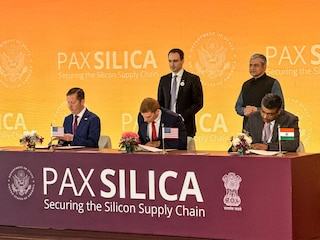
India and the United States on Friday signed the Pax Silica declaration, bringing India into a US-led initiative aimed at securing artificial intelligence (AI) and semiconductor supply chains.
Speaking at the signing event, Alphabet and Google chief executive officer Sundar Pichai said the US-India technology partnership would play a critical role in shaping the next phase of AI-driven growth.
“We are on the cusp of an era of hyper progress and new discoveries. The best outcomes are not guaranteed. We must work together to ensure the benefits of AI are available to everyone and everywhere. The US-India partnership has a critical role to play,” Pichai said.
He added that India was emerging as a major AI market and innovation hub. “I believe India is going to have an extraordinary trajectory with AI, and we are supporting with a full-stack commitment, including products, skilling and infrastructure,” he said.
Pichai highlighted India’s developer ecosystem, noting that Indian developers had already contributed 22 Gemma AI models, and pointed to initiatives such as AI-based monsoon forecasting and healthcare screening tools.
On infrastructure, he referred to Google’s previously announced investments. “We announced a $15 billion investment in Indian infrastructure with the AI Hub at the centre,” he said, adding that subsea cable connectivity projects would further strengthen digital trade links between the two countries.
Micron Technology president and CEO Sanjay Mehrotra also spoke on the importance of semiconductor collaboration in enabling AI systems.
“Memory and storage are critical to driving AI… as real-time demands on performance are placed on AI systems, they need more and more memory,” Mehrotra said, adding, “Micron is making an investment of $2.75 billion here in Gujarat… this is a pioneering project of semiconductor manufacturing here in India.”
Pax Silica: A roadmap for economic security cooperation
US Under Secretary of State for Economic Affairs Jacob Helberg described the declaration as a long-term roadmap for economic security cooperation between the two countries.
“This is not merely an agreement on paper, but a roadmap for a shared future,” Helberg said. “Today, as we sign the Pax Silica declaration, we say no to weaponised dependency and we say no to blackmail. Together we say that economic security is national security.”
What is Pax Silica?
According to US Department of State, Pax Silica is a flagship initiative on AI and supply chain security, aimed at building trusted technology ecosystems across areas ranging from critical minerals and semiconductors to AI infrastructure and connectivity.
The framework seeks to reduce dependencies on unreliable suppliers and promote collaboration among partner nations on investment, infrastructure and advanced manufacturing, including trusted data centres and fibre-optic networks.
India’s role in Pax Silica
US Ambassador to India Sergio Gor said India’s inclusion in the initiative was strategically important. “Entry into Pax Silica isn’t just symbolic. It’s strategic. It’s essential,” he said, adding that India’s engineering capabilities would strengthen the coalition.
Gor linked the development to broader bilateral ties. “From the trade deal to Pax Silica to defence cooperation, the potential for our two nations to work together is truly limitless,” he said.
He described the initiative as a coalition designed to secure the entire technology stack. “From the mines where we extract critical minerals to the fabs where we manufacture chips to the data centres where we deploy frontier AI… this is about ensuring technologies that will define the next century are deployed and controlled by free nations,” he said.
India’s inclusion follows earlier concerns after the US initially named other partner countries but not India. The signing comes after progress on an interim trade agreement framework between the two nations.
India’s semiconductor ambitions
Following the US Ambassador, Union Minister for Electronics and Information Technology Ashwini Vaishnaw took the stage. He said India’s growing semiconductor capabilities were a key reason for joining the initiative.
“Today our talented engineers are designing some of the most complex, most advanced two-nanometre chips here in India,” he said, adding that workforce development was central to India’s semiconductor plans. “The semiconductor industry will need about one million more talented people… we have made semiconductor design tools available free of cost in universities.”
Vaishnaw credited India’s diplomatic positioning for enabling deeper technology partnerships: “India today is a trusted country… that trust and respect have been built through our foreign policy.”