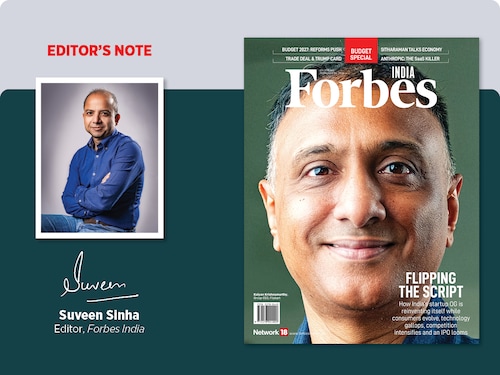
What does it mean when a leader, entrepreneur or public figure refuses to give an opinion on a specific issue that is in the news? As the old adage in journalism goes, even a ‘no comment’ is a comment
Put these words in your Google search string: Vishal Sikka hindustantimes.com Suveen Sinha. The two top results—the AI Overview—and the second one will lead you to an interview of Mr Sikka from November 2016. Although the byline on hindustantimes.com appears as “Anonymous”, that was this writer interviewing Mr Sikka when he was the CEO of Infosys.
The previous month, Ratan Tata had fired Cyrus Mistry from Tata Sons. And, at one point in the interview, I asked Mr Sikka if there was no chance of his being the next Mistry.
Sikka said: “Oh my God. (Pause) I don’t want to comment on that. (Pause) That’s not a fair question. These are very serious things we are doing.”
I had—have—all the respect for Mr Sikka. The first non-founder CEO of Infosys, he came like the breath of fresh air the company needed. Back then, he was talking about artificial intelligence (AI), automation and cloud, and trying to put Infosys on the path of becoming a company that would be known for its cutting-edge work.
Mr. Sikka recounted in the interview that he had met NR Narayana Murthy, the founder of Infosys, a few months earlier in London who had said: “Vishal, I was reading some of your interviews and what you are trying to do is to convert us from reactive problem solvers to proactive problem finders.” Mr Sikka had found this a beautiful way of putting what he was trying to do at Infosys.
In his interview with me, Mr Sikka had been nothing but candid to the point of being disarming, until I raised the Mistry flag. But I would have failed in my duty as a journalist if I had not.
In the days preceding the interview, there had been reports suggesting that Mr Murthy, whose standing in Infosys, beyond the legal documents, was no less than Mr Tata’s in Tata Sons, was not happy with the direction the IT giant was taking.
As you would probably know, things did not end well for Mr Sikka at Infosys. That is why it is heartwarming to see all the accolades and limelight he is getting now at a time when AI is threatening India’s IT outsourcing biggies. Keyboard warriors are crawling out of the woodwork and taking to social media to lionise Mr Sikka, which he deserves now as much he did back then.
The unfortunate part is that it took a decade for people to appreciate him. And what it took was the meltdown of IT outsourcing companies’ stocks after Anthropic released a set of AI-based tools which can automate several tasks now done by these firms. To rub salt into wounds, the Claude chatbot maker’s recent fund raising of $30 billion gave it a valuation of $380 billion, which is higher than the combined market value of the Nifty IT index.
Curiously, days after Anthropic cast its evil eye on Indian IT, Mrinank Sharma posted on X to say February 9 was his last day at Anthropic where he was an AI safety researcher. Sharma posted his resignation letter, which said: “The world is in peril.” Earlier that week, an Open AI researcher had resigned amid concerns about advertisements being incorporated in ChatGPT.
Seven days after Sharma left Anthropic, my colleague Naini Thaker was interviewing its CTO, Rahul Patil, in Bengaluru. She asked him for his thoughts on “the recent instance of an employee’s dramatic resignation”.
At this point, Anthropic’s communications person decided to take matters into her own hands. “He can’t comment on specific employee things,” she said.
As the old adage in journalism goes, even a “no comment” is a comment. At times an eloquent one.