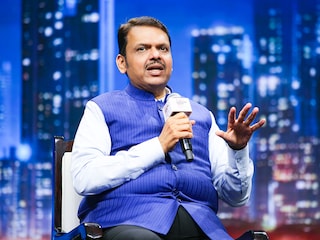
Maharashtra is no longer thinking like a state; it is thinking like an economy. This was evident in Chief Minister Devendra Fadnavis’s articulation of growth, where comparisons were not drawn with Gujarat, Karnataka or Tamil Nadu, but with other countries. “Maharashtra’s economy is now $660 billion. If we were a separate nation, we would be the 30th largest economy in the world,” he said at the Forbes India Leadership Awards held at the Jio World Convention Centre at Mumbai’s Bandra-Kurla Complex on March 24. “In the next two years, we will surpass economies like the UAE and Singapore.”
During an interaction with Bodhisatva Ganguli, group consulting editor, Network 18, at the occasion, Fadnavis laid out a plan which was characterised by scale, speed and systems that he claims will make Maharashtra the most competitive state in India.
At its core is the transition—from being India’s largest contributor to the country’s GDP to being a globally competitive economic hub. This relies on Maharashtra’s excellence in manufacturing and finance, and the state aggressively pushing new-age industries like startups, data centres, semiconductors and creator economies.
This growth is also being driven by robust infrastructure, agile policy-making and rapid execution, which can together create an ecosystem capable of attracting capital at an unprecedented scale.
India’s federal structure is no longer merely a subtle administrative arrangement. Rather, it has become an active economic battleground. Fadnavis spoke about this evolution: “While earlier there were only three to four states which mattered in terms of attracting investments… now there are at least 10 states in the fray. That is good for the country. We believe in competitive federalism.”
Still, within this crowded space, Maharashtra is looking to assert leadership, both in terms of legacy and reinvention. “The state has manufacturing prowess. We have been leaders in manufacturing for a long time… and we continue to do that,” he said. However, the focus shifted to new-age industries shortly after. “We are the fintech capital. We are the startup capital.”
The claim is pointed, especially in a landscape where cities like Bengaluru and Hyderabad are often seen as innovation hubs. Fadnavis pushed back on that perception, with data. “By absolute numbers and absolute investment, Maharashtra is the startup capital. Maharashtra also accounts for the largest number of unicorns,” the chief minister said.
In addition to this, Fadnavis emphasised that Maharashtra is currently at a systemic advantage. “We have the best human resources, the best engineers, the best technocrats. Technology-wise, we are much ahead. There is an extremely good work culture. People mean business here.”
Most importantly, the government is looking to eliminate all the obstacles in the investment pipeline. “Ease of doing business and cost of doing business… if the government works on these two, investments will come,” he added.
This approach is also reflected in the implementation. “We have plug-and-play parks where we immediately give land. There are cases where we have closed deals in 24 to 36 hours, allotted land and issued offer letters,” he continued. The rapidity of decision-making, along with an established base, is what Fadnavis called Maharashtra’s “X factor”.
But this becomes even clearer in the data centre sector, where digital growth directly depends on strong infrastructure. “Now we are the data centre capital of India,” the chief minister pointed out. Of the roughly 1.5 gigawatts of operational data centre capacity in the country, more than 1 gigawatt is in Maharashtra. The pipeline is also much higher, with deals worth ₹8 lakh crore equating to nearly 9 gigawatts of new capacity.
However, the actual differentiator is energy (or power). “The biggest thing for data centres is power. Maharashtra is power surplus,” he said.
Looking at the future
Besides, the planning for future needs has already been incorporated. “If the Mumbai-Thane-Navi Mumbai region needs 5,000 megawatts in the next five years, we are ready,” said Fadnavis.
There is also a long-term vision for sustainability. “By 2030, we will be 52 percent renewable. By 2035, 65 percent renewable,” he said. And he added that Maharashtra is ready to supply sustainable energy too.
While power availability is often a major bottleneck for many industries, Maharashtra is banking on its energy availability to be its differentiating factor. “Others are signing deals, but they don’t have power,” he observed.
While Maharashtra has not managed to bag any major semiconductor fabrication unit under the semiconductor policy of India, there is another side to its semiconductor industry. “We are leaders in OSAT [Outsourced Semiconductor Assembly and Test] and ATMP [Assembly, Testing, Marking, and Packaging]—one of the most important processes in the semiconductor ecosystem,” Fadnavis said.
The next big jump may be through the proposed Rs83,000 crore facility with Tower Semiconductor. “We have entered into an MoU, land is identified and soon that facility will come,” he said.
In addition to tech, Maharashtra is also developing its “orange economy”, a term used to describe the creator economy, which includes animation, gaming and digital content creation. “Maharashtra is a natural ecosystem for the creator economy,” Fadnavis said. The state’s AVGC-XR [animation, visual effects, gaming, comics, and extended reality] policy, first launched in 2017 and now in its second phase, aims to develop this segment further.
One of the initiatives is the upcoming Indian Institute of Creative Technology, which will be set up in Mumbai. “This will be like an IIT for the creator economy,” the chief minister said.
The model is expansive, with a central hub and 12 spokes, all designed to support infrastructure and training across the state.
Infrastructural developments
Innovation and enterprise may be one half of Maharashtra’s story, but infrastructure is the other half—and arguably the more important half—of the state’s development efforts.
The key to this effort, said Fadnavis, is the new Vadhavan Port, which is currently under development and which he described as a transformational project. “For the last 30 years, our maritime power has been Jawaharlal Nehru Port Trust, which accounts for 55 percent of container traffic. But even after expansion, there is no space available.”
Vadhavan promises to change this picture entirely. “It is three times bigger and has a 20-metre natural draft. From day one, it will be among the world’s top 10 ports,” Fadnavis added. But the new port is not just about size. It’s also about integration. The port will be connected to the Mumbai-Nagpur Samruddhi Expressway.
This will provide districts in the hinterland a direct route to global trade routes. “Around 25 districts will have direct access. Goods can reach the port in eight to 10 hours,” the chief minister said.
This port-led growth strategy promises to ease logistics costs, enhance export competitiveness and foster decentralised growth.
Urban infrastructure, especially in the Mumbai Metropolitan Region, is also being developed on a massive scale. The Atal Setu is already transforming the connectivity landscape between Mumbai and Navi Mumbai. “Between Atal Setu and the new Navi Mumbai airport, we are building the third Mumbai,” Fadnavis said. “Near Vadhavan, we are planning the fourth Mumbai.”
The plans also include the extension of the coastal road from Bhayander to Virar and then on to Vadhavan. In addition, there is also the plan of constructing an offshore airport—the third airport in the region—between Virar and Vadhavan, which is currently in the feasibility stage.
However, the execution of these plans is also important, and land acquisition has traditionally been seen as a problem in Maharashtra.
Fadnavis admitted this, but also pointed out the state’s success in land acquisition in the past decade. “The Ratnagiri refinery is the only project where we failed in land acquisition. Otherwise, in the last 10 years, we have completed all projects undertaken,” he said. He cited the example of the Samruddhi Expressway, where land acquisition for the 750 km greenfield project was completed in just nine months, connecting the two capital cities of the state.
“Our policy is to pay four to five times the value. In most cases, we have done consent awards,” he said. This approach, moving from coercion to consensus, is also an important factor in speeding up large-scale infrastructure projects.
What also comes through in the Maharashtra government’s policies is the attempt to rise above incremental growth rates and achieve structural transformation, with infrastructure, innovation and administrative speed being the tools for competing not only with states but also with countries. “We are not just competing with states anymore… we are competing with countries,” Fadnavis said.