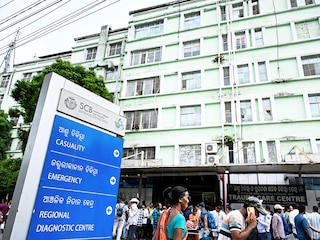
In the early hours of Monday, March 16, a major fire broke out in the trauma wing of the ICU at the SCB Medical College Hospital in Cuttack, Odisha. Since then, the death toll has climbed to 12 and caused a political uproar in the state. While news reports point to low staff presence and delayed emergency response, this tragedy marks the sixth major hospital fire in India in five years, bringing a key question to the fore: How can India’s hospitals be better equipped to fight fire?
A few factors make hospitals uniquely vulnerable: High oxygen concentration, large amounts of electrical equipment and patients who are unable to evacuate easily. A 2023 study of hospital fires in India since 2010, published in The Journal of Failure Analysis and Prevention, shows that short circuit was the major cause of such fires, contributing to 89 percent of total outbreaks. The next big trigger was flammable chemicals, causing 4 percent of accidents.
Interestingly, nearly as many accidents took place at privately-funded hospitals (49 percent) as in government-funded ones (51 percent). Half of all the hospitals were not compliant of safety norms.
“The law requires that all hospitals should obtain certificates of compliance from all regulatory agencies on different aspects of safety and disaster management. But the present study revealed that, in practice, gadgets for fire prevention and control are often installed simply to get the necessary permission to function,” the report noted.
“Subsequently, there is little or no follow-up to keep the gadgets in fully functional condition, nor keep the staff adequately trained,” it said. “For instance, in PBM (Prince Bijay Singh Memorial Men’s) Hospital, Bikaner, a short circuit occurred due to faulty electrical wires, which were very old and lacked proper insulation. The aged wires could not carry the load, which had been increasing with time. A tripping point reached when indiscriminate use of air conditioners, medical equipment, computers, etc., overloaded the wires because there had been no mandatory inspection of the power supply system.”
Read More
Dhruv Shah, partner at Mumbai-based fire safety solutions firm Monark Fire, says that they often encounter vulnerabilities in oxygen storage, wiring and HVAC (heating, ventilation and air conditioning) systems at hospitals. “There are many old wires, and often, the HVAC systems are terrible,” he says. “That causes a lot of residual heat. Hospitals mainly have foam and boards in their false ceilings, and there is often negligence as far as maintenance is concerned.”
The hospital fire study mentioned above notes some glaring lapses:
- The study reveals that many hospitals do not even have the basic fire protection measures in place. When fire started in the Murshidabad Hospital in West Bengal, the emergency exit gate was closed, the fire alarm and the elevator were non-functional, and hospital lacked the basic firefighting infrastructure like fire extinguishers.
- The fire that raged in the DGH (District General Hospital), Bhandara, in 2021, burnt to death 10 babies because the hospital did not have the mandatory fire extinguishers and the staff was not trained to use whatever equipment that was available.
- Sunrise Hospital, which is situated on the 3rd floor of Dreams Mall in Bhandup, Maharashtra, was given provisional occupational certificate to run COVID-19 centre. March 2021, the hospital witnessed a fire outbreak, which took a toll of 11 people. The audit report of the hospital reveals that major firefighting appliances like riser system, pumps, sprinkler system, underground water storage tanks and hydrant system had been installed, but none was functional.”
In older hospitals, where redesigning the building’s own layout for better fire safety isn’t possible, Shah of Monark Fire recommends installing systems that contain the fire spread between sections: More fire doors, modular fire extinguishers, more sensitive detections system that raise alerts much sooner. “You also have auto diallers; this means that even If there’s an alert at 3 am, it will raise alarms to the required fire services instantly,” he says.
A key aspect is to conduct regular fire audits and understand how flammable material is stored and segregated. “We need more frequent training, not just to satisfy a criterion on paper. We need consistent fire drills, staff training, oxygen leakage emergency protocols, and establish a certain flow of events when trying to evacuate patients, especially via fire lifts and on stretchers where possible,” he adds.