Ayurganic: A lesson in organic, slow fashion
Organic fabrics dyed naturally and infused with herbs help drive well-being for people and the planet
By
Prefer us on GoogleLast Updated: Jun 15, 2019, 09:00 IST3 min
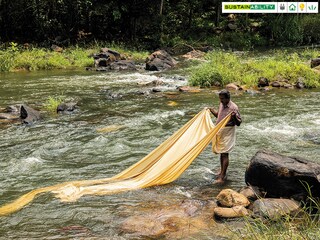
The fabric is washed in the Neyyar river, where plant pastes used in the cloth become fodder for the fish
Image: Sagar Ahuja[br]We are at an Ayurvastra dyeing centre in Balaramapuram near Thiruvan-anthapuram in Kerala, watching how organic cloth is being treated using Ayurvedic principles. Global Organic Textile Standard-certified organic cotton is scoured in fresh water to clean it, then put into vessels filled with water with a small portion of oil. The fabric is then dried and treated with buffalo milk and cow urine mixed in water—the milk and urine taken from cows and buffaloes fed with herbs—as well as cotton seeds and leaves.
“Scouring is the first step in the treatment of the fabric and the process takes about an hour. When it comes to the oils, we use different oils… say, for well-being we use castor oil and for energy, coconut oil,” says Mr K Rajan, who manages the dyeing centre.
After the treatment with buffalo milk, the fabric goes through the process of gumming, or with a fixing agent for the herbs, and preparing the fabric for dyeing. “About 25 different kinds of plants—used in combinations according to a person’s needs—are applied to the fabric by boiling the fabric in a decoction. For this, the plants are differently prepared—cut, powdered, grained, juiced or pasted. For one hour, the fabric is constantly stirred and boiled in the decoction,” adds Rajan.
“Sustainability was always our preoccupation and when we came to India, we became profoundly enamoured with the concept of Ayurvastra—a principle so old and so Indian that had been forgotten. Ayurganic as a product is a bridge between the ancient and the present, and between India and the world,” says Sagar.
“Making ayurvedic vastra has been part of our tradition for generations and I plan to pass this down to my next generation. I involve my kids in the whole process to ensure the craft does not die with me,” says Rajan. The process of creating the fabric requires eight hours of work over 15 days for the production of a two-metre length cloth. Extracts of ayurvedic herbs are used in the dyeing process and no synthetic or chemical materials are used at any stage of the process, he says.
They use 48 different plants for the Ayurganic fabric. After gumming, the fabric is washed in the Neyyar river, where the plant pastes used become fodder for fish. The fabric is then left to dry for a few days before being transported to Ayurganic’s studio in Delhi.
The designers make a range of products including pants, bathrobes, shawls, scarves, eye masks and even yoga mats. Considering the dyeing is done with organic substances, the range is currently available only in a butter yellow colour. “We’ve sold a lot of our pieces in Germany, Switzerland, Austria and quite a few in India,” says Sagar.
“Everyone moving towards more natural dyeing processes ensures that chemicals are removed from the supply chain and manufacturing of products, in the longer run ensuring sustainability,” says Kriti Tula, founder of Doodlage, which makes sustainable clothes. “Sustainable fashion is a global movement that needs to be adopted within the fashion industry. Natural dyeing is a great process for sustainable fashion and including it in collections helps in ensuring that polluting chemicals don’t make it into soil or water.”
Dr Nikhil Parmar, a dermatologist at Sparsh Clinic in Ahmedabad, says textiles infused with herbs and natural medications during the dyeing process can be beneficial for people suffering from skin diseases. “If the organic clothes retain their medicinal properties even after long use, they could be beneficial for skin allergies, infections and irritation,” he adds.
(The writer travelled to Ayurganic’s dyeing centre in Thiruvananthapuram, Kerala, on invitation)
First Published: Jun 15, 2019, 09:00
Subscribe Now