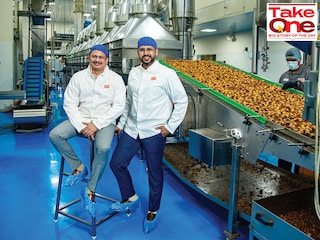
An assortment of modaks moves seamlessly on an automated machine before they are neatly packed in modified atmosphere packaging boxes. On another floor, on other equipment that needs minimal manual intervention, a special mix of spicy and tangy masala is layered onto dough that eventually becomes a roll, is deep fried and cut into bite-sized slices. Once ready, the bakarwadi spirals are sealed in packets of various sizes and dispatched to multiple outlets.
It is the run-up to the festive season and the sprawling Chitale Bandhu Mithaiwale factory in Ranje, about an hour from Pune, is abuzz with activity, churning out everything from kaju katli and modaks to gulab jamun and mango barfi.
Spread across 1.5 lakh square feet—with an adjacent building totalling 2 lakh square feet—the manufacturing unit, first set up as an export unit in 2006 and then rebuilt as a mega project from 2017, was a step towards automation that has helped the regional company, known for its sweets and bakarwadi, scale.
Now in its 75th year, Chitale Bandhu, which has been a household name in Maharashtra, mainly Mumbai and Pune, is trying to make its presence felt nationally and expand its range of offerings, especially in the snacks space. Leading this effort are fourth-generation second cousins Indraneel Chitale and Kedar Chitale.
Kedar, partner at the enterprise, and Indraneel, who is managing partner, joined the business in 2000 and 2011, respectively, but lessons in entrepreneurship were ingrained in them during their growing up years by their fathers and uncles, who ran the show at the business started by their great-grandfather Bhaskar Chitale in 1939.
After losing all his cattle to famine and disease, Bhaskar had migrated from Limbgaon village to Bhilawadi, both in Satara district, Maharashtra, to pursue his passion for dairy and farming. He started by sending fresh milk, curd and chakka (strained yogurt) to Pune and Mumbai via a channel partner. The BG Chitale dairy, as it was called, however, had to press the brakes on the business as it was not feasible to send perishable products to far-off locations. Bhaskar asked his son Raghunathrao, who worked in a mill in Surat, Gujarat, to set up base in Mumbai.
His other son, Rajabhau, joined the business later. In 1950, they opened the first Chitale Bandhu store at Kunte Chowk, Pune—later shifted to Baji Road—followed by another at Deccan Gymkhana in 1954. The spirit of innovation and pivoting continued with the company introducing bakarwadi in 1976. The Gujarati-origin snack, which has gone on to become its star attraction, was adapted to Maharashtrian taste after a lot of trial and error. It has become so popular that it is now almost synonymous with the Chitale brand. The company claims to make 2,000 kg of bakarwadi per hour on one machine now compared to 200 kg per day with the help of 40 people in the initial days.
“I focussed on automation. It was happening in some way since 2014, however, it was a chicken-and-egg situation… one needed scale to push it. We addressed the issues that were resulting in restrictions on scale—in terms of volume, shelf-life preservation and hygiene,” says Indraneel, 36, who has a BTech in electronics and telecommunications, and has used his engineering expertise and technology application knowledge to build scale at the family-run enterprise.
Automation began with ladoos and pedhas followed by kaju katli. The company also scaled up bakarwadi production as it began eliminating human involvement in the production process or keeping it to a bare minimum.
Mithai packaging was another area the brothers worked hard on. In India, people usually bought fresh sweets across the counter. “So, when it came to packing and selling those, it took time. We had to standardise a lot of things. We introduced the modified atmosphere packaging concept in India for mithais,” he says, as he takes Forbes India on a factory visit.
Before the pandemic, adds Kedar, 48, a commerce graduate, buying packaged sweets was an alien thought for consumers. “It was not acceptable. But people’s idea of hygiene has changed since then,” he says.
Kedar’s early focus was on retail and his initial on-the-job training meant that he knew the intricacies of running a store. “As production capacity improved and we shifted to a franchisee model, we got a lot of time for expansion. As a consequence, we improved our capacity to meet demand and also strengthened our supply chain to take our products outside Pune,” he says.
The Ranje unit is Chitale Bandhu Mithaiwale’s third renovated factory—the other two are in Pune’s Gultekdi and Parvati Industries, both spread across 3,000 to 4,000 square feet plots.
Modaks: One of Chitale’s best-selling items
More than Mithai
The fourth-generation entrepreneurs know they have their hands full as they deal with growing competition, try out innovations and explore newer territories.
From a products point of view, salty and packaged snacks are crucial to the company’s growth aspirations. “In India, the salty snacks market is huge—around ₹60,000 crore—and it will go up to ₹135,000 crore in the next 10 years. So, our focus is to get a good double-digit share in that market,” says Indraneel. To this end, they have not just scaled the snacks they are known for, including bakarwadi, but also expanded their offerings to include other namkeens and healthy snacks, while keeping their focus on their strengths like Maharashtrian savouries.
“The snacks business is extremely regional and has a lot of players. Chitale focuses on Maharashtrian snacks compared to generic popular products which have a lot of competition,” says Samir Kuckreja, founder and CEO, Tasanaya Hospitality, one of India’s leading hospitality consultancies.
Though getting into the snacks category puts the Chitales in direct competition with the likes of Bikaji and Haldiram’s, their strategy will hold them in good stead, say experts. “It’s difficult to compete with a Haldiram’s and Bikanervala because of the territories they operate in, their salience and brand recall,” says Kuckreja, adding that Chitale also has a relatively limited footprint when it comes to retail stores compared to a Haldiram’s or Bikanervala considering it hasn’t expanded as aggressively as the two brands.
“Haldiram’s and Bikanervala have mastered the art of combining their snacks retail business with a restaurant. They have also penetrated various cities. There is no grocery store or supermarket where you will not see their products,” says Kuckreja. But, he adds, “Chitale is a household name in Pune and there is no reason why it can’t achieve that kind of stature or reach. It has a healthy topline, is privately held and snacks is a high-margin business.”
The cousins’ trajectory has steadily focussed on expansion and scale—Chitale has about 125 stores in the country today as opposed to eight retail points in 2015. They are also moving to Xpress outlets—small, packaged food retail outlets designed for urban and high mobility-driven areas—with 35 such outlets outside Pune.
There are other ways in which they are increasing visibility for their snacks—Chitale was a snacking partner for the Mumbai Indians team in the Indian Premier League in 2025. It has also started a loyalty programme and will open stores at 10 metro stations of the newly inaugurated Aqua metro line in Mumbai.
While nowhere close to the scale of Haldiram’s, which had a $10 billion market valuation as of March 2025 and sold nearly 10 percent of its stake to Singapore sovereign fund Temasek for $1 billion, Indraneel says Bikaji is their closest competitor. Bikaji is also vying for a national play and has Bollywood superstar Amitabh Bachchan as its brand ambassador.
“One of the biggest challenges for the longest time for our industry was that we did not have industry recognition. Mithai-namkeen operators were never looked at with an industry lens because most were single-shop owners. We were never taken seriously,” he says. “The valuation of Haldiram’s, in fact, is a great validation for the industry.”
More players entering the space also augurs well for the industry and everyone stands to benefit as the size of the pie has increased, the cousins say. Ankur Bisen, senior partner, The Knowledge Company, a management consulting firm, too believes the more the merrier, as it means more innovation and snacks for consumers. He compares the fight for top honours in the segment to what’s happening in carbonated drinks where there are established players like Cola and Fanta, but now also Lahori Zeera and Red Bull which are playing the numbers game too.
He adds that the path for Chitale is pretty well laid out. “You can ask why Chitale hasn’t become a Haldiram’s… and that is a question Chitale has to answer. It has to chalk out its future trajectory. How can it make bakarwadi or chivda a national product like Haldiram’s has done to chola bhatura,” he says, adding that Chitale as a brand stands out in India’s western region but should do more of what it is doing. “It is underplaying its strengths. It is punching beneath its weight. There are people in India who punch above their weight. That is the norm,” he says.
The bakarwadi is synonymous with the Chitale brand
From Regional to Global
Kedar says staying regional was a limitation, not a strategy. “We also wanted to grow,” he says, adding that when the company came out of its retail focus, it realised “there were other avenues they hadn’t explored”. The demand for its offerings was such that they had no choice but to automate. “Once we adopted this technology, we realised the sky is the limit,” says Kedar.
The modak market for Chitale Bandhu, for instance, has grown more than 10 times in the past four to five years since the focus on automation, research and development, backward integration and marketing, according to Indraneel. He claims the company got an order for a crore modaks during the Ganpati festival this year, but they had to decline the request as they were not prepared for such huge numbers.
It has chosen to be slow and steady, but those decisions have yielded results. Bisen of The Knowledge Company says Chitale has always been a strong regional brand whose products cater to the sensibilities of a certain demography with a formidable connect around those, but adds that the company has made the right decisions in its journey. “How one scales up business is important, and those decisions have to be taken at the right inflection points. And the Chitales have succeeded in that,” he says.
Chitale, he continues, recognised the profile of a changing India. “It was a brand at the right place at the right time, particularly around western Maharashtra where Pune was emerging as an IT hub and India was undergoing a transition,” he says. “In food, scaling up the business does not mean you just open shops. It is also about supply chains, product, consistency, quality assurance, hygiene, promise of standardisation, taste. The consumers of a changing India became demanding on this front. And Chitale incorporated these in its offerings,” adds Bisen, who leads The Knowledge Company’s work in retail, consumer products, food and ecommerce.
While retail still contributes 60 percent to the business, the Chitale siblings were conscious of the fact that they cannot achieve scale with a single avenue. “So, not just stores, but also distribution. Not just distribution, but also exports. Then, post Covid, came ecommerce and quick commerce. Now, it’s an omnichannel business where brand play has become more important than the channel of sale. That is the play we are establishing over the past few years,” says Indraneel.
Kedar adds: “Quick commerce will keep getting strong. If, for example, its contribution in our turnover was 2 percent earlier, it has now doubled to 4 percent.”
Besides hyper local, the focus has also been on expanding internationally. “We also took small efforts to go pan-India or international from 2016,” says Indraneel. Chitale is present in 60-odd countries with partnerships with the likes of Shri Krishna Vada Pav and Annapurna. As part of its global outreach, the company is opening kiosks/shop-in-shop experiences for customers, partnering with restaurant chains abroad. As of today, 25 such exist in the US, over 30 in the UK and more than five in Australia and the UAE.
“The focus is on making our products available. Getting real estate abroad is a problem and then there is a price war to justify that. So, we have employed a distribution strategy and that is paying dividends for us,” he adds.
Kuckreja, who is working with a couple of partners on potentially taking leading Indian brands to Australia, feels there is tremendous demand for Indian snacks from the subcontinent diaspora and the locals. “Focusing on exports helps in various ways. It opens up new markets and adds another territory where your products are available. But one has to make products that cater to the tastebuds there,” he says.
Bisen adds that the right exports strategy can lead to an even bigger play. For example, he says, if bakarwadi is exported to the US, chances are that nine out of 10 times, it will be bought by Maharashtrians living there, not by Punjabis or Bengalis. “You are chasing your customer wherever he is, you are making your product available to him. If that is the definition of expansion, it’s fine, there’s nothing wrong in that,” says Bisen. “But if you want to take the appeal of your product beyond your core customers, you need to make a concentrated effort to make those recipes and products stick to a larger audience.”
Keeping an eye on the overseas market, Chitale Bandhu Mithaiwale is currently doing research on frozen technology with Maharashtrian snacks and sweets like modaks, vada and kothimbir vadi, which can be consumed either fried or steamed.
It is also banking on the healthy snacks segment with its brand M Square—which stands for mindful mouthful—with products that don’t have added sugar, and are gluten- and lactose-free. They also include baked cookies, millet products and ready-to-cook items. Binge bars is another snacking item the company is focusing on. “The ₹10 snacking bar is important. It’s a nice product-market fit,” says Indraneel.
Brand play has also become an important part of their strategy. Till about 2015, Chitale Bandhu Mithaiwale relied heavily on word of mouth. Later, it roped in a professional agency and began making short emotional films to focus on branding. “Creating brand films for Chitale was a chance to relive childhood memories. Chitale is more than just a brand; it’s a part of Marathi culture. I wanted to tell stories that were organic, entertaining and memorable,” says filmmaker Varun Narvekar, who recently also directed a Chitale commercial featuring cricketing legend Sachin Tendulkar.
The company roped in Tendulkar as brand ambassador in its 75th year of operations. “As someone who values tradition and excellence, I am pleased to partner with a brand that has been a cherished part of so many lives, including mine, for generations,” Tendulkar said in a statement.
Kedar adds that in terms of a cultural change, “we changed the Chitale Bandhu Marathi logo to English. Our ads are also in English and Hindi.”
Rugwed Deshpande, director, Setu Advertising, who collaborated with the company in its milestone year, is also excited with Chitale’s vision to take the ‘made in Pune’ brand to the world stage. “The clarity, ambition and commitment they bring to this new chapter are truly inspiring,” he says.
Modified atmosphere packaging boxes
Change and Constants
Though much has changed at Chitale Bandhu, there are some things that remain the same. One of these is Chitale Bandhu’s resolve to avoid external involvement in the running of the business or getting funded. It claims to have a compounded annual growth rate (CAGR) of 20 percent for the past few years and ploughs back profits back into the enterprise. “As of now, we are not looking at getting private investors,” says Indraneel. “Because our business is high on inventory turnaround, our capital is not stuck for a long time. If you are prudent in terms of deploying capital, then a good CAGR can be acquired by being wise.”
Indraneel points out that it makes sense to raise capital if one wants to grow exponentially in the next decade or get into lots of mergers and acquisitions. “That is not the plan now… we are focusing on leveraging the brand’s strengths. Once we are able to do that, we can think of other things,” adds Indraneel.
The other is keeping people and the customer at the core of everything that Chitale Bandhu does. Arvind More, one of Chitale Bandhu’s oldest sales team members who joined the company in 2003, calls it an organisation that deeply respects people. “Even during Covid, when people were losing jobs, the company stood by us. It’s more than a workplace, it’s a family,” he says.
Giving an example of how people’s emotions are attached to the brand, Indraneel reveals that when they thought of mechanising the production in 1994-95, they partnered with a company that made spring rolls in Amsterdam. After trials, the Chitales bought the machine to India and made bakarwadi on it. Everything was fine till they hadn’t revealed that fact to the customers. Once they publicised how they had made the snack on the machine, customers complained it did not taste like before. They continued their focus on automation and went on to get their own machines.
“A Chitale customer has always come to us for quality. They have never come to us because we are very cheap or very expensive. They are assured of certain things and how to keep delivering that is our focus,” says Indraneel.
He adds that though they have changed with time, they have ensured that the family values and cultural DNA are intact. “We are fairly professionalised now. Chasing growth is much more institutionalised than what it was 10 years ago,” he says. “Revenue is an important part of our business, but we don’t chase it obsessively. We are looking at maintaining healthy ratios and a good balance sheet.”
It’s what they have grown up doing and plan to continue doing, though it’s too early to be speaking about what the next generation will do. From the time he was in school, Kedar says he would sit at the family store, devouring pedhas and barfis from the manufacturing unit that was below their house. “We grew up in that environment, so there is no question of doing anything else,” he says.
It helps that it has also been an environment where they have had the freedom and authority to innovate and take decisions. “Freedom has been the best part of running the business. We have a progressive mindset and the ability to experiment. The earlier generations had the vision to take a quantum leap. Not everyone gets freedom… what you do with it is the question,” says Indraneel.