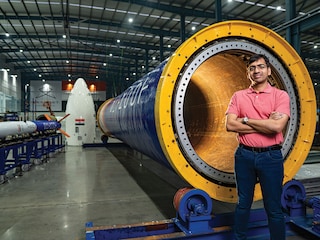
Seven years ago, Pawan Kumar Chandana left his job as a scientist at the Indian Space Research Organisation (Isro) to set up Skyroot Aerospace with Naga Bharath Daka.
Chandana and Daka were colleagues at Isro. And now they are poised to return to their alma mater—in a manner of speaking. As you read this, Skyroot is counting down to the launch of its rocket, Vikram I, from Isro’s launchpad in Sriharikota.
It is a four-stage rocket meant to put into space small satellites, which constitute a burgeoning market. The first stage of Vikram I is reported to have reached the Satish Dhawan Space Centre in Sriharikota, named after a former chairman of India’s space agency. What ensues is a round of integration after which, in a month or so, the final validation will start for the rocket to blast off for its inaugural flight. If all goes to plan, it will become India’s first privately built multi-stage orbital vehicle to reach space.
As marriages go, this one was a leap of faith. Back then, India’s space sector was steered exclusively by Isro, the agency celebrated for its frugal engineering and spectacular, if occasional, space missions.
That changed in 2020, when the government opened up the space sector, allowing private companies to participate in all space-related activities and created the Indian National Space Promotion and Authorisation Centre (IN-SPACe) as a single-window mechanism for non-government entities to access Isro’s facilities. Building further on this, the Indian Space Policy 2023 provided an overarching framework, with operating guidelines, zoning laws, and regulatory certainty.
The following year, in February 2024, the government allowed 100 percent foreign direct investment in the space sector. And eight months later, in October 2024, it created a dedicated venture capital (VC) fund of Rs1,000 crore for the space sector. This has been leveraged to create a Rs10,000 crore fund led by IN-SPACe to invest in more than 40 large and small space tech companies over five years, according to the India Brand Equity Foundation.
Fuelled by the reforms and funds, the sector has burgeoned. The country now has more than 200 space tech startups which together employ more than 5,000 people. Estimates say India’s share of the global space business pie will increase from 2 percent in 2022 to 8-10 percent—translating into a value of $44 billion—by 2033.
Indeed, space tech startups are harbouring soaring dreams.
Ground Zero
In 2022, Skyroot became the first private entity in India to launch a rocket named Vikram S, a sub-orbital test mission. “We signed the first ever MoU with Isro. So, we became the first beneficiary of the space reforms,” says Chandana.
He may have the first-mover’s headstart, but others are not far behind. In August this year, a single SpaceX Falcon 9 rocket launched three hyperspectral imaging satellites from Bengaluru-based Pixxel.
Awais Ahmed, Pixxel’s CEO, was part of a student satellite team mentored by Isro. Later, a chance encounter with the Hyperloop project led him to Los Angeles and SpaceX headquarters, where he saw the Falcon 9 booster. “It felt almost like a pilgrimage,” he says. He vowed to work in space tech for the rest of his life.
Pixxel was founded in 2019 to build a “health monitor for the planet” using hyperspectral imaging satellites, which capture data across 150 wavelengths, capable of seeing what traditional cameras cannot. “NASA and Isro offered 30-metre resolution, but that wasn’t good enough. We built a 5-metre camera—the best resolution commercially available today,” says Ahmed. NASA is the United States space agency.
Today, Pixxel operates six commercial satellites feeding data into Aurora, its artificial intelligence-powered platform. “Aurora works like Google Earth, but smarter,” Ahmed says. “You can ask it for a crop health report or methane leak detection, and it will run the models automatically.”
The pricing is pay-as-you-go, with subscriptions for basic features and additional charges for intensive analysis, like a cloud compute model. Customers span entities involved in agriculture, oil and gas, and mining, in addition to government agencies.
Photo by Mexy Xavier
Pixxel also designs and builds satellites for others, including one for the Indian Air Force, positioning itself as both a data provider and a hardware manufacturer. “It takes a lot to send satellites up there, but once you do, the economics works,” says Ahmed, who expects Pixxel to be Ebitda-positive next year. Ebitda, short for earnings before interest, tax, depreciation, and amortisation, is an indicator of financial health.
The Big LEAP
Aboard the same Falcon 9 rocket, the one that put Pixxel’s satellites in space, was Dhruva Space’s LEAP-1 mission. LEAP, short for Launching Expeditions for Aspiring Payloads, is Dhruva’s first commercial space venture. It is in collaboration with Australia-based Akula Tech and Esper Satellites. This mission carried an advanced AI module and a hyperspectral imager, to be hosted on Dhruva’s indigenously developed P-30 satellite platform.
LEAP missions enable multiple companies to share satellite capacity, instead of making payload developers acquire an entire satellite. This allows innovators to validate their technology at a fraction of the usual cost. If successful, the data gathered informs and greenlights the customer’s move toward their own dedicated, large-scale missions.
Sanjay Nekkanti’s journey with Dhruva began 13 years ago. During an early investor pitch seeking a modest investment of Rs4 crore, Nekkanti was goaded by an investor to think bigger. “I’ll give you Rs400 crore. What will you do with it?” the investor asked.
This made Nekkanti pause and return to the drawing board. He consulted mature companies in the Isro ecosystem and relaunched Dhruva with his three current co-founders. The new avatar is a full-stack solutions provider. Early revenue, supplemented by VC money, fuelled research and development, enabling the company to expand its satellite platforms from the initial P-Dot cubesat and P-30 nanosat platforms up to the development of P-Nu, its microsatellite platform.
“Small satellites and small launch vehicles are the future, powering a newer generation of solutions on the ground, from space. And today, we are playing in the sweet spot of the nano to micro satellite class,” says Nekkanti.
Dhruva is also selling solar arrays, sensing an opportunity because few companies specialise in manufacturing the complex, long-lifespan arrays that require expensive gallium arsenide cells. The early investor who goaded Nekkanti to think big would be happy to know that the team at Dhruva is pursuing a “grand scale” expansion.
The Ascent
Bellatrix Aerospace has designed a business model based on propulsion—the most complex part of a satellite.
Satellites vary in size and available power, so Bellatrix offers chemical, electric and hybrid systems. The strategy mirrors automotive giants such as Fiat or Cummins, which supply engines to multiple brands. “Our goal is simple: Every satellite manufacturer should use Bellatrix engines,” says its co-founder, Rohan Ganapathy.
Bellatrix builds not just engines but all subsystems, including tanks, valves and power electronics. “Space is expensive, and you can’t afford failures. So, we control the quality and cost by doing everything in-house,” he explains. Given that India’s component ecosystem is far from mature, Bellatrix’s ‘everything in-house’ strategy reduces dependence on imports and has helped achieve 84 percent indigenisation.
Bellatrix prioritises high specific impulse over sheer thrust. “If you want to travel far in space, you need mileage, not just thrust,” Ganapathy explains. Traditional chemical systems deliver short, powerful burns but are inefficient for long missions. Bellatrix’s electric propulsion converts propellant into plasma and accelerates it using electromagnetic fields. “The thrust is tiny, but in space, with no resistance, you keep accelerating. Over time, you become incredibly fast.”
An early breakthrough was conceptualising engines that could run on water, enabling in situ resource utilisation on the moon or Mars: “Your fuel is available in the solar system; you don’t need to carry return fuel,” says Ganapathy.
Bellatrix is now extending that propulsion edge into Very Low Earth Orbit (VLEO) satellites—an underexplored regime, where atmospheric drag typically causes rapid decay. The plan is to collect trace nitrogen from the ionosphere, ionise it, and use it as fuel sustained by solar power. “Unlimited fuel, solar energy, and continuous thrust mean you can stay closer to Earth, get sharper images, and enable direct-to-phone connectivity for 6G,” says Ganapathy.
This VLEO platform is designed to be configurable, letting customers swap payloads—imaging, communications, or specialised sensors—without redesigning the bus.
“It’s like Swiss watchmaking—tiny, high precision systems that must work for 15 years without failure,” says Ganapathy. “We are not just building engines; we are building the future of space mobility.”
That future is increasingly reliant on reusable launch vehicles, a complex domain that Bengaluru-based EtherealX is preparing to tackle.
New Feed Cycle
EtherealX plans to launch its Razor Crest Mk-1, a medium lift launch vehicle, in 2027.
The key lies in recovering the upper stage of the vehicle, which would reduce the recurring costs to just refurbishment or replacement, propellant, and launch operations.
Historically, re-entry heat has rendered upper-stage recovery economically unviable. But EtherealX says it has developed a completely new rocket engine feed cycle from scratch, which redirects re-entry heat during the descent. This enables development of the reusable upper stage, designed to tackle the industry’s two critical constraints: Launch cadence and pricing.
“The only way is to combine the advantage of reusability with the unit economics advantage of large rockets. That’s the reason why we are going for it,” says Manu Nair, co-founder of EtherealX. He adds that the reusable upper stage puts the startup in a good position to tackle the next frontier: Rocket cargo.
Nair understands the enormity of matching the high launch frequency of SpaceX, which does five a week. So, EtherealX focuses on profitability by keeping the cost per launch as low as possible, shifting the business model from revenue-per-launch to one based on the vehicle’s full lifecycle revenue.
The three-year-old startup has an orderbook totalling $130 million. Nair says the goal was to sign with customers who “have cash in the bank and can actually pay you out.”
The company pursued “harder” customers, government agencies and large private aggregators, avoiding research institutions or startups. These established entities only sign contracts for technologies that are fully necessary and validated.
The Glitch
Despite the momentum, Indian space tech startups need much more capital in the face of an uncertain returns timeline. Technical complexity remains high and failures can be catastrophic. Space startups collectively raised more than $139 million in 2023 but fell short of that figure in 2024 and 2025, according to data from Tracxn.
“We always say building a rocket is rocket science, but raising capital is an even bigger rocket science, especially because this a new sector,” says Chandana with a chuckle. The first investor cheques for Skyroot came from entrepreneurs who had a “10x risk-taking capacity”.
Manish Gupta, general partner at growX ventures, says the overall ecosystem is maturing. “We are seeing a lot more people coming out of Isro, DRDO, and legacy space tech companies like Team Indus. People are bolder now. When we invested in Pixxel, the founder was still in his fourth year of college.” DRDO is the government’s Defence Research and Development Organisation.
“Seed funding has been available for the past five years. Mid-stage rounds of $5–10 million were a challenge earlier, but that has improved. The real gap is at $20–100 million stages. There are very few deep-tech investors in India,” says Gupta.
Later-stage investors want results: Satellites in space, customers, revenues and clear progress. “That is where the struggle lies,” he adds.
Priyanka Chopra, CEO & managing partner at IIMA Ventures, believes space tech stands out as a frontier sector fostering economic growth and national self-reliance. Her fund has backed some of India’s most promising space tech startups, such as AgniKul Cosmos, Bellatrix Aerospace, PierSight, Satleo Labs, Orbitt Space, GalaxEye, and Olee Space.
Though India’s space tech journey began upstream, driven by Isro’s strong supply chain, Chopra emphasises that “indigenous launch capability is a matter of national strategic self-reliance” and continues to be attractive given the global demand for low-cost, on-demand launch services. At the same time, she sees downstream services like satellite imaging as offering “massive and near-term monetisation opportunities”.
Nekkanti says the Indian space ecosystem will remain a “work in progress” until a company achieves a significant breakout success. “There is a lot of silence before liftoff,” he says.
Global competition is fierce: SpaceX and Blue Origin have massive headstarts in technology, capital, and market presence. China’s space sector, heavily backed by the state, is expanding rapidly.
Talent acquisition poses another challenge. While India produces tens of thousands of engineering graduates every year, space technology requires specialised skills.
The Final Countdown
Meanwhile, at the Infinity campus in Hyderabad, Skyroot’s team is diligently handling the crucial final stages of rocket integration, addressing last-minute glitches and troubleshooting ahead of the launch.
But there is more to life after the launch. Skyroot is also developing a reusable launch vehicle. Chandana confirms that this project is “far beyond the ideation stage.”