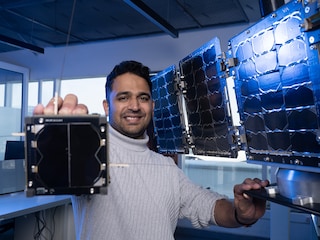
The journey of a space startup is rarely a linear path to the stars. More often, it is a test of endurance on the ground. For Dhruva Space, that journey spanned 13 years, defined by a pivotal shift from building a modest product company to envisioning a globally scalable space infrastructure. In this interview with Forbes India, co-founder and CEO Sanjay Nekkanti speaks about the evolution of the firm—from being rejected by 162 investors to securing a Rs 450 crore order book. He also speaks about the strategic decisions behind building high-stakes hardware, such as space-grade solar arrays and the P-Nu microsatellite platform, while navigating the complex expectations of the global space market. Edited excerpts…
Thirteen years is a very long journey. But one thing I learnt is that if you must build anything foundational, which has a breakthrough technology, which is globally scalable and creates large impact, you can't do that without having strong perseverance. And every time I hit a roadblock, I would remind myself of exactly that. Initially, when we were talking to investors, we were trying to build a product company. And in one of the conversations with a potential investor, he asked me, ‘What you're trying to do is amazing. The vision is great. But nobody in India is going to believe that you'll be able to pull this off. You're asking for four crore. I'm going to give you 400 crore. What are you going to do with that?’ That actually changed the way I was looking at things, because I felt we were trying to solve a problem, but we were not looking at the scale. I needed to get a little more realistic. So, I started consulting for a few matured companies in this industry… I was trying to study those companies.
I just paused. I said I don't have an answer but I'm going to go back, reflect on this and come back. For me, that helped me spread my wings, remove my blinders and made me think big and bold. And the foundational line there is trying to solve hard problems first, trying to find customers first and trying to build for India first. These then became the core principles around which the company started building its foundation.
Q. How did you get the final ‘yes’ from your first investor?
We raised our first round of capital in 2019, seven years after we set up Dhruva. We got lucky with the 163rd investor we approached. It was very tough, but we wanted to do hard things first. The reason we had so many meetings to convince an investor was also because we were trying to build a wide foundation. That’s the nature of the industry. But a lot of investors would like to see specialisation over a very specific product line. Trying to do the breadth as a small company is extremely hard. But it was very clear that we are in this for the long run.
Q. How is P-Nu different from any product you have so far?
So, P-Nu is a micro satellite in the 100 to 250 kg class bucket. Solutions from space can broadly be classified into two types—Earth observation and communications. And this particular platform of 100-250 kg offers the maximum bang for the buck in terms of the quality of the solution. Today, with this platform we are already able to meet the 30-centimeter class in terms of imagery.
Q. And what about the upcoming LEAP-2 and LEAP-3 missions?
This is from the P-Nu class of satellite. LEAP stands for launching expeditions for aspiring payloads. Technology is evolving very fast. Similarly, when electronics on ground evolves fast, the quality of solutions that you can build from space for applications should also be very fast. Today, lots of companies are innovating on different payloads. But you would want to test out that payload in space, right? And that is precisely where LEAP missions come into play, where multiple companies building innovative payloads need not buy one full satellite, which can be expensive. They can share a satellite where they can test out their payload capabilities first.
Q. Building space-grade solar arrays is a feat achieved by only a handful of companies globally. What inspired Dhruva Space to take on the challenge of developing this elite technology?
Drawing the narrative parallel to the automotive industry—what powers the car? It's the engine. What powers satellites? It's the solar panels and battery packs. And the solar panels that we use for satellites are very different from the solar panels that we use on ground. When the life of the satellite is expected to be 10-12 years, you use gallium arsenide solar cells. And these are very expensive cells. But if the lifetime of the satellite is only a couple of years, then you can also use silicon cells like the mega constellations of Starlink. What we realised is that there are a limited number of companies globally who have the specialisation to build solar arrays. And thanks to Government of India’s initiatives and their support, we've been able to deliver larger size solar arrays for an Indian customer. And because of the complexity of the technology that is involved and the shortage of solar cells in the market, we felt that it presents a massive opportunity for us to capitalise on.
Q. In the space industry, where the margin for error is razor-thin and failure is frequent, how do you manage the pressure of delivering returns to investors who may be wary of such high-risk timelines?
It is a very important piece of the puzzle. And we are building a business, so we're not doing charitable work. It is extremely important that as a business you make profits. From Dhruva’s standpoint, we've been extremely capital efficient. Our current order book is about Rs 450 crore, which is quite significant when compared to the amount of capital that we've raised. In the next 18-24 months, we want to get to a Rs 4,500 crore order book. We are setting up one of the largest facilities for mass production of satellites in the country which is coming up in Hyderabad. This facility will act as a capacity multiplier, not just for India's own requirements, but also for the global OEMs. And that will be our pathway to creating that kind of order book and we are expecting to be EBITDA positive starting next financial year.
Q. China has already exceeded its launch targets for 2025. Is the number of launches in a year a metric to judge a country’s space programme? And if it is, then are we not being ambitious enough?
It depends on what the needs of your country are, and how do you solve for that first. And today, I believe that we are at a stage where we are creating category defining products. So, essentially, the India space stack is a work in progress which will become one of the benchmarks as we move forward into the future. These total number of launches don’t mean anything at this juncture.
Q. How is AI being used in space right now?
AI can augment a lot of capabilities from space. We are currently trying out a few things like object detection and collision avoidance. But large-scale deployment will show how effective this is. All I can say right now is that it looks very promising, and we will know the outcomes in 18-24 months.
Q. Despite a government push and the success in the sector why is startup funding still a problem in the space sector?
There’s a lot of silence before liftoff.