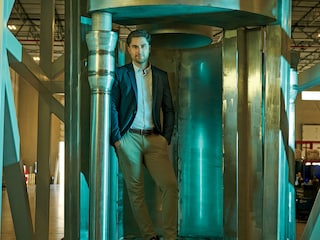
At Aalo Atomics’ 3,700-square-metre factory on the south side of Austin, Texas, workers move 1.5-centimetre-thick steel plates onto machines that slowly bend and roll them into 3.5-metre-wide cylinders, which they then weld into 8-metre-tall vessels. These could be made cheaper by outside contractors. But Aalo co-founder and CEO Matt Loszak wants to do this work in-house, since each vessel will eventually contain the guts of a 10 megawatt (MW) nuclear fission reactor. Five of these Aalo-1 reactor units, working in tandem, will power a single 50 MW electric turbine—enough juice to run a large data-processing centre or 45,000 homes.
“It’s not a paper reactor; it’s getting built,” declares Loszak, a 35-year-old Canadian engineer now on his third startup.
In August, Aalo broke ground on a 1-hectare site at the US Department of Energy’s (DOE) Idaho National Laboratory, where it aims to achieve “criticality” by July 4—America’s 250th birthday and the deadline US President Donald Trump has set for at least three American startups to prove that their advanced nuclear reactor designs work. To achieve criticality, Aalo will load a vessel with off-the-shelf nuclear fuel rod assemblies and then initiate a self-sustaining nuclear fission chain reaction.
Producing electricity? That comes later. Even after achieving criticality Aalo will still need to build out manufacturing and a supply chain of vendors, sign data centre customers and get final approval from the Nuclear Regulatory Commission (NRC).
“We’ll get the factory set up, come down the cost curve and have this Holy Grail product,’’ vows Loszak, who is shopping for up to 93,000 square metres for a Gigafactory and recently hired Bryson Gentile, who headed Falcon 9 manufacturing at Elon Musk’s SpaceX, to set up Aalo’s mass production operation. “What Elon did [with electric cars and rockets] was kind of like running the four-minute mile. When that happens, everyone’s like, ‘Wait, this is possible’,” Loszak says. He hopes to produce electricity in 2027.
Demand for electricity is soaring, largely because of the power-sucking data centres undergirding the artificial intelligence (AI) boom, and Loszak isn’t the only nuclear entrepreneur aiming to ride the wave of AI dollars. A dozen ventures with names like Valar Atomics, Oklo, Kairos Power and X-energy are racing to perfect, permit and deploy a new generation of small, pre-fabricated reactors that could power individual data centres or even feed the larger electrical grid.
So far in 2025, venture capitalists, stock market investors, billionaires, the DOE and others have poured more than $4 billion into these and other new US nuclear ventures, versus closer to $500 million in 2020, per PitchBook. Tens of billions more will be needed if nuclear power is to make a comeback. Two-year-old Aalo has raised $136 million ($100 million of that in August), with billionaire Antonio Gracias’ Valor Equity Partners as its lead backer. Valor was one of Tesla’s first institutional investors, and Gracias, who sits on SpaceX’s board, told Forbes that Aalo will be a winner because of its commitment to manufacturing and vertical integration “similar to Tesla’s first-principles approach to batteries, electric vehicles and robotics”.
These startups won’t all succeed. But the stars seem aligned for nuclear energy’s comeback. Demand is there—OpenAI’s Sam Altman has said he’ll need an outlandish 250 gigawatts (GW) of power in eight years. (That’s as much as Brazil uses.) More sober analysts predict that by 2030, data centres will need double the roughly 40 GW they now consume. At the current average industrial electricity price of nine cents per kilowatt hour, 40 GW would cost $32 billion a year—but prices will rise if demand grows faster than generating capacity. Analysts see natural gas turbines filling maybe 60 percent of the need, but those are on four-year back order. Coal remains unpopular (no matter how often Trump refers to the dirtiest fossil fuel as “beautiful and clean”). Wind and solar, besides being on Trump’s hit list, don’t provide the sort of 24/7 reliability data centres require. That’s a big gap for nuclear startups to fill.
“There is plenty of room for everyone to do well, because the world needs that much energy and more,’’ says Iran-born billionaire Kamal (Kam) Ghaffarian, the aerospace entrepreneur who is the founder of Rockville, Maryland–based X-energy, which is developing a gas-cooled nuclear reactor.
Sure, lots of folks still oppose nuclear reactors, particularly in their own backyard. But support is now both broad-based and top-down. Since reoccupying the Oval Office in January, Trump has cancelled giant offshore wind projects, scotched a solar megafarm and signed the One Big Beautiful Bill Act, killing tax credits for wind and solar power projects that begin construction after next July 4. But that same law preserved and expanded benefits for nuclear power—tax credits for new designs now equal up to 40 percent of investment. The Trump administration is also overhauling the famously slow and cautious NRC, which should speed up approval of new designs. And it aims to make permitting easier, in part by encouraging startups to locate reactors on military bases or at sites—like the Idaho National Lab—that have hosted nuclear activities since World War II’s Manhattan Project.
While Microsoft co-founder Bill Gates has been singing nuclear energy’s praises as an answer to global warming for two decades, other voices now join the chorus. People say: “If we invented nuclear fission today, we would view it as the silver bullet that solves climate change,” says Drew Wandzilak, a principal at VC firm Alumni Ventures, which invested in X-energy, Aalo and Valar. “That’s how powerful it is.”
Back at Aalo, Loszak and his co-founder, chief technology officer Yasir Arafat, 39, have added personal reasons for pursuing a nuclear revival. Loszak’s childhood asthma abated after his home province, Ontario, replaced nearby coal-burning plants with nuclear ones. Arafat did his calculus homework by candlelight in Bangladesh before coming to the US as a college student and earning a master’s in nuclear engineering from North Carolina State. His career has spanned the scale: He worked on Westinghouse’s big AP1000, an 1,100 MW reactor, before heading to Idaho National Lab in 2019 to lead microreactor design. The co-founders hope eventually to sell their small mass-produced reactors not only to AI firms but also to developing, power-starved countries. Aalo means “the light” in Bengali.
Not so long ago, the future of nuclear energy looked grim. After a tsunami led to disaster at Japan’s Fukushima nuclear plant in 2011, both Japan and Germany began mothballing sites. The US industry, for its part, had been struggling since the partial meltdown at Pennsylvania’s Three Mile Island in 1979. The accident dominated headlines for months, but the small amount of radiation released turned out to pose no threat, the NRC says.
Valar Atomics founder and CEO Isaiah Taylor in front of the Ward 250 test reactor in his El Segundo, California, factory. Photo by Ethan Pines for Forbes
Nevertheless, the regulatory fallout from Three Mile Island led to plant cancellations and stricter NRC rules, contributing to delays and runaway costs for big nuclear plants. In 2024, after 15 years, Georgia Power finally completed its Augusta, Georgia, plant with two Westinghouse AP1000 reactors, capable of powering 1.7 million houses. The cost surpassed $30 billion, more than double the original budget, reportedly due to unproven engineering, non-existent supply chains and a skilled-worker shortage. Building a plant of equivalent size with natural gas turbines (assuming they could be found) would cost just $7 billion. It seemed the US no longer had the ability to construct big nuclear plants efficiently. It now has 94 operating grid-scale reactors (many over 40 years old), down from 112 in 1990.
DOE, Gates and other true believers were already pouring money into new reactor designs when Russia’s February 2022 invasion of Ukraine and AI’s voracious power demands jump-started the nuclear bandwagon. The European Union, desperate to wean itself off Russian oil and gas, decided that zero-carbon nuclear power can be considered “green” in some cases. Meta, Amazon and Alphabet’s Google have all inked long-term deals to buy nuke juice. Even Three Mile Island is back in the game. Its surviving reactor, closed in 2019, is now being prepped for restart after Microsoft agreed to buy all its output for the next 20 years. It’s been renamed the Crane Clean Energy Center.
At 40, Mike Laufer, CEO and co-founder of Kairos Power, is a new-nuke veteran, having already built, operated and decommissioned a demonstration plant in Albuquerque, New Mexico. “In nine years, we’ve learnt a huge amount,” he says. Kairos is now building Hermes 1, its first power-generating (demonstration) reactor, as well as Hermes 2, its first commercial reactor, which aims to deliver 50 MW to the Tennessee Valley Authority’s electric grid by 2030. Google has agreed to buy, by 2035, some 500 MW of power from Hermes reactors.
Kairos’s headquarters is in a converted aircraft hangar at the former Naval Air Station in Alameda, California, just south of UC Berkeley, where Laufer and his two co-founders got their doctorates. The startup expects $303 million in funding from DOE by the time it completes Hermes 1 in 2028. (Laufer refuses to say whether his billionaire father, Henry Laufer, a mathematician who built US hedge fund pioneer Renaissance Technologies with the late Jim Simons, is a backer.)
The pre-fabricated modular Kairos system capitalises on decades of advances with a molten fluoride, salt-cooled reactor design. It uses a novel “pebble” fuel known as TRISO (for tri-structural-isotropic). This fuel is a feature of several new reactor designs, and a big reason why backers claim the new systems are both meltdown- and terrorist-proof. Tiny uranium dioxide kernels (the size of poppy seeds) are coated in millimetre-thick layers that insulate the uranium and contain dangerous fission products. Kairos then encases the TRISO in graphite to form pebbles the size of golf balls. When a lot of these pebbles are close together, they can initiate fission reactions, yet the multi-layered coatings aim to prevent the fuel from ever getting hot enough to initiate a runaway chain reaction (or meltdown). Backers claim that even if bad guys stole the thousands of TRISO pebbles in a mini-reactor, they’d be hard-pressed to do anything dangerous with them, and if they blew up a reactor, a cleanup crew would be able to go in after and safely pick up the pebbles. Kairos has devised its own TRISO production line, which is now being moved to DOE’s Los Alamos National Lab site, so it can finally “pelletise” actual enriched uranium. “In-house manufacturing is a key part of our strategy,” Laufer says.
Isaiah Taylor, the 26-year-old founder and CEO of two-year-old Valar Atomics, also plans to use TRISO fuel but isn’t producing it himself yet—he’s too busy developing what Steve Marcus of Los Angeles–based Riot Ventures, which seeded Valar, describes as “the Toyota Corolla of reactors, not a Lamborghini”. In September, the El Segundo, California–based startup broke ground in Utah on its first demonstration reactor. In November, Valar announced a $130 million funding round and said it had achieved zero-power criticality (fission but no electricity) in a test of its reactor core at Los Alamos.
Mike Laufer (left) and Ed Blandford, two of the three PhD founders of Kairos Power, in their Alameda, California, headquarters. Behind them is Hades, a replica of the heat decay removal system in the Hermes test reactor. Photo by Cody Pickens for Forbes
It’s not clear if zero-power criticality meets Trump’s goal. Regardless, Taylor expects to achieve full reactor criticality (generating electricity, that is) by the president’s July 4 deadline with his “Ward 250” high-temperature, gas-cooled reactor design (named after his grandfather Ward Schaap, a scientist on the Manhattan Project). Valar has already built a thermal prototype that gets subjected to the same operational temperatures and pressures, but without the uranium fuel inside. “We dump 16 city blocks of LA power—half a megawatt—into the core,” says Taylor, whose team has discovered leaks and learnt valuable skills by repeatedly taking their prototype apart and putting it back together.
Taylor, who is a member of 2025’s Forbes 30 Under 30, is a man in a hurry. The Idaho native dropped out of high school at 16 and spent what would have been his college years teaching himself nuclear engineering. His gung-ho attitude appeals to both funders and MAGA influencers. “He has the unique ability to be persuasive and get people to join the mission,” Marcus says. Fittingly, another Valar investor is Palmer Luckey, the billionaire who was featured on Forbes’s 30 Under 30 list in 2014, sold his virtual reality firm Oculus to Meta when he was just 21 and co-founded high-tech weapons maker Anduril at 24.
This year, Valar joined a lawsuit filed against the NRC claiming it was taking too long to permit new nukes and might not have the authority to regulate mini-reactors anyway. (Other plaintiffs in the case are US startups Last Energy and Deep Fission plus Texas, Utah, Louisiana, Florida and the Arizona legislature.) The case has been stayed for settlement talks. “We need nuclear now,” not after a three-year review process, says Deep Fission CEO Liz Muller, 47, who founded the company with her father, a retired UC Berkeley physics professor. The two-year-old startup raised $30 million in a September public offering. Its unusual approach involves boring a 75-centimetre-diameter hole 1.5 kilometres down into the earth, lowering a uranium fuel containment canister into it and filling the hole with water, which will be heated by the reactor to generate power, while keeping the reactor safely ensconced in solid rock.
“Over the next two years we’re going to see who can actually start to build and who can’t,’’ Muller says.
One startup that has cashed in on the hype without even building a pilot plant is Oklo, founded in 2013 by husband and wife Jacob and Caroline DeWitte. OpenAI CEO Sam Altman was its chairman from 2015 until April. The company went public via a SPAC in 2024, and its market cap of $14.9 billion (down from a $26 billion peak in October) makes both DeWittes billionaires. While Oklo has begun prep work on a site adjacent to Idaho National Lab, it’s unlikely to reach criticality by next July 4. Still, it has friends in high places; energy secretary Chris Wright was formerly on Oklo’s board. It’s the highest-profile of a half-dozen publicly traded mini-nuke companies. “[Oklo’s] stock is very symbolic of what public opinion is; everybody’s pro-nuclear and wants to be invested in it,” Riot’s Marcus says.
It’s worth noting that even the wealthiest, most intelligent and most powerful people on the planet can’t just will a new reactor into being. Bill Gates co-founded TerraPower in 2008. After 17 years and close to $4 billion in investment from Gates, DOE, Nvidia, HD Hyundai and others, it still doesn’t have the NRC’s approval for its 350 MW molten salt reactor design.
There’s also a chance, particularly given Trump’s constant flip-flopping, that old-fashioned big nuclear plants, not factory-built units, could be the future. Having gone through bankruptcy and multiple ownership changes in the past decade, Westinghouse received a fresh lifeline in October when the Trump administration pledged to help expedite permitting and financing for $80 billion in new reactors (enough to build anywhere from five to 10 Westinghouse AP1000s) in exchange for Uncle Sam taking a 20 percent “participation interest” in any Westinghouse profits above $17.5 billion generated by 2029.
That’s terrific news for Amarillo, Texas-based Fermi America, which has minted the richest new nuclear billionaire: Co-founder and CEO Toby Neugebauer, 53. A private equity investor and son of a former Republican Congressman, Neugebauer (and his family) saw their net worth hit $6 billion after Fermi went public in October. Fermi’s plan is to build colossal data centres powered by at least four AP1000 reactors on 2,025 hectares adjacent to Pantex, a DOE outpost in the Texas panhandle that for decades has manufactured the plutonium heart of nuclear warheads. “If you can’t build nuclear power on this site, you can’t do it anywhere,” says Neugebauer, whose co-founders are Rick Perry (the former governor of Texas and Trump’s first energy secretary) and Perry’s son, Griffin.
Neugebauer is a project developer, not an innovator. He has hired as his chief nuclear construction officer Mesut Uzman, a Turkey-born US citizen who helped manage the building of the first four AP1000 reactors in China, then another in Bulgaria and four more in the UAE. “We have someone who is not a virgin. He’s got 13 kisses under his belt,” brags Neugebauer, who says that once the small nuclear reactor guys are ready, he’ll happily build multiple gigawatts of them on the site, too.
Neugebauer is also hedging his nuclear bet: He already has 2.5 GW of natural gas turbines on order and intends to build 11 GW of gas power before his first reactor is complete. But his long-term vision is for Amarillo to serve as the federal government’s hub for atomic-powered artificial intelligence. “China is building 33 [large] reactors, not for air conditioning. They are building power out the wazoo. That’s why we need nuclear AI.”
—With additional reporting by Jonathan Burgos and Gloria Haraito