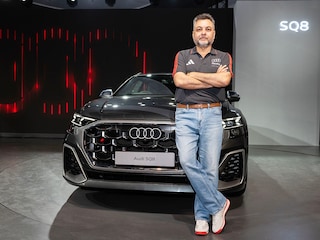
Audi India is bracing for a year of modest expansion, aiming to grow broadly in line with the luxury car market following a period of fluctuating sales.
After a robust performance in 2023, the German luxury car brand has faced declining sales over the past two years within an industry that remained largely stagnant, recording just two percent growth last year. Industry growth this year is expected to remain subdued again, hovering in the mid-single digits at best, tempered by currency volatility, global uncertainty and rising prices.
Speaking to Forbes India on the sidelines of the launch of the Audi SQ8, Balbir Singh Dhillon, Brand Director of Audi India, addressed the recent sales trajectory. He attributed the decline to several factors, primarily the 2020 strategic pivot to exit the diesel market in favour of petrol and electric vehicles (EVs). “We moved towards petrol and electrification when the industry was still largely diesel,” Dhillon says, adding that EV adoption “has not moved at the pace we anticipated”.
Despite the impact on volume, Dhillon remains firm on the decision. When asked if the decision was more apt for Europe and not for the Indian market, the head of Audi India says: “We are more than happy, we don’t regret that decision.”
Dhillon said the move allows for a simpler, more sustainable portfolio that is easier to service over the long term.
With over 80 models competing in a market of roughly 52,000 units, per-model volumes are thin, making portfolio simplification a necessity for after-sales sustainability, according to him.
Audi currently sells 10 models in India: Three sedans in the A series and seven SUVs in the Q series.
Other headwinds include significant depreciation of the rupee against the euro and a lack of new products.
To bolster its “brand shaper” portfolio, Audi launched the SQ8 in India last week at an introductory price of Rs 1,77,72,000 (ex-showroom). Positioning it as the “sweet spot” between the Q8 and the RS Q8, Dhillon says that the SUV is designed for the “self-driven” enthusiast who requires daily practicality.
The performance SUV is powered by a 4-litre V8 engine delivering 770 Nm of torque and sprinting from 0 to 100 km/h in 4.1 seconds.
But the model isn’t going to bring volumes for the brand. “This is not going to be a volume generator. It’s a brand shaper,” he adds.
(L to R) Balbir Singh Dhillon, India Head Audi India, Piyush Arora, MD & CEO Skoda Auto Volkswagen India and Ravi Shastri at the launch of Audi SQ8 car in New Delhi. 17th March, 2026.Photo by Amit Verma
The EV Game
Audi’s EV strategy remains a long-term play, currently comprising the Q8 e-tron, Q8 Sportback e-tron, e-tron GT, and RS e-tron GT.
Its current allocations in India are sold out, and the carmaker says it’s awaiting the next set of units under Audi’s global planning cycle.
“Given that the Audi e-tron range is priced above Rs1 crore, it naturally caters to a more focused and limited customer segment, yet the traction we have seen has been extremely encouraging,” Dhillon had said in an earlier conversation.
While the Audi boss noted that electrification has not progressed as rapidly as anticipated two years ago, the brand has focused on building an after-sales ecosystem.This includes 12 high-voltage battery repair centres and the integration of over 6,500 charging points via the Charge myAudi app.
Lauch of Audi SQ8 SUV car in New Delhi. 17th March, 2026Photo by Amit Verma
Top-Heavy Market
The luxury landscape in India is becoming increasingly top-heavy. Data shared by Dhillon shows that the C and D segments (cars priced above Rs75 lakh) accounted for 42 percent of the market in 2023. This had jumped to 49 percent last year.
“Almost half of the cars which are being sold are above Rs75 lakh,” Dhillon notes, suggesting a market driven more by repurchases from existing luxury owners than by first-time buyers. “The people already in luxury are repurchasing more than those entering it.”
That shift has been driven partly by a twenty-five percent increase in luxury car prices over the past five years, squeezing out new buyers.
Audi’s response is twofold: Maintain a spread across entry and high-end models, and build a parallel pre-owned ecosystem. Last year, the company sold nearly one used luxury car for every new one.
Once inside, customers tend to stay. “More than ninety-five percent luxury car owners don’t leave the segment,” Dhillon says.
Looking ahead, he highlighted several factors that could steer Audi’s future, including the many Free Trade Agreements (FTAs) that India has signed of late.
“We are waiting for the fine print of the India-EU FTA, which could provide the freedom to bring in more products via quota systems,” says Dhillon, adding that he’s equally bullish about the other FTAs, including the one with the UK.
The Audi India head is also optimistic about the Indian economy, citing the rapid creation of billionaires and the country’s low car penetration as indicators of massive untapped potential.