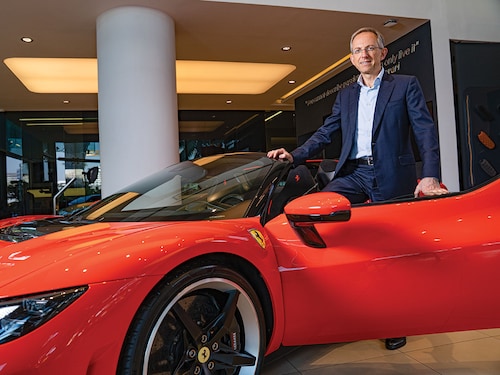
Benedetto Vigna is not your usual automotive CEO.
He took the wheel at Ferrari in September 2019 after a quarter century as a techie in the Silicon Valley. And he is emphatic that the making of a car cannot be left to engineers. What he does draw from his tech background is comfort with the pace of change in today’s world: He does not think it is too fast in automotive, despite the drive to electric. On that point, he says Ferrari has no intention of ever becoming a fully electric vehicle company. The Elettrica, which arrives in India this year, will be one of the things the company would do, alongside internal combustion and hybrids.
The Elettrica is not the only big thing happening to Ferrari in India, where the average Ferrari buyer is a decade younger than the average global buyer. This is the year, Vigna says, when Ferrari will put India in sharp focus with a far more direct presence than ever before. Edited excepts from an interview.
One of the countries I like most is India.
Q. Why is that?
Because I find that the people here are very spontaneous. Also, the Indian culture and Italian culture are not so different. When I was living in Geneva, my daughter was going to an international school and the best friends she had were from India.
Q. You have been a techie in the Silicon Valley. How do you find Bengaluru?
You have the same kind of people in Bengaluru as in Santa Clara. But—let’s put it this way—in Santa Clara, relationships are more transactional.
Q. You come from an interesting tech background. How is Ferrari, under you, finding its space in a world that is changing, where people’s priorities are changing, sensibilities are changing? About your industry itself, there is this drive towards electrification. How is Ferrari evolving with the times?
When you start in a high-tech business, such as semiconductors, usually within the first month, they start to talk about the strong cycle of the industry. In those industries you have a period of very good time and a period where things don’t go well. When you work in the semiconductor business, the landscape keeps changing at a very high pace, the technology and the product keep changing.
When you are in a luxury or automotive business, the speed of change is not so high. For me, this period of uncertainty that we live in—I don’t want to minimise it—is nothing new. In this business, that is the luxury business, the pace of innovation is not the same. It does not need to be the same. When you work in a luxury company like Ferrari, there is one dimension that is very important, which is heritage.
Heritage for a high-tech company is meaningless, it is a burden. In high-tech, you don’t care about experience. You make the best phone, the best AI chip, and the buyers can make the experience they want. Here, you also have to create a community that brings people together.
I lived through five technology transitions before coming to Ferrari. So, this is an additional technology transition. This is more difficult because you also have the infrastructure that must change. This was the story of the 3G to 4G transition. And 5G is the same story.
If you have a car with a combustion engine, or a hybrid, how can you think that you can make a full transition in 10 years? Any person working with technology would say this transition cannot happen in such a short time.
So we said, look, we will never have a transition to electric car. Never! We will have an addition. Today we are doing ICE, we are making hybrids, we also do electric. But we will lag electric. We never said, like other brands said, that we will go fully green. If you have a minimum of technology background, you will never say that. A few years ago, people said automotive companies will become tech companies with thousands of software engineers. That is an extreme. The reason why new automotive companies are acting faster is because they talk more about the product, less about the process.
In Ferrari, because of what we do on the racing side, innovation has always been important. Ferrari, you know, is a small company. It is not a 100,000-, 200,000-, 300,000-people company. When you work in those companies, it is more difficult to change the culture. It is easier for a new company, for a startup, to work on product innovation.
So, Ferrari has a unique opportunity. One, to be small, so things can change fast. Two, to be in the same place. Most of the people developing a new car are in the same place. When you are in the same place, decisions happen faster. In the history of Ferrari, innovation and technology have always played an important role.
My contribution is three things. One, I want the company to act faster and simplify the organisational structure. When I got into the company, there were nine layers in product development. Now we have five. So, number one is to flatten the organisation so that you can act faster in a world where uncertainty is dominating the speed of change and learning. Second is the Ferrari supply chain. Ferrari was used to working with companies in a range of 1,000 km from where we are. Now you will see more and more cars with technologies coming from all over the world.
When you work in semiconductors, there is one word that is known to everyone: It’s called Open Innovation. Open Innovation means you can innovate with the people in the company, but also with the people around you. So, for a person coming from high-tech, India, Japan, Taiwan, Silicon Valley, China… they are all, I would say, rooms of the same apartment.
Third, what I was told by some colleagues, is that the people have become more confident about innovation.
Q. It is interesting how you are making a distinction between the technology industry and the automobile industry, because these days we often hear the term “computers-on-wheels” being used to describe a car.
I’ll try to be more precise. If you want to make a car, you cannot make it only with mechanical engineers. You cannot make it only with electronics engineers. Often people forget that when you are in a car, the senses used to experience the car are not only the eyes or the ears, it is the full body. It’s not like a watch, where you interact with your eyes. You cannot enter the watch, but you enter a car and you experience it with all your body.
The difficulty of the automotive industry is not that cars are becoming electric. The difficulty of the automotive industry is the change. How to manage the change? If you are not used to change and you have to change, there is some kind of friction.
The point is not the electrification. The point is the change. It is much better to be in a place where everything is under control, right? It requires less energy. If many things are happening and the management is put under constant challenge, this requires energy. What is happening now is a good wake-up call and tells all of us in Europe and the US that you cannot go at the pace and speed that you have had for the last 20 or 30 years.
Q. But for you, it’s more complicated, because you have to manage the change when you have this background of heritage and luxury. You have to balance a lot of things.
Honestly, it’s much easier in a company such as Ferrari than in other companies. As I said, we are small. Number two, we are in the same place. Number three, the history of this company has been always to push innovation. Not many people know that Enzo Ferrari was not an engineer, he was a racer. And I think when you do innovation, it’s good to start from the client, not from the technology. Steve Jobs was not an engineer.
Q. Not at all.
When you are an engineer, you think too much about the technology and not too much about the client. I am also on the technical side and I don’t want to offend anyone, but that’s a fact.
When Mr Enzo Ferrari said he wanted to make a 12-cylinder car, everyone in Modena, the place where he was working, called him mad. Everyone said it will consume all the money, that it will run out of cash. After 80 years, we are still selling 12-cylinder cars.
What I want to say is that innovation has always been at the heart of Ferrari. And, I would say, innovation at the right time, because if you push too much innovation when the clients are not ready, it’s a waste of money. I believe what we are doing in Elettrica, I think it is at the right time.
At Ferrari we have something that is unique. We have a lot of innovation, a lot of ideas from the past that we can leverage. Technology is important, but so is heritage. But heritage does not mean that you just take this colour and you do the same colour in the future. No, you may do this colour in different ways. You may develop some features in the car that are unique, that are new. That’s the point. That’s not a burden. It’s a booster.
Q. Over the last decade, Ferrari has also worked very hard to have Ferrari clubs, and I think the company has been successful at that. Somebody was telling me that in the US, a lot of people buy a Ferrari but don’t drive it every day. So, they pay to have it stored, and they take it out on a race track every few months.
This has been rooted in the history of Ferrari: The story of every community and of the people who like to be part of the same community. In one of the books by Enzo Ferrari, he talks about the importance of having people feeling part of a community. I feel that in the last 10 to 15 years, the company has been improving the quality of the experience, on track and on the roads, that we deliver to people. Every year we have several events organised by the headquarters as well as by people in different regions.
Q. What about in India?
In India, we started in 2010. In 2026, we will start to give more relevance to all the activities we have in India. We can have two events. One is going to be around March. We will launch new cars and it will be the first time we launch directly in India. And we will have what we call the Ferrari Universe, or Universo Ferrari (an immersive exhibition showcasing the entire Ferrari world).
This concept of a community, to put the people together, to let them know each other, has always been important for us. Now we want to bring this more and more to India. We are very glad to have this interview, because we want to convey a clear message that India for us is important because of what we see, how the economy is changing, the attachment to the brand. You see that the country is taking a big step forward. And you see the way people are attached to our brand. So, we want to be more present here.
Also Read: We are looking to be the No 1 player next year: BMW India CEO
Q. Do you see a new class of buyers emerging in India? A new category of professionals, founders, entrepreneurs? Also, in the old money section, a new generation is taking charge.
Yeah, we see a new class of buyers. You see how the economy of India was 20 or 30 years ago and you see how the economy is now. I mean, you have a lot of new entrepreneurs, a lot of people in the digital or high-tech sectors that 30 years ago were not there. Twenty-five years ago, when I decided, as part of the other company, to invest in India, the salary of a person in India was lower than in Italy. Now it is much more here.
Q. But the per capita income is still low in India.
Yes, okay, because you have 1.4 billion people. But if I see how big the high-net-worth-individual population is here… I think this is really a good opportunity to give everyone a clear message that India, for us, is a key market. We believe in India. We believe also because the average age of the people in India is lower. The enthusiasm, the energy of Indians and the way they see the future is also important for our brand, because there is more willingness to do things. Do you know what is the average age of our clients in India? Can you guess?
Q. I would imagine it to be 38 or 40.
Forty. And that is for the existing clients. For new clients, prospective clients, the average age is 38. Do you know the average age of our existing clients in the rest of the world?
Q. In the 50s?
Fifty-one.
Q. What is the average age in China?
Forty-six.
Q. Are you willing to give us a sense of the size and scale of your sales in India?
Usually we don’t. What I want to say is that we believe there are a lot of opportunities in this country. Czech Republic, Poland… they are much smaller than you. And we are having a lot of growth over there. A lot of growth.
Q. Is this your first visit to India as the CEO of Ferrari?
Second time. So, don’t paint me like a person that never came to India.
Q. Not at all. In fact, the opposite. We are looking at you as a person who is very familiar with India.
Yes, I am very familiar.
Q. To recap, you have a lot of changes round the corner, not only globally but also in India. And you mentioned that we are going to see many of those changes in 2026 and I think Ferrari Elettrica is also coming to India in 2026.
I would say that you will see more and more direct presence of Ferrari in India. That’s a key point.
Q. What does that mean?
It means that we will come here, we will organise events directly, where we will show new products, we will show the universe of Ferrari. We never did this in the past. We want to be more present, not because the dealer did not do a good job, not at all. We are pleased with what they have done. But we want to put more focus. So, 2026 is the year when we want to put more focus on India with direct presence as a company. In 2026 we will also unveil the completely new Ferrari with electric traction.
Q. Financially, you have done very well. Revenues and profits have gone up, and margins have been increasing. As a luxury carmaker, you obviously see a world where there are people who have money to spend. Is it possible that in the next few years you will be able to become much more profitable?
We believe in co-prosperity. We could squeeze our suppliers. We could boost our profits more. But this would be a short-term view. If we do well, we need to make sure that the people around us do well. In an ecosystem, if one guy does well, too well, and he forgets about the people around him, it is not sustainable. No way.
I have been a supplier. The company I was working for was a supplier. You need to have suppliers that are engaged with you, so that they are in love and they propose new things. If they are not in love, they don’t propose new things. They just do what you tell them to do. So you lose all the brain power of the suppliers. And brain power is innovation. We need to make sure that the people around us get benefits. Ferrari, financially speaking, is not looking for a sprint race; it is looking for a marathon.
Q. Recently you had your Capital Markets Day where you presented, I think, a roadmap to 2030. According to you, what would be the tenets of long-term sustainable growth for Ferrari?
There are three things. One, we believe in horizontal product diversification. We have to keep pushing horizontal product diversification. Two, we want to make sure that people understand that when you think about Ferrari, it is not a sprint race; it’s a marathon. Then there is another important point for me. It is that if the client is happy, the shareholder is happy. The other way around may not be true, and we want to make sure people understand that.
Q. You know, it’s very curious to hear you say that Ferrari is not in a sprint race when your car here does zero to 100 in, like, 2.5 seconds.
That’s a good point. But you need to know where to make it (zero to 100 in 2.8 seconds)… on the track is okay. In the business, it’s not. Why are we so keen on sustainability? A few minutes before I was going up on the stage to talk about the Capital Markets Day, an investor told me, “Don’t let us waste our time with ESG.” And I said, “Maybe you should go out, because you will hear about what we do in ESG.” For a country like India, which is younger, it is important to show that Ferrari is doing something for the future.
In four years, we have cut emission of our plant and operations three times, and we aim to go down by 10 times by the end of this decade. We have been working with our suppliers to cut down their emissions: We aim to go down by 25 percent in absolute terms by the end of this decade.
I’ll tell you this funny story. There were some clients of Ferrari who, two or three years ago, were saying they would never buy Ferrari Elettrica. Now they are 45 or 50, they have kids who are teenagers and are more aware of the impact of the quality of the air and water. They are saying, “You know what! I will take one because I think it’s important for the new generation.” For Ferrari, to get the social licence, to be relevant for the new generation, it is important to show that we are serious and consistent on sustainability. We have to make sure that the new generation feels that we take care of them. To win the marathon, we have to take care of this.
Q. One last thing. How do you see the profile of the Ferrari buyer evolving globally and in India?
In India, as I told you, the clients overall are younger: 40. The new clients, prospective clients, are 38 years old. We see more and more people coming from the new fields: Digital entrepreneurs, the new rich, let’s say, new money. Globally, our clients are from 24-25 years old to 90 years old. The average age is 51, which has come down in the last few years. In some countries it is lower, such as in China, South Korea, Czech Republic, Poland. In some countries it is a little bit higher, but it is coming down.
A lot of our clients belong to what I call the eighth continent. Seventh is the digital one. Eighth is a continent where the people are spread all over the world, and they buy the car where they want. For us, it’s clear that India is a great opportunity. We want to do more business here directly, be present directly in India.
Yes, clearly. Well, thank you very much.