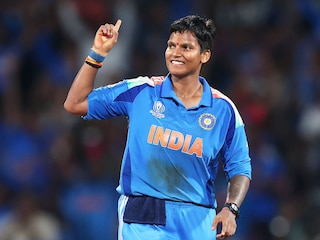
Years ago, Deepti Sharma was at Agra’s Ekalavya Sports Stadium to watch her brother’s net session when she caught the eye of then national selector Hemlata Kala by uprooting the stumps with a throw from the sidelines. “Who’s the little boy?” Kala asked her brother, Sumit.
Sharma’s hair, cropped above her neck, could still be mistaken for a boy’s, but it’s a question she no longer has to answer. Player of the Tournament in India’s victorious ODI World Cup campaign, the first cricketer to record a double of 200-plus runs and 20-plus wickets in a single edition of a World Cup, the highest wicket-taker in women’s T20Is and the key architect of a few Test victories too—the 28-year-old’s CV does all the talking.
Besides her on-field heroics, the World Cup win has also amped up Sharma’s brand equity. From three brands prior to the tournament, her portfolio now comprises 10, while her endorsement revenue has jumped nearly 4x.
“Earlier, people would think Deepti is just an on-field phenomenon, and doesn’t exist much outside. The World Cup has now balanced both sides,” says Sharma. But, she adds, being on the fringes before the tournament never really bothered her. “I always knew good things take time,” she tells Forbes India over a cup of masala tea. Edited excerpts from the exclusive conversation:
Not really. The only thing I focussed my practice on was hitting a single ball in many different areas, so that I can convert the ones and twos into boundaries. That helped me play my shots in different areas apart from those which were already my strengths. It gave me multiple options for a single ball.
Q. Why did you need to practice this in particular?
Because cricket is quite tough now. The fast bowlers we face come to you at different paces. There are quality spinners too. You can no longer play copybook, that is, hit according to the field placement. A ball bowled straight at the stumps might need to be steered on the offside. It took me some time to learn these improvised shots. For the past 4-5 months, whenever I’ve been home during the off-season, I’ve been practising these in my academy. Or, I’ve been taking throwdowns for these when we were in the middle of a series.
Q. The World Cup win didn’t come easy. There was a phase of three consecutive losses in the league stage.
Never easy for a team. We weren’t even sure if we would qualify for the last four. We had a meeting after the England match [the third consecutive loss]. It was a sad moment and I don’t think anyone slept that night. But we also felt that we needed to win just one match, and then the momentum would shift. Our next two matches were New Zealand and Bangladesh, so New Zealand had all our focus, and, as it would happen, everything clicked in that match. Also, we never lost faith in the team—we always said we were playing for the person standing to our right in a huddle; that way, each one was playing for the other in the team.
Q. In the semifinal against Australia, Jemimah Rodrigues played a match-winning knock of 127. She later mentioned that you were egging her on during a phase in which she was fatigued. What did the two of you talk about?
Usually, during a match, Jemi is the one egging us on—she punches fists, keeps talking. But she was quite exhausted that day and told me, “Deepti, keep talking to me so that my mind doesn’t wander.” She had played a few dot balls and sometimes that takes focus away from the next ball. So, I kept telling her that she was doing quite well, and that the finish line wasn’t far. I told her, “I’ll take the risks, but you stay till the end to finish the job. Agar tu rahegi, to hoh jayega, kyunki ek set batter ko ball toh football dikhne lagta hai [if you stay, then we’ll get it done, because a set batter starts viewing a cricket ball as clearly as a football].” The momentum shifted with our partnership, and that’s what we wanted; we were playing with the mindset that we were the last recognised batters, so we had a job to finish.
Q. The final wasn’t a cakewalk either. South Africa was playing well enough to stay in the game. When did you all realise that you could bring it home?
Before that, I’d like to add that we played the semifinal as the final because a match against Australia is always competitive. But, once we won that, we closed the chapter immediately and moved on to South Africa. In the final, we scored around 300 batting first and knew it would be a competitive total because there was no dew on the field; dew makes it easier for batters. When Laura Wolvaardt was batting, there was a bit of worry that the momentum might shift, but we tried to stay positive. During the drinks breaks, when we would gather, Harry di [captain Harmanpreet Kaur] would say, “Who knows if we will ever make it to a World Cup final again, and that too in India, so make this moment count.” When we got Wolvaardt’s wicket, we were fully charged.
Deepti Sharma (pictured here during a WPL match) was picked up by the UP Warriorz for a record Rs 3.2 crore.Photo by Deepak Malik / CREIMAS for WPL
Q. You took that wicket, and Amanjot [Kaur] took that catch, but she fumbled twice before holding on.
When that ball was in the air, I was confident of the catch, but when the fumble happened, sab logon ki saansein ruk gayi thi [we were all holding our breath].
Q. The final wicket was also yours.
It feels good when you get the last wicket, because that video gets replayed everywhere and you are reminded of the winning moment. But I didn’t celebrate before the catch was taken. Once that catch was taken, puri team toh alag dhun mein thi [the whole team was on its own trip]. It’s been said before, but worth repeating that it felt like the 1983 moment. We were so busy with celebrations that we didn’t even check our phones after the match.
Q. You are an all-rounder; you are expected to deliver with both the ball and the bat. How do you handle that pressure?
Mujhe pressure hi achha lagta hai [it is the pressure that I like]. Jab match mein takkar ka situation aata hai, tabhi mujhe achha lagta hai [I like it when a match is on a knife’s edge]. In the nets, I practice for situations where I have to score a lot of runs in a few balls, or when I have to deliver dot balls. If you play the final stages of a tournament, you will have to face many such situations; you need to know how to steer your thoughts then. If you are batting with a tailender, you need to know what to tell them so that they can rally with you and win the match. And you need to prepare for that.
Q. You’ve been equally good across formats: You’ve been key in India’s Test victories, you were the Player of the Tournament in the ODI World Cup, and recently became the leading wicket-taker in T20Is. How do you switch formats so easily?
I practise it a lot. We are told beforehand at which stage of the match we would be required to come in, and we prepare ourselves according to that. Like, in T20s, I know I would be batting in the last 4-5 overs. So, I use net sessions to practise specifically for those overs. I know that phase typically presents a tough scenario, so I build my mindset according to that. Jab challenge aata hai na samne, tab fight karne mein mazaa aata hai [when I am facing a challenge, it’s fun to fight].
Q. How do you see yourself: A batter who bowls or a bowler who bats?
I have always considered myself a batting all-rounder, but the role has now transitioned to a bowling all-rounder (laughs). I bowl a whole lot more.
Q. Lisa Sthalekar, the mentor for your WPL team UP Warriorz (UPW), had once said that, in a match, you never back away from a contest. How did you pick up this aggressive streak?
I have picked it up on my own through playing as well as watching a lot of games; I love watching cricket too. It has taught me that the ball is never dead and there is always an opportunity, you just have to be alert. For example, it’s not necessary that I can run a player out only when she is taking a run, I can run them out even if they step out to tap the bat without informing the umpire. I have picked these up through my experience of playing the game.
Q. You were a consistent performer even before the World Cup, but you were never talked about as much. Has it changed now?
Of course. A lot of things have changed, not on the field but off as well. Earlier, people would think Deepti is just an on-field phenomenon, and doesn’t exist much outside. But I’ve always believed that the better you are on the field, the more visible you will be. It might take time, but your on-field successes will eventually follow you outside. Yeh World Cup ke baad abhi dono cheez hi balanced hai [after this World Cup both sides have become balanced].
Q. Did it bother you earlier that the spotlight wouldn’t always be on you?
Never. I always knew good things take time, and bad things can happen in quick time. Believe me when I say I never bother about what others are saying about me. I am miles away from social media.
Q. Speaking about good things, you had a record bid in this year’s WPL—Rs 3.2 crore from the UPW.
I was watching the auction along with my family. I was seated in the outside room, and when there was a bit of pause after the first bid of Rs 50 lakh, the base price, my family went, “arre, only Rs 50 lakh”? I wasn’t very worried, because I knew about the Right To Match card [where franchises can buy back one of their players by matching the highest bid], and I explained it to my parents. “Aage bhi hoga [there’s more to come]”, I told them.
Money isn’t the big incentive for me here. I was very happy with the bid, because I got to play for UP, my home state, and I got back to the previous team with whom I’ve had a very good experience. In franchise cricket, that’s all you need.
Q. What does money mean to you?
Money isn’t my focus. If you play well, money will follow. But, yes, I can help my parents with the money, I hope my three-year-old niece takes up a sport and I can help her with that. Going forward, I also want to help girls who are in need.
Q. When you started playing, no one knew about women’s cricket. How do you see things change now?
You can see a clear shift in mindset. People who have never heard of women’s cricket have watched this entire tournament. I heard parents regretting not letting their girls take up cricket. When I went home after the World Cup win, the prevailing sentiment was that we’ll let our kids take up a sport. The imprint of the World Cup win will stay on for the next 10 years. And, if anything, will only improve—consider how BCCI is furthering women’s cricket with initiatives like pay parity even at the domestic level. This will encourage kids from small towns and villages to take up the sport. And platforms like the WPL that televise all the games will take women’s cricket to the farthest corners of the country.
Q. The T20 World Cup is scheduled in June. Has the team started preparing already?
Absolutely. After the ODI World Cup win, we all let our hair down a bit. But we are back now. We know there isn’t a lot of time, and pitches in England are different from ours, so our focus has shifted. Once the WPL ends, we will play a series in Australia—and we will play that series with the same focus as the World Cup.