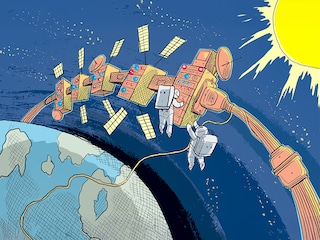
At the World Economic Forum in Davos on January 22, a previously far fetched proposition suddenly took centre stage: Building data centres in space. The discussion—rooted in the reality that AI’s explosive growth is overwhelming power grids, water supplies and permitting systems—came just weeks after Google CEO Sundar Pichai declared in December 2025, “We want to put data centres in space.”
At Davos, Elon Musk, Tesla CEO and founder of space technology company SpaceX, went even further, arguing that space will become the lowest cost place to run AI data centres within two to three years. “When you have solar in space, you get five times more effectiveness, maybe even more than that, than solar on the ground,” he said.
These comments have pushed what seemed “like distant science fiction even months ago” into serious commercial consideration, says Awais Ahmed, founder and CEO of Pixxel Space Technologies. But is it realistic?
Ahmed explains that the theoretical appeal of space-based computing is straightforward. “Orbit offers continuous, abundant solar power without atmospheric losses or day-night cycles. For AI workloads—particularly frontier scale model training—space provides not just clean and uninterrupted energy but also natural thermal management in a vacuum and freedom from terrestrial grid constraints,” he says. Together, he argues, these factors could help overcome the infrastructure bottlenecks that currently limit the efficiency and scale of advanced AI systems on Earth.
However, whether this vision becomes viable ultimately comes down to economics, not imagination.
Read More
SpaceX, Musk said at Davos, is on track to cut the cost of access to space dramatically. “Hopefully this year we should prove full reusability for Starship, which would be a profound invention,” he noted. “The cost of access to space would drop by a factor of 100… under $100 a pound easily.” That kind of price shift would fundamentally alter the economics of deploying compute infrastructure beyond Earth.
Yet, even as enthusiasm builds, critics argue that the idea remains premature, and glosses over key economic and technical realities.
A Gartner report, for instance, concludes that data centres will continue to thrive on Earth despite optimistic projections about orbital infrastructure. The analysis cites unresolved challenges around radiation protection, in space maintenance, scalability, debris avoidance and regulatory frameworks. Even allowing for lower launch costs, analysts say, space facilities cannot match the “performance of terrestrial facilities”, especially compared with grid connected, liquid cooled, nuclear-powered campuses.
Fundamentally, the report adds, semiconductor design itself would need to shift away from the industry’s traditional focus on sheer performance toward weight efficient and radiation hardened architectures tailored for orbit. And that assumes a steady supply of launch capacity and spacecraft engineered specifically for compute—neither of which is guaranteed at scale.