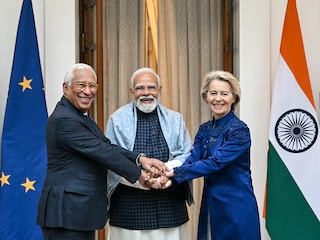
India and the European Union (EU) on Wednesday signed a historic free trade agreement (FTA), granting New Delhi duty-free access to European markets for over 99 percent of its exports by value. Prime Minister Narendra Modi and President of European Commission Ursula von der Leyen announced the conclusion of the trade and defence pact at the 16th India–EU Summit at Hyderabad House in New Delhi on January 27.
Besides boosting investment and innovation between the two partners, Modi said, the partnership “will facilitate easier access for our farmers and small enterprises to European markets, create new opportunities in manufacturing, and further strengthen cooperation across our services sectors.” Dubbed the “mother of all deals” by von der Leyen, the pact will give EU reduced tariffs on more than 90 percent of its exports to India; EU aims to double exports to India by 2032.
Experts suggest the true success of the deal will be measured by “tariff rationalisation and the dismantling of technical barriers”.
As the world’s second and fourth largest economies respectively, the EU and India represent a fourth of global GDP and a third of world trade. The agreement, finalised after 18 years of negotiations, arrives amid mounting tariff threats from the US and global geopolitical uncertainty.
For India to de-risk without deglobalising, deeper integration with the roughly $30-trillion OECD market beyond the US—anchored by the EU—represents the only viable path forward, says Ajay Shah, senior research fellow and co-founder, Xkdr Forum. “The EU–India FTA should therefore be seen not as a zero-sum exercise in balancing bilateral deficits, but as an instrument to lower tariff and non-tariff barriers, expand trade volumes, and embed Indian firms more deeply into European and global value chains.” Even as deficits continue to fluctuate, integration, productivity gains, and regulatory reform effects matter far more over the long term, he adds.
Shah adds that the India-EU FTA negotiations unfolded under intense geopolitical pressure, and both sides were negotiating from positions of “relative weakness.” “Any real optimism must rest on binding commitments: Meaningful tariff rationalisation, credible mutual recognition agreements, customs and standards reforms that improve utilisation, and institutional mechanisms—through periodic reviews and high-level fora like the Trade and Technology Council (TTC)—to resolve frictions,” he says.
The FTA spans the full economic spectrum, from core pillars like goods, services, and customs facilitation to forward-looking sectors such as digital trade and SME integration. For India, the deal represents a strategic pivot towards European markets at a time of heightened global protectionism and tariff uncertainty.
The centrepiece of the agreement is the immediate elimination of duties on 70.4 percent of tariff lines, which will provide an instantaneous competitive edge to India’s labour-intensive sectors like textiles, leather, gems, and jewellery. These sectors have been significantly impacted by high US tariffs and are grappling with EU import duties ranging from 4 to 26 percent.
The engineering sector, which ships $16.6 billion to the EU, is eyeing a larger slice of Europe’s $2-trillion import market. With tariffs as high as 22 percent being dismantled, the agreement provides a boost to India’s MSME clusters.
On the agricultural front, Indian tea, coffee, spices, table grapes, gherkins and cucumbers, sheep and lamb meat, sweet corn, dried onion, and other fruit and vegetable products will now enter Europe with preferential status. New Delhi has also negotiated protections for sensitive sectors, shielding domestic dairy, cereals, poultry, soymeal, and fruits and vegetables from European competition—a move that balances export ambitions with food security.
The deal throws a lifeline to India’s blue economy by granting 100 percent preferential access to EU’s $53.6-billion marine market. By ending tariffs that peaked at 26 percent, the FTA is set to provide a boost to exports of shrimp, frozen fish, and high-margin value-added seafood. India exports marine products worth $1 billion to the EU.
The EU will eliminate duties on 99.1 percent of trade lines which previously had tariffs up to 6.7 percent. India-made medical devices, surgical instruments, and precision lenses will now enter European hospitals and labs with a significant cost advantage. The agreement also grants Ayush practitioners access to EU member states where local regulations do not exist.
Beyond goods, India has secured commitments across 144 service sub-sectors including IT/ITeS, professional services, education, and other business services. The agreement ensures the “temporary entry and stay” of professionals, including contract service suppliers and independent experts.
The framework smoothens the movement for Indian employees—along with their spouses and dependents—working with EU-based subsidiaries across all service categories. Furthermore, the deal opens the door for Indian firms to bid on high-value contracts across 37 key sub-sectors, providing a direct pipeline for IT, business, and professional services to cater to European markets with ease.
New Delhi and Brussels have also agreed on a five-year roadmap to enable Social Security Agreements (SSAs) with all EU member states alongside provisions for “post-study work visas” for Indian students.
For European businesses
European industrial sectors stand to gain dramatically. India will progressively reduce automotive tariffs from 110 percent to 10 percent, with an annual quota of 250,000 vehicles. India’s car imports from the economic bloc have jumped fourfold between 2019-20 to $430.6 million in 2024-25.
“With over 95 percent of European OEM sales already locally manufactured, this FTA strengthens Make-in-India, expands consumer choice and opens reciprocal export opportunities for Indian OEMs,” says CS Vigneshwar, president of Federation of Automobile Dealers Associations (FADA).
Machinery and electrical equipment exports—currently valued at €16.3 billion—will see an end to tariffs up to 44 percent. Similarly, duties on chemicals (22 percent), aircraft and spacecraft (up to 11 percent), pharmaceuticals (11 percent), optical and medical equipment (27.5 percent), gems and pearls (up to 22.5 percent) will largely come to an end.
For European farmers, the FTA removes or sharply reduces tariffs that average over 36 percent on agri-food exports. Wine tariffs will be cut from 150 percent to 20-30 percent, while spirits will fall to 40 percent and beer to 50 percent. Processed foods, olive oil, fruit juices, and mutton will enter India duty-free, while tariff on sausages and processed meats will drop to 50 percent from 110 percent. Sensitive European agricultural sectors, including beef, sugar, and rice, remain fully protected. A separate negotiation on geographical indications (GI) will further safeguard traditional European products from imitation and unfair competition.
A step forward for defence
The deal includes a forward-looking Security and Defence Strategic Partnership, enabling closer cooperation on shared priorities, including maritime security, non-proliferation, disarmament, space, cyber threats, hybrid warfare, and counterterrorism. Since the defence pact has been signed in the context of significant geopolitical changes within the EU and Indian neighbourhoods, S Samuel Rajiv, research fellow at MP-IDSA, says the EU is undergoing significant changes in its defence, technological and industrial base and is looking to increase investments in its defence sector. This FTA gives India an opportunity to tap into those investments. “The EU is also following its own version of Atmanirbhar European defence industrial policy to cater to domestic defence requirements. It sees India and Japan as crucial for its goals,” he says.
India is only the third Asian country after South Korea and Japan to enter this kind of a security and defence partnership with EU. The pact helps India’s defence exports, with public and private sector companies starting to export ammunition to significant European countries.