Rs 200cr a day: Price of Iran war for India’s airlines
More than 750 flights cancelled; planes forced to take longer routes and spend more fuel which is becoming costlier
By
Prefer us on GoogleLast Updated: Mar 03, 2026, 16:57 IST4 min
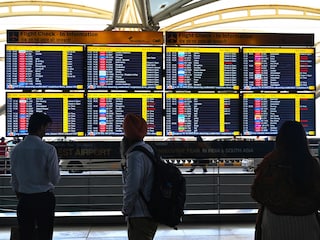
India’s airlines are losing Rs 150-200 crore a day as airspace closures over West Asia after the killing of Iran’s Leader Ayatollah Ali Khamenei on February 28 force aeroplanes to take expensive detours. This, along with the rising crude oil prices, bodes ill for the financial health of the airlines because a large part of their cost is fuel, more of which now must be burnt over the detours.
Their financial health is already weak. India’s aviation industry is expected to report a combined loss of nearly Rs 18,000 crore in the current financial year. The latest disruption could not have come at a worse time.
West Asia is a busy sector for India’s air carriers, especially its two largest—IndiGo and Air India—not only because a lot of people fly to the countries in the region but also because it forms the primary aviation bridge that connects India to Europe, Africa, and North America.
Within hours of the coordinated United States and Israeli airstrikes that killed Khamenei, Iran launched missiles and drones at Israel and Gulf countries hosting US military bases, including the United Arab Emirates, Qatar, Bahrain and Kuwait. Several West Asian states subsequently shut or restricted their airspace, triggering widespread flight cancellations across the busy global aviation corridor.
Limited flight operations resumed Monday night. However, rerouting and operational restrictions continue to weigh on airlines.
“We estimate that the industry is losing Rs 150-200 crore daily. This figure includes direct ticket revenue loss and a sharp increase in block time (fuel, crew, and maintenance) for flights that must take detours to avoid restricted regions,” Gagan Dixit, Vice President at Elara Capital, told Forbes India.
Some westbound services have attempted northern detours through Russia and Central Asia, these are geopolitically sensitive and operationally expensive.
Ashish Chhawchharia, Partner and Aviation Industry Leader at Grant Thornton Bharat, said the crisis had highlighted structural dependence. “Aviation is one of the most globally interdependent industries. The recent conflict in Iran, with the closure of the Iranian airspace, has disrupted airlines across the region and beyond. The Middle East corridor is particularly vital for India, serving as the bridge to Europe, Africa, and North America. Its closure has exposed just how reliant Indian aviation is on these transit hubs,” he told Forbes India.
“Airlines are attempting rerouting via Central Asia or southern detours over the Arabian Sea and East Africa, but these add two to four hours of flying time, increase fuel costs, and reduce efficiency,” he said.
ICRA expects losses to narrow to Rs 11,000-12,000 crore in FY27, supported by a recovery in domestic passenger traffic growth to 6-8 per cent. The agency has maintained a “stable” outlook on the sector while cautioning that geopolitical developments warrant close monitoring.
ICRA also reported that yields declined 2 per cent year-on-year in the first nine months of FY26. As of February 2026, 13-15 per cent of the industry’s fleet remained grounded due to engine failures and supply chain challenges, limiting capacity flexibility as airlines manage rerouting and longer block times.
Air India also faced operational complexity on long-haul routes during the airspace closures, while Akasa Air and SpiceJet suspended destinations in West Asia during the peak disruption.
Foreign carriers such as Emirates, Qatar Airways, Etihad, FlyDubai and Saudia also suspended operations during the airspace shutdown, stranding thousands of Indian passengers, Chhawchharia noted.
“Compounding the challenge, Pakistan’s airspace restrictions further constrain Indian carriers, forcing longer detours and reducing operational flexibility,” Chhawchharia said.
Pakistan continues to bar Indian aircraft from using its airspace under a Notice to Airmen (NOTAM) valid until at least March 23 this year. The restriction prevents Indian carriers from using the direct northern corridor for flights to Europe and North America.
First Published: Mar 03, 2026, 16:57
Subscribe Now