West Asia tensions send shockwaves through aviation
Airspace shut across key corridors, carriers suspend services, travellers left stranded at airports, and airline shares tumble as markets react to escalating regional conflict
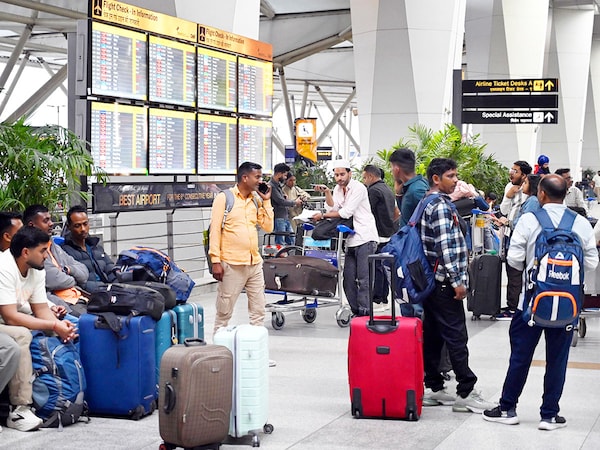
Passengers with their luggage awaiting information about their flights at the Terminal-3 Delhi airport after many flights cancelled due to airspace restrictions over Iran and parts of the Middle East on March 1, 2026 in New Delhi, India. Photo by Arvind Yadav/Hindustan Times via Getty Images
Airspace closures across West Asia disrupted global aviation between February 28 and March 2. Flights were cancelled, routes were diverted and passengers were stranded across major transit hubs. Indian airlines suspended Gulf operations, while Asian airline stocks fell as markets reacted to the conflict.
The disruption followed the killing of Iran’s Supreme Leader, Ayatollah Ali Khamenei, in coordinated United States and Israeli airstrikes on February 28. Iranian state media confirmed his death early Sunday. Iran responded within hours by launching missiles and drones towards Israel and countries across the Gulf that host American military bases, including the United Arab Emirates, Qatar and Bahrain. Explosions were reported near major aviation hubs such as Dubai and Abu Dhabi, forcing multiple countries to shut or restrict airspace and triggering widespread flight disruptions.
At least 72 flights were cancelled on February 28.
The airline later cancelled 203 flights, including 160 services on March 2 alone, according to information available on its website.
The cancellations affected routes linking Indian cities with destinations in West Asia, the Gulf region and parts of Europe.
“We are closely monitoring regional updates concerning Iran and its airspace. The safety and security of our customers and crew remain our highest priority. Our teams stand prepared to implement any necessary adjustments as the situation evolves. Customers are advised to check their flight status prior to departure. In the event of any impact, updates will be communicated promptly via registered contact details.”
Air India
The airline suspended flights to destinations across West Asia and diverted its Delhi–Tel Aviv service back to India after Israeli airspace closed.
Around 50 international flights were cancelled on Sunday, the Hindustan Times reported. Flights to North America will operate from Monday using alternative routings, although some Europe services remain cancelled, the report added.
“In view of the developing situation in parts of the Middle East (West Asia), all Air India flights to all destinations in the Middle East (West Asia) have been suspended. We remain committed to maintaining the highest standards of safety for our passengers and crew. We will continue to assess the safety and security environment for our flight operations and adjust operations proactively as required. Our teams will be extending all necessary support to passengers.”
“Additionally, select flights to Europe scheduled on 2 March 2026 have been cancelled, along with the scheduled return legs of AI117: Amritsar–Birmingham, AI151/AI152: Delhi–Zurich, AI157/AI158: Delhi–Copenhagen and AI114: Birmingham–Delhi,” the airline spokesperson told the Hindustan Times.
Air India Express
At least 55 flights were cancelled on February 28.
The airline extended the suspension of flights to Bahrain, Kuwait, Oman, Qatar, Saudi Arabia and the United Arab Emirates until March 2.
“Air India Express has extended the suspension of flights to and from Bahrain, Kuwait, Oman, Qatar, Saudi Arabia and the United Arab Emirates until 23:59 hrs IST (18.29 hrs UTC) on March 2, 2026. Impacted guests are being notified directly through their registered contact details. To support guests who had booked travel to or from the Gulf region up to February 28, for journeys scheduled until March 5, we are offering the option to reschedule travel to a future date without any date-change fees, or cancel and get a full refund to the original mode of payment,” the airline said.
SpiceJet
“Due to airspace closure in Dubai (DXB), some of our flights may be affected. Passengers are advised to check their flight status at http://spicejet.com/#status or contact our 24*7 Reservation Helpline numbers at +91 (0)124 4983410 or +91 (0)124 7101600 for assistance.”
Akasa Air
Akasa Air temporarily suspended flights to and from Abu Dhabi, Doha, Jeddah, Kuwait and Riyadh until March 2, offering passengers refunds or rescheduling options.
Airports in India
Airport operators also issued advisories warning passengers of schedule disruptions.
Thiruvananthapuram International Airport cautioned that certain international flights could face delays or rerouting.
Delhi’s Indira Gandhi International Airport said on March 2 that westbound international flights continued to face disruptions due to the evolving situation in West Asia.
“Due to the evolving political situation in the Middle East (West Asia), westbound international flights continue to experience disruptions and schedule changes. Passengers are advised to check the latest flight updates with their respective airlines before heading to the airport,” Delhi Airport said.
Passenger Impact and Stranded Indians
The disruption affected passengers across regional transit hubs:
More than 45 tourists from Gujarat were stranded at Dubai and Abu Dhabi airports after flight cancellations continued, BJP MP Hemang Joshi told ANI.
Several Indian travellers were also stranded across the UAE, according to media reports.
Badminton player PV Sindhu described a “tense and scary” situation at Dubai International Airport after an explosion occurred nearby following the airspace shutdown, PTI reported.
Government Response and Advisories
Authorities issued multiple alerts and assistance measures for Indian nationals in the region:
The Ministry of External Affairs released emergency contact numbers for Indian nationals in Qatar and the UAE (emergency contact information can be found at the end of the article).
Indian citizens in Syria were advised to avoid unnecessary travel.
The Cabinet Committee on Security, chaired by Prime Minister Narendra Modi, reviewed the situation on Sunday and directed departments to assist Indians stranded in the region, PTI reported.
State governments, including Karnataka, said they were coordinating with the foreign ministry to assist residents stranded abroad.
3,400 Flights Cancelled Across West Asia
Airspace closures across West Asia expanded rapidly after the escalation in hostilities. Flight tracking platform Flightradar24 said more than 3,400 flights were cancelled across seven airports in West Asia on March 1, with airspace across much of the region closed and GPS experiencing “severe” spoofing and jamming.
Iran shut its airspace through at least March 3 via a NOTAM (Notice to Airmen), an official aviation alert issued to pilots and airlines. Several countries, including Iran, Israel, Iraq, Qatar, the United Arab Emirates, Bahrain, Kuwait and Jordan, also closed or restricted airspace as military operations continued.
Airports in the Gulf region were directly affected. Iran launched missiles and drones targeting locations across the Gulf, striking airports in Kuwait, Dubai and Bahrain and causing damage. Debris from an intercepted drone targeting Zayed International Airport in Abu Dhabi killed one person and injured others.
Dubai International Airport and Dubai World Central–Al Maktoum International Airport suspended operations “until further notice”, according to Dubai Airports. “Emergency response teams were immediately deployed and are managing the situation in coordination with the relevant authorities,” Dubai Airports said, adding that four staff members were injured.
Regional airlines suspended services across their networks. Emirates said: “Due to multiple regional airspace closures, Emirates has temporarily suspended operations to and from Dubai. We are actively monitoring the situation and engaging with relevant authorities.”
Etihad Airways suspended departures from Abu Dhabi until March 1 afternoon local time, while Qatar Airways suspended operations through March 1 pending a safety review.
Oman Air suspended flights to Baghdad, citing regional developments.
Global Airlines and Airports
Airlines across Europe and Asia adjusted operations as closures spread across key transit corridors linking Europe, Asia and Africa.
The European Union Aviation Safety Agency (EASA) issued a Conflict Zone Information Bulletin on February 28 advising airlines not to operate in the airspace of Bahrain, Iran, Iraq, Israel, Jordan, Kuwait, Lebanon, Oman, Qatar, the UAE and Saudi Arabia, citing a “high risk” to commercial aviation.
“Given the ongoing military intervention, retaliatory actions against U.S. and Israeli assets in the region are likely to occur, introducing additional high risks not only to the airspace of Iran but also to that of neighbouring states hosting US military bases,” EASA said.
Lufthansa Group suspended flights to Tel Aviv, Beirut, Amman, Erbil and Tehran until March 7 and said it would avoid airspace across multiple countries in the region. Air France cancelled February 28 and March 1 flights to Tel Aviv, Beirut, Dubai and Riyadh, while British Airways cancelled services to Tel Aviv and Bahrain until March 3, Reuters reported.
Virgin Atlantic temporarily avoided Iraqi airspace and cancelled its London–Dubai service on Saturday, Reuters reported.
Turkish Airlines cancelled flights to several destinations in West Asia, including Lebanon, Syria, Iraq, Iran, Jordan, Qatar, Kuwait, Bahrain, the UAE and Oman, according to Reuters.
Pakistan International Airlines suspended flights to Gulf countries, including the UAE, Bahrain, Qatar and Kuwait, PTI reported.
Airports outside the region also issued advisories. London Heathrow said some flights were cancelled or delayed due to West Asia airspace closures, while Boston Logan International Airport warned travellers that flights to Dubai, Doha and Tel Aviv could be affected.
Asian Aviation Stocks Fall
Airline stocks across Asia fell on Monday, March 2, as markets reacted to the conflict.
InterGlobe Aviation, parent company of IndiGo, and SpiceJet saw their shares fall more than 5 percent as markets opened on Monday.
Shares in Singapore Airlines were down about 4.5 percent, while Australia’s Qantas and Hong Kong’s Cathay Pacific fell by around 5.4 percent and 2.8 percent respectively. Japan Airlines declined about 5.6 percent.
Other Asian carriers also dropped, including ANA Holdings, Air China, China Southern Airlines, China Eastern Airlines, AirAsia X, China Airlines and EVA Airways, with several stocks falling at least 4 percent.
Broader Asian equity markets also declined. Hong Kong’s Hang Seng Index fell about 1.6 percent, Singapore’s Straits Times Index dropped around 1.8 percent, and Japan’s Nikkei 225 declined about 1.4 percent.
Emergency Contacts for Indian Nationals
The Ministry of External Affairs (MEA) issued emergency contact details for Indian nationals affected by the disruption in West Asia: Doha, Qatar: +970592916418 Emails: repoffice@mea.gov.in | cons.ramallah@mea.gov.in Abu Dhabi / UAE assistance: Toll-free: 800-46342 WhatsApp: +971543090571 Emails: pbsk.dubai@mea.gov.in | ca.abudhabi@mea.gov.in