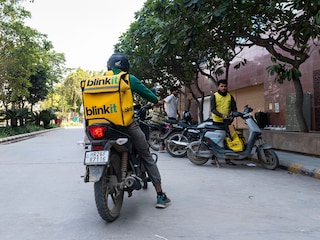
India’s decade-long quick-commerce boom has reached an inflection point. What began as a convenience-driven promise—groceries or a meal arriving at your doorstep in under ten minutes—has now become the centre of a debate about labour, safety, and the economics of speed.
The discussion reignited on 1 January, when Eternal CEO Deepinder Goyal—whose parent company oversees both Zomato and Blinkit—published a detailed thread on X explaining that the ten-minute model is enabled by dense dark-store networks, rapid pick-and-pack cycles, and sub-2-km routes rather than delivery partners racing against timers.
At the heart of the dispute is a simple question: is India’s ten-minute delivery model a feat of modern logistics, or a system that shifts the burden of speed onto vulnerable gig workers?
While quick-commerce players insist that ultra-fast delivery is the product of infrastructure and technology rather than human strain, worker unions and policy voices counter that the model compromises the safety, dignity, and fair compensation of workers.
Speed by Design, Not by Risk
In his New Year’s Day thread, Goyal sought to dismantle the idea that riders are compelled to dash through traffic. He argued that Blinkit’s promise hinges on dense, hyperlocal store grids and two-and-a-half-minute pick-and-pack cycles.He wrote: “Our 10 minute delivery promise is enabled by the density of stores around your homes. It’s not enabled by asking delivery partners to drive fast. Delivery partners don’t even have a timer on their app to indicate what was the original time promised to the customer.”
Paytm founder Vijay Shekhar Sharma also backed Goyal, voicing his opinion on X: “I wonder why people don’t get this? It’s like calling a car which is near you/10 mins away,” he said, adding that it is a modern tech-enabled assembly line for service delivery.
Read More
At the core of India’s ultra-fast delivery model lies a piece of infrastructure most consumers never see: the dark store.
These are small, tech-enabled micro-warehouses, closed to walk-in customers and designed solely for sorting, packing, and dispatching online orders at high speed. Every aspect of a dark store is engineered for efficiency—from inventory density to layout, to the warehouse management systems (WMS) that direct workers the moment an order arrives.
The entire space is optimised to handle large order volumes: fast-moving items are stocked closest to the dispatch zone, slower-moving ones deeper inside, and every SKU is tagged, scanned, and tracked to ensure real-time visibility across the supply chain.
Sanjeev Bikhchandani, founder of InfoEdge and an early investor in Zomato, also took to social media to express his views on the debate. He urged people to check how far dark stores are from home. “In my case it is 400 metres. That is how I get the delivery in under 10 mins. The riders are not forced to take risks. Very often they are on transport that cannot go at speed and very often they do not even go onto a main road,” he wrote.
This precision is key to fulfilling the 10-minute guarantee—because speed begins inside the store, not on the road. As a result, dark stores remain the most critical cog in the quick-commerce machine.
Also Read: Gig workers’ strike has little impact on new year’s eve
The Workers’ Rebuttal: Pressure, Pay and Safety
For many delivery partners, lived experience diverges from platform assurances. Year-end strikes across multiple cities amplified demands for better pay, safer working conditions, and a rollback of ten-minute targets.Riders say that even without visible timers, algorithmic task allocation, consumer expectations, and the fear of order throttling create implicit pressure to rush—with physical fatigue, stress, and road risk as predictable outcomes.
Devina Mehra, founder of wealth management company First Global, publicly spoke about unfair systems for gig workers in quick commerce. She wrote: “…people choose to work within unfair systems because the choice is between being unemployed and this; not between being employed in a fair system and this.”
News reports and on-ground accounts have also highlighted difficult conditions around dark stores and picking-and-packing routines, with platforms responding that process design prioritises safety over speed and that riders are not penalised for delays.
Meanwhile, the consumer baseline has shifted: industry tracking shows that ten-minute delivery is increasingly treated as a utility and competitive norm, raising strategic questions for FMCG supply chains and retail incumbents.
How can India balance the convenience of quick commerce with fair working conditions? Take the 2-min Forbes India survey and help find a solution