Thanks to Bedi’s contribution of ₹15 lakh, the five-match one-day international series was played as the ASMI Cup. Since then, the celebrity began batting for women’s cricket in whatever way she could. “I would slip in women’s cricket with whichever brand I was associated with, whichever company I could work with. I tried my best [to get sponsors on board], but people were not forthcoming that time,” she laments. “Today, there will be 100 sponsors. It’s easy when you have a World Cup win behind you and have stars in the making. In those days, nobody cared.”
Finally, a World Cup
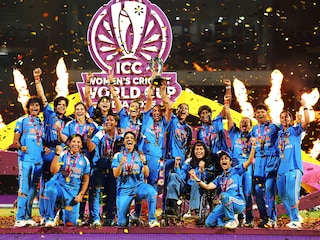
This November, India won its first World Cup by beating South Africa in the final, making it a watershed moment for women’s cricket. The final, which streamed on JioHotstar, saw a record 185 million tuning in, matching the figure for the 2024 International Cricket Council’s (ICC) men’s T20 World Cup final. The euphoria that ensued was justified, as a dream of nearly 50 years—the Indian women’s team first played a one-day international in 1978—finally came true.The result is an effort of several people who worked tirelessly behind the scenes. An army of former cricketers, administrators, corporates and Good Samaritans showed faith in the players at a time when women’s cricket wasn’t taken seriously, or people did not know it existed. They not only contributed money but also fought battles and biases in what remains a male-dominated sport.
Prior to Bedi’s benevolence, Arvind Prabhoo—now president of the All India Pickleball Association—had stepped in to ensure that a three-match one-day international series between India and New Zealand took place in 2000-01. Former India pacer and the then-WCAI secretary Surekha Bhandare approached Prabhoo’s father, Ramesh Prabhoo—a member of the legislative assembly from Shiv Sena and former mayor of Mumbai—asking if he could arrange sponsors for the matches. He directed her to his son, an ardent cricket fanatic.
In 1999, Prabhoo had organised three one-day matches in New York, San Francisco and Canada between an Asian XI and a World XI to “promote men’s cricket and as a commercial venture”. A couple of years later, shortly after returning from the US, an opportunity to contribute to the women’s game came walking.
“They wanted to raise ₹6 lakh for the three matches and the players’ accommodation. I paid it out of my pockets,” Prabhoo tells Forbes India. On seeing the team play, he was impressed. “I saw Jhulan Goswami comfortably bowling at 120 to 130 kmph, and Mithali Raj hitting boundaries with ease. I felt they were as good as the men’s team—not physically, but in terms of their technique and skills.”
From that day, Prabhoo began pitching in. He became a patron for women’s cricket and would travel with the team—from Aurangabad and Guwahati to Sri Lanka, Australia and New Zealand. In 2005, he was instrumental in sending the Indian team to South Africa 10 days before the World Cup so that they could acclimatise to overseas conditions. He shelled out ₹12 lakh for their stay, rented a house for them and hired a caterer to provide Indian food. In addition, he provided ₹10 lakh for their air tickets, an amount that the association later returned.
“It was always a fight to get sponsors for women’s cricket,” says Prabhoo. “Mandira brought a lot of backers, including a three-year apparel deal for ₹1 crore.”
Also Read: Why the World Cup win is a watershed moment for women’s cricket
Building Foundations
From an administrative point of view, Kulkarni—an Arjuna Award recipient—was at the forefront of bringing about a desperately needed revival. The association was not in a healthy state and was in dire need of money. “We were in the red when I took over as secretary in 2003. It meant finding sponsors not just for tournaments but also to clear off some earlier debts,” she explains.
For the first couple of series after she took charge, she sought help from friends in the media and marketing. In fact, throughout the WCAI days, they relied heavily on families and acquaintances to bail them out financially. “We would have sponsors here and there, but never a continuous flow. Mandira helped us a lot. Except for men’s sport, every other sport was struggling to get sponsors,” says Kulkarni, who represented India from 1976 to 1991.
Her chat with Bedi at CCI and the subsequent involvement of a few brands provided partial relief. But there were other monumental challenges to overcome. Bringing women’s cricket under the Board of Control for Cricket in India (BCCI) was one of them.
The International Women’s Cricket Council and the ICC were in the process of merging when Kulkarni became WCAI secretary. They mandated that women’s cricket must come under one board. “The BCCI refused… I don’t know why. Right from the beginning, it wasn’t keen on such an arrangement till Sharad Pawar became president,” she lets on. Eventually, women’s cricket came under the BCCI in 2006.
On the field, the big prize was the 2005 World Cup and Kulkarni, along with Prabhoo, was determined to ensure the team was ready to take on formidable opponents. Although the Indian players were competitive, they lagged in terms of fielding and fitness.
Working on these aspects required infrastructure: Grounds where players could dive without getting hurt, and facilities like a proper gymnasium. “It wasn’t possible for us to give them those,” Kulkarni rues.
Infosys had such amenities in Mysuru. The women’s team had played matches there previously, and the WCAI sought permission from the IT services company to use the facilities. After getting the nod, the Indian team trained there for two years. “It was a world-class training centre with a gym, swimming pool and a cricket ground. We also had a dietician who provided the girls with the nutritious food they required,” says Kulkarni. “N Narayana Murthy [Infosys founder] and Mohandas Pai [former board member at the IT company] were extremely supportive. Infosys did not charge us anything. Their human resources team helped the girls with personality development and team building too, so all the soft skills were honed there.”
India lost the 2005 World Cup final to Australia by 98 runs. However, Pai had announced prizes for players—such as for someone who takes five wickets or scores a century. Some of them received these amounts personally from him after the tournament.
Sudha Shah, who took over as coach of the Indian team in 2003, says it was a blessing that the team could go to South Africa 10 days before the event. She had insisted on a month-long fielding and fitness camp, with an eye on the coveted trophy. “Those sorts of things were unheard of in those days because there was lack of finance. The WCAI did not have funds and we had to depend on sponsors from series to series,” she says. “Women’s cricket did not get publicity.”
Support That Sparked Change
It was also in 2005 that Bedi arranged air travel tickets for the Indian team for an overseas tour via a sponsorship deal with a travel company. She had started hosting corporate events a couple of years earlier, and used her platform to raise whatever amount she could for women’s cricket. “Wherever I could get a corporate to come on board, even with ₹5 lakh, I would… it meant something because it was zero versus ₹5 lakh. We would take whatever we would get,” she says.Bedi, though, does not want credit for championing the cause of women’s cricket. “I just felt it was the right thing to do. I wanted to give back something to the sport,” she says, adding that people like Kulkarni and Prabhoo are the “true warriors”.
Shah and Kulkarni are glad that today, women cricketers who play for India travel business class (the domestic teams also travel by air), stay in five-star hotels, have contracts, get match fees and access to some of the best training facilities. In their time, there was none of this. They played purely out of passion and love for the game.
“We travelled unreserved everywhere—from Varanasi to Chennai—and sometimes in luggage compartments. If we lost a match, we had to travel back the same day, so invariably there were no reservations. We didn’t have the best of accommodation—we have stayed in classrooms and dormitories, and slept on bunk beds. But even when we sat next to the toilets or the doors on the trains, we had a lot of fun,” says Shah, who played for India from 1976 to 1991, including the country’s inaugural Test match.
Kulkarni agrees. “We didn’t get allowances at that time. We stayed in dormitories with common toilets and bathrooms. We carried our own food from home that would last us for a few days,” she reminisces.
There was no future in the game, and most players had to fight with their families to let them take up the sport. “A lot of parents did not allow their girls to play cricket. We would have to meet them and coax them into sending the girls for tournaments,” says Kulkarni. “Many had to give up the game because they had to start working,” explains Shah.
During her playing days, continues Kulkarni, of the 15 players in the squad, at least 10 were working with the Railways and three others in Canara Bank, which was trying to set up its own team. Later, it was Air India and Railways. “Today, they are able to sustain themselves and make a bit out of the game itself. Earlier, they had to do a job as well. That doesn’t happen now. You can see the mindset changing,” she adds.
In the absence of match fees, women cricketers in the earlier era had to pay from their own pockets to play for their state or country. For one of the international tours, the players approached the Maharashtra chief minister and requested funds so that part of the expenses could be covered. “From arranging the nets to booking train tickets or playing without a coach or manager, we have done it all,” says Kulkarni, a former India captain.
While playing domestic cricket, Shah would often visit the railway office to get a concession and then stand in queues to buy train tickets.
A New Era, but More Work Ahead
Women’s cricket has, of course, turned over a new leaf since it came under the BCCI almost two decades ago. Finance issues are a thing of the past. The BCCI’s clout on the international stage means there is both money and muscle power. Visibility has also improved—the ICC has stepped up marketing efforts, and tournaments like the Women’s Premier League (WPL), launched in 2023, have attracted greater brand participation. Social media has amplified player profiles further.“Earlier women cricketers were not even earning in hundreds. By the time I left, they were getting in tens of thousands. Now they are dealing in crores. It has become an aspirational sport now,” says Prabhoo.
The glitz and glamour are important, but Bedi sounds a word of caution despite the hype around the WPL. The opening ceremony saw a huge turnout with actors like Kiara Advani and Kriti Sanon performing along with Canadian rapper AP Dhillon. “But as the tournament progressed, there wasn’t much crowd. A lot of spectators came for the final again because there was no entry fee,” she points out.
Bedi, who was also at the 2020 T20 World Cup final in Brisbane, recalls the stadium being packed to capacity because American singer Katy Perry performed before and after the match. “There is always a lure of some big name, some attraction… that’s what gets people to the stadium. The tournament itself was not really written about,” she says. India lost that final to the hosts.
The turning point is the 2025 World Cup win, which is certain to open the floodgates for more benefits and bonanza for women’s cricket. “Something that we started 50-odd years back has finally borne fruit. Frankly, at that time, I didn’t expect it to get to such heights. I am over the moon. From this point, it’s just going to move forward,” says Shah.
The men’s game has become too predictable, feels Prabhoo, with almost every ball in the Indian Premier League, for instance, going for a boundary or six. Women’s cricket, in contrast, still has some excitement and reinvention. “The World Cup win will see a lot of women participation in sport. It’s a landmark win. It will give them the self-belief that one must possess to compete at the highest level and win. There’s a big difference between being a runner-up and being a winner,” says the president of the Prabodhankar Thackeray Krida Sankul. The sports complex in Vile Parle, Mumbai, is already seeing a rise in girls enrolling for cricket practice.
Kulkarni, who owns a cricket shop in Pune, is also witnessing a surge in girls taking interest in the game and parents encouraging them to consider cricket as a career. She highlights that all officials during the 2025 World Cup were women—a powerful signal that the ecosystem now supports opportunities beyond playing on the ground.
“There was a time when we used to say that if women’s cricket has to grow, India has to win the World Cup. This is just the beginning,” she says.
Yet much still needs to be done, especially at the grassroots. Fitness culture, for instance, must be strengthened at the state level, according to the stakeholders. Kulkarni believes match fees must also go up in domestic cricket. “This will help the girls invest in their game,” she says.
Shah reiterates that the expectations will be higher after the World Cup victory, and the women cricketers will have to match them. “Getting to the top is good, but staying there is even tougher. The girls will have to work much harder.”
For now, though, it is time to celebrate and look forward to sunny days. “Things happen when you are at the top… you will see the entire landscape of women’s cricket changing. It’s going to be an upward string from here,” says Kulkarni.