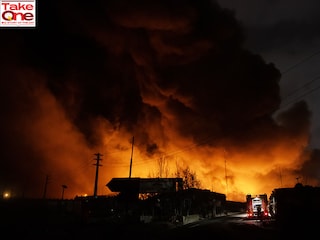
Investors and traders across Asia rushed to dump stocks on Monday as oil prices neared $120 per barrel amid escalating conflict in the Gulf region. Brent crude futures climbed to a high of $119.50 per barrel, surging around 25 percent in a day, the highest since the Russia-Ukraine war in 2022.
Benchmark indices Sensex and Nifty skidded nearly 3 percent during the day, while the fall in the rest of Asia was more severe. South Korea’s Kospi tumbled over 8 percent, Japan’s Nikkei slipped 7 percent, while Hang Seng in Hong Kong fell around 3 percent. As most countries in Asia are net oil-importing economies, equities are feeling the heat of a sustained rise in crude prices.
The India volatility index has also spiked nearly 18 percent during the day, indicating fear and worry among investors.
Some major producers have cut supplies, and fears of prolonged shipping disruptions have gripped the market due to the expanding US-Israeli war with Iran. Energy markets are particularly nervous because the crisis is unfolding around the Strait of Hormuz, through which roughly one-fifth of the world's oil supply normally passes, Reuters reported. Iraq and Kuwait have begun cutting oil output, adding to earlier liquefied natural gas reductions from Qatar, as the war has blocked shipments from the Gulf region.
“Crude oil prices, at this juncture, are encapsulating the ‘sum of all fears’ arising out of the significant escalation of the conflict in the Gulf region,” says Vinod Karki, equity strategist, ICICI Institutional Equities Research. He adds that a sharp rise in crude oil above the $100 per barrel mark would be an indication that severe oil supply disruption could continue for a longer period of time.
According to his estimates, if crude prices sustain above $100 per barrel, Nifty could potentially drop by 10 percent, while the price-to-earnings (PE) ratio could drop to 18 times, which is closer to the lowest levels in the post-Covid era.
“Consequently, the earnings yield could rise to 5.6 percent (highest in the post-Covid era), while the relative spread of bond yield over earnings yield could dip to 100 basis points, thereby increasing the relative attractiveness of equities over bonds (assuming bond yields do not spike),” Karki explains.
India imports more than 85 percent of its domestic oil needs, while around half of its crude oil imports currently transit through the critical oil corridor, the Strait of Hormuz (SoH). In FY25, Iraq, Saudi Arabia, the UAE and Kuwait (in the Persian Gulf) cumulatively comprised close to 46 percent of India’s annual crude oil imports, underlining the importance of this chokepoint for India’s energy security. Over 40 percent of India’s crude imports transit through the SoH.
The SoH is the only marine entryway into the Persian Gulf, with Iran on one side and Oman and the UAE on the other. It also links the Persian Gulf to the Gulf of Oman and the Arabian Sea in the Indian Ocean. The closure of this critical oil corridor will lead to a steep increase in oil prices, affecting all countries, even if oil is not imported from the Gulf region, as prices tend to be linked across markets.
Rising crude also impacts India’s economy as higher crude oil prices lead to higher retail prices of fuel products and increased inflation. The Reserve Bank of India (RBI) estimates that a 10 percent increase in global crude oil prices leads to a 0.15 percentage point drop in gross domestic product (GDP) growth and a 0.3 percentage point increase in inflation, but this is based on the old inflation series.
Factoring in the new series, Nomura economists see a much lower impact of 0.1 percentage point on inflation and GDP growth and believe that there is a buffer to absorb crude oil price shocks before the government needs to consider a fiscal hit to make up for under-recoveries.
“India’s major external sector risk, though, is not from its current account but from the capital account, where a sharp drop in foreign investment flows could lead to a large balance of payments deficit in FY26. A combination of a widening current account deficit (CAD) and foreign institutional investor (FII) outflows due to global risk aversion could accentuate rupee weakness,” they add.
Tailwind Risks for Emerging Market Economies
According to Fitch Ratings, a more sustained disruption to global energy supplies from the Gulf would result in a stronger US dollar and weaken the market for debt issuance, particularly for highly speculative-grade issuers. “Higher energy prices could put upward pressure on inflation, affecting monetary policy decisions globally,” it says.
These factors are likely to increase the effective cost of servicing and refinancing debt for emerging market sovereigns. “However, many have front-loaded a significant share of their planned foreign-currency issuance for the year in January-February, enhancing their flexibility against temporary market volatility,” Fitch Ratings adds.
It says that a further surge would widen India’s current account deficit and stoke inflation. It will also impact India Inc.’s profits, given the critical role of energy across sectors.
Brent crude prices had already risen over 10 percent in February to $73 per barrel on potential supply disruption risks due to heightened US-Iran tension. Oil prices have been drifting higher since mid-January, building in a higher geopolitical risk premium.
Additionally, India also imports about two-thirds of its liquefied petroleum gas (LPG), with the majority of it from the Middle East. LPG is primarily used for household consumption, with only 10 percent used as fuel in industries, limiting the impact on India Inc,” says Crisil Ratings.
In addition to crude oil and petroleum products, merchandise trade with the Gulf region consists primarily of basmati rice, fertilisers and rough and polished diamonds, as well as some capital goods and spices. Furthermore, various service sectors, including airlines and travel operators, also have significant direct and indirect exposure to the region.
Meanwhile, a rise in crude oil prices will benefit upstream oil companies because it translates to more revenue, while costs are fixed.
“Besides the Strait of Hormuz, the Red Sea route via the Suez Canal is another critical shipping lane in the Middle East, extensively used for global merchandise and crude oil trade, connecting Asia with Europe, North America and North Africa,” says Crisil Ratings.
Although trade through the Suez Canal has declined significantly over the past 15-18 months following the Houthi rebel attacks, it remains substantial. Any major disruption to this shipping route, as a potential domino effect of the conflict, could further impact crude oil prices and increase shipping time and cost, and will warrant close monitoring.
Asia’s high-income economies, which heavily rely on commodity imports, are particularly vulnerable to the direct economic fallout from the conflict. Japan, South Korea, Taiwan (China), Singapore and Hong Kong import more than 80 percent of the energy they consume domestically.