More than two decades before India’s historic win at the 2025 Women’s ODI World Cup, actor Mandira Bedi quietly batted for the sport. Making optimum use of her newfound popularity as an anchor-broadcaster after the 2003 Men’s World Cup, she persuaded corporates and brands to sponsor tournaments and encourage women’s cricket. At times, she even diverted her earnings to promote the game.
The 2003 World Cup was a turning point in my career. Cricket is still a male-dominated sport and there was no room for women in broadcasting in those days. But I got acceptance by the end of the tournament. When I came back to India after the World Cup, everybody knew me by my name. Until then, I was the characters that I played on screen. Cricket gave me so much… it made me an anchor, a master of ceremonies, and it made me host events. I wanted to give something back; I wanted to do something for the game.
More than two decades ago, I had gone to the Cricket Club of India [in South Mumbai] for an event. The Indian women’s cricket team was playing a match. And I just went into the pavilion—like you go in for a cold call—and said, ‘Hi, I am Mandira… what tournament is this?’ And the first person I met—Shubhangi Kulkarni, former India player and the secretary of the Women’s Cricket Association of India—explained that India was playing against New Zealand. I continued, ‘How can I help and what can I do for women’s cricket?’ Shubhangi shot back: ‘Oh my gosh, how much time do you have and where can you start?’ That’s how it began.
Q. What were some of the issues ailing women’s cricket?
There were no funds, no visibility and no attention from spectators; there was nothing coming towards women’s cricket. The men’s sport was set—it is cash-rich, visible, seen, loved—and people have been crazily passionate about it for years. I knew the women’s game existed and I knew the team. But where could one read about it or know about it? There was nothing anywhere. In fact, even if there was a World Cup or a big tournament, there wouldn’t even be a two-by-two-inch space in a newspaper.
During our chat, Shubhangi told me the West Indies were scheduled to tour India and the association didn’t even know if it had the money to host the team. Imagine the shame! There’s an upcoming series, but we don’t know whether the tournament will happen because we don’t have the money.
Q. What did you do? How did you help?
It was after the 2003 World Cup and a lot of brands were approaching me. A lot of work was coming my way. ASMI, a diamond jewellery brand, wanted to sign me as their brand ambassador. I told them: ‘I’m keen to do this, but I want all my funds to go to the Women’s Cricket Association because I want the series against the West Indies to take place’. It eventually did, and it was called the ASMI Cup.
Q. What was the amount?
It was ₹15 lakh.![]()
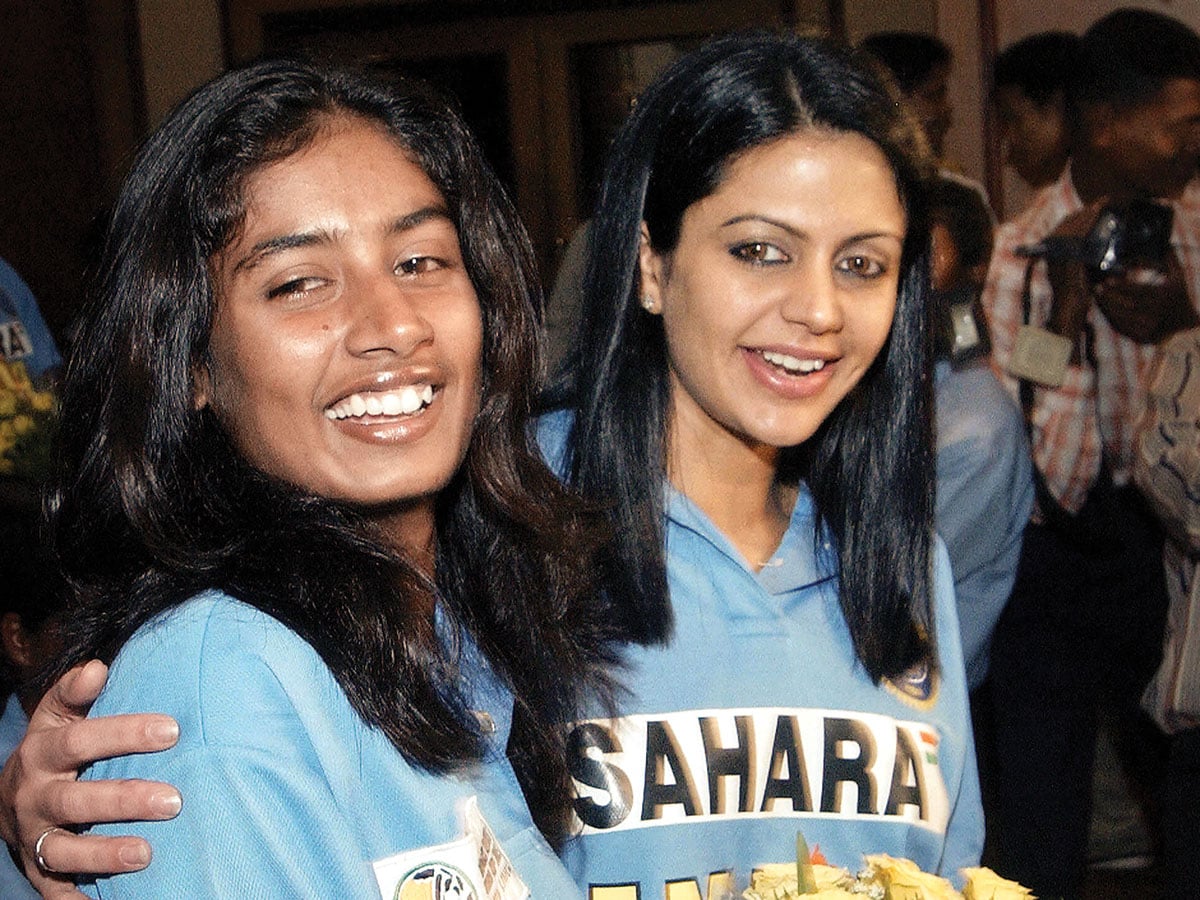
Mandira Bedi with then-India captain Mithali Raj (left) in 2005
Photo by Sebastian D’Souza / AFP
Q. Did you watch the series? How was the experience?
Yeah, and how much attention did it get? Nothing. I remember going for one of the matches to Eden Gardens in Kolkata, and fewer than 100 people turned up. That too because I think they opened some stands for free for schoolchildren. It was sad. There was so much ignorance about women’s cricket. Even if I told my friends that I was travelling with the team to Sri Lanka, they would ask, ‘Oh, there’s a women’s cricket team? Can we play?’ People had no clue, no idea.
Also Read: The unsung champions behind the rise of women's cricket in India
Q. How did you go about promoting the game?
I would slip in women’s cricket with whichever brand I was associated with, whichever company I could work with. However, people were not forthcoming at that time. Now if you say women’s cricket, there will be 100 sponsors. It is easier when you have a World Cup win behind you, and you have got stars in the making. At that time, nobody cared.
Q. You also helped sponsor air tickets for the Indian team for an international tour in 2005.
Yes, that was through another sponsorship deal. When attention came my way recently that I did this for the game, I didn’t know what to say. At that point, I just felt it was the right thing to do. Of course, there were people who have done so much more—Shubhangi and Arvind Prabhoo [he contributed huge sums from his own pocket], for instance. They are the true warriors. I was an outsider in that sense. But whatever I could do, I did. From 2003, I began hosting corporate events. So wherever I could get a corporate to come on board, even with ₹5 lakh, it would mean something, because it was zero versus `5 lakh. We took whatever we got.
Q. After the 2025 World Cup win, people have suddenly discovered what you did two decades ago. Why didn’t you speak up then?
I find it very embarrassing, that’s why. If you see my social media, I haven’t posted or reposted even one message about this. I just feel I didn’t do it for attention. I didn’t do it to be seen as doing the right thing. It was the right thing to do at that time. Even now, when people ask me about my charity work, I tell them I don’t speak about it because I don’t call it charity. I do it wherever I feel that my voice can help in any way.
![]()
Q. Isn’t it ironic, because when you became anchor-broadcaster for cricket matches, you were dismissed as ‘eye candy’? You also had to deal with sexism.
Of course, people are going to say these things when they’re seeing something they’ve never seen before—in terms of a woman being on a panel. One newspaper wrote about what I wore during the tournament… and then it moved from my clothes to what I said. When you are the first to do something, you will always have it the hardest because you are under the greatest amount of scrutiny. People will hear every word of what you say and catch every mistake that you make. There are a billion people watching cricket, so there is a little bit of stress, baggage and nervousness in your head. And I was not getting much acceptance from my left and right [on the panel], who also felt that I shouldn’t be there either. There were times when I would ask questions and I wouldn’t get replies. People would just stare at me and say whatever they wanted to… as if I was just a spare part on the show.
It took a lot of resilience and hanging in there. At the end of every pre-, mid- and post-match show, I would put my head down and cry. I would wonder, ‘What am I even doing here?’ But Sony [the broadcaster] really supported me. They told me you are not an expert, analyst or commentator… you are just a presenter, go out there and have fun. And it was a switch in my head—from one week of feeling unaccepted by people around me to saying, you know what, ‘I’m here to stay’. They need to accept me. After that, if I asked a question and they wouldn’t answer it, I would say, ‘Sir, I asked you this question’, and they would have to answer it. The cameras were on. I learnt a lot on the job.
Q. What is the significance of this World Cup win?
It is the turning point for the sport. It is the one thing that is going to make all the difference. The players have become household names. To see the players performing the way they did, the attention was inevitable, but I hope it sustains. I don’t know whether they will ever get the same kind of attention as men’s cricket does, but I hope we’re halfway there or three-quarters of the way.