Centre introduces VB-G RAM G Bill amid changing rural employment dynamics
Union Budget allocations have fallen, as fewer families complete 100 days of guaranteed work under MGNREGA
By Samreen Wani
Last Updated: Dec 16, 2025, 17:37 IST1 min
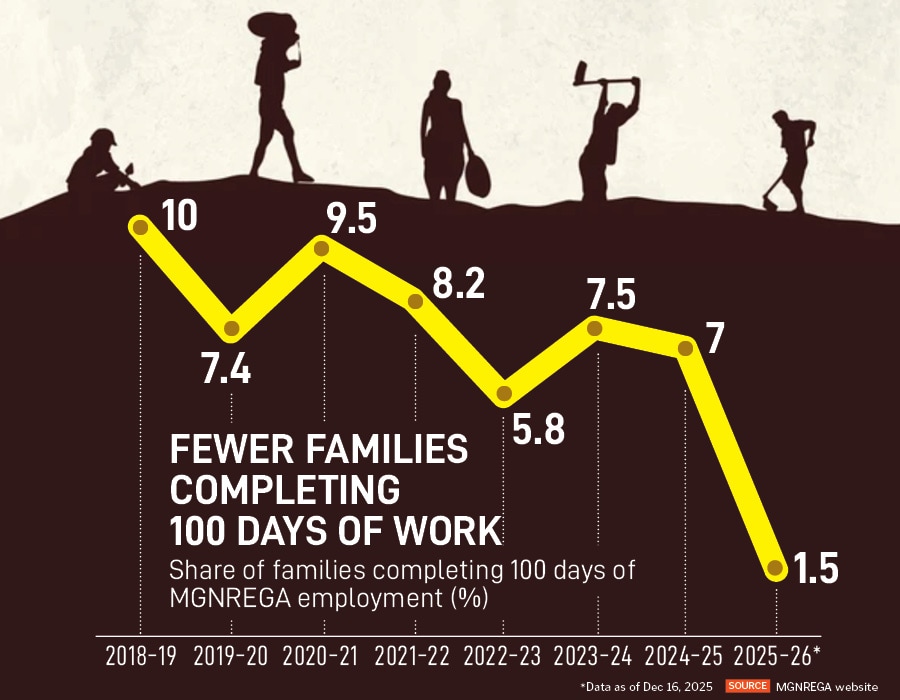
As the Centre moves to replace MGNREGA with the VB-G RAM G Bill 2025, a Forbes India analysis shows a sharp decline in families completing 100 days of work (guaranteed by MGNREGA), amid a post-pandemic drop in fiscal allocations for the scheme.
According to government data, the share of families completing the existing 100-day quota has been on a downward spiral. The share peaked at 10 percent in 2018-19 (FY19), before dropping in the subsequent year. However, as rural distress intensified due to the Covid-19 pandemic lockdowns and demand for MGNREGA work increased, the share picked up in FY21 to 9.5 percent. MGNREGA acts as a fallback option for distress-driven unemployment in rural areas and is seen as a crucial safety net during economic downturns.
From 7.5 percent of households completing the quota in FY24, the share has dropped to 1.5 percent as of December 2025, its lowest in the last eight years. States such as Maharashtra, Kerala, Odisha, Chhattisgarh, Tripura, Jharkhand, Himachal Pradesh, Andhra Pradesh, Sikkim and Uttar Pradesh, however, show higher shares of families completing 100 days of employment under the scheme.
The VB-G RAM G Bill proposes to increase the number of days of guaranteed work to 125, from 100 days.
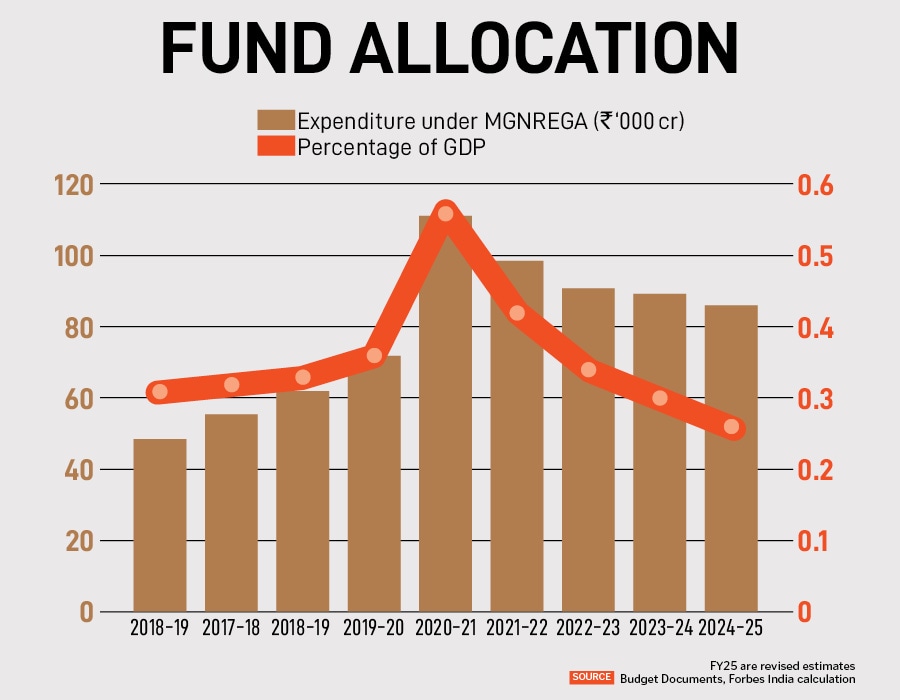
There has been decreasing budget allocations towards the scheme. Documents show MGNREGA expenditure has dropped to 0.26 percent of Gross Domestic Product (GDP) in 2024-25, from a pandemic-era high of 0.56 percent in 2020-21. In absolute terms, revised estimates for FY25 peg spending at Rs 86,000 crore, substantially lower than the Rs 1.1 lakh crore spent in 2020-21.
As the economy recovered and urban opportunities resumed after the pandemic, the government has progressively reduced MGNREGA allocations and expenditure. From about Rs 98,500 crore in 2021-22, spending fell to Rs 90,800 crore in 2022-23 and Rs 89,200 crore in 2023-24. Allocation for the ongoing fiscal year remains unchanged at Rs 86,000 crore.
The new Bill also introduces a fundamental change in funding:Moving from a model where the Centre bore 100 percent of funding to a 60:40 cost-sharing ratio with states, except for certain special category states.
First Published: Dec 16, 2025, 18:06
Subscribe Now