EV market is where auto industry was 4 decades ago: Maruti Suzuki
Adoption won’t accelerate until infrastructure and confidence are built, says executive
Last Updated: Dec 15, 2025, 13:51 IST2 min
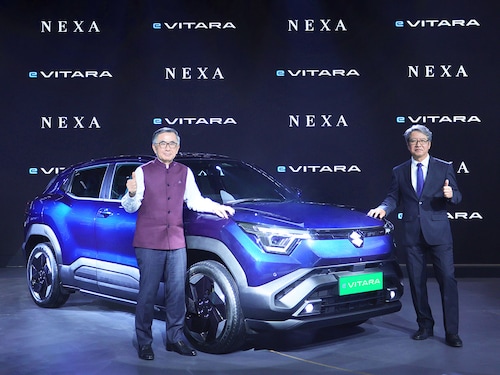
Electric vehicles (EVs) in India occupy the same uncertain space that passenger cars did four decades ago—visible on the horizon but barely an industry—according to the country’s largest carmaker, Maruti Suzuki, which will start selling its first EV, the eVitara, in the country next year. It is already being exported.
When Maruti entered the market in the early 1980s, it found no supply chain, no service network, and little consumer trust. It spent years building all three. The company now believes the EV transition demands a similar, ground-up construction project.
“At that time there was no industry. We created it,” Partho Banerjee, Senior Executive Officer for Marketing & Sales at Maruti Suzuki, said at a media roundtable.
He said that for EVs, consumers have concerns about range, charging infrastructure, and after-sales service. “EV penetration is low because confidence is low. The ecosystem has to come first.”
Maruti is spending heavily to make that ecosystem real. The company has installed 2,000 exclusive charging points across its sales and service network. Its nationwide network is being retrained to handle electric drivetrains and software-led diagnostics, and the company is preparing for a service model in which breakdown support may matter far more than routine maintenance, which is anyway lower in the case of EVs.
It is also offering an assured buyback programme, Battery as a Service (BaaS), and a subscription model.
Also Read: Auto rebound faces new roadblock as Mexico slaps tariffs
The barrier now, he argued, is consumer psychology. Few households are willing to make an EV their primary vehicle, and charging anxiety remains pervasive. “Unless customers believe they can charge anywhere and that we stand behind the product, adoption won’t accelerate,” he said. “Confidence takes time.”
Price remains another constraint, even as the government has already incentivised EVs through tax breaks. EVs benefit from a 5 percent GST rate compared with 40 percent for large ICE models, and “now it’s for the OEMs to do the work—educate the consumer and build the ecosystem”, said Banerjee.
He said that since the battery makes up around 40 percent of the vehicle cost, car prices will come down once batteries start getting cheaper.
Segment dynamics are shifting as well. The company chose an SUV for its first EV despite being a proponent of small cars. “We needed to increase our market share in SUVs, and that category is growing because of an unusually high number of launches there.”
Maruti has already shipped 10,000 eVitaras for export, with domestic volumes still under review as the market adjusts to GST 2.0 and upcoming fuel-efficiency norms.
Maruti’s pre-GST forecast for the auto market was 5.5–6 million annual car sales by FY30, of which 13–15 percent were seen as EVs. With GST 2.0, this will now have to be reassessed next fiscal year, according to Banerjee.
The company plans five EVs by FY30, including the eVitara, but said it won’t commit to a penetration forecast, calling the landscape too fluid.
First Published: Dec 15, 2025, 13:56
Subscribe Now