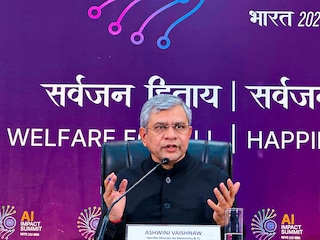
India plans to add another 20,000 graphics processing units (GPUs) under the IndiaAI Mission, taking the total available compute capacity beyond the existing 38,000 GPUs, Union Minister for Electronics and Information Technology Ashwini Vaishnaw said at the India AI Impact Summit 2026 in New Delhi on Tuesday. He explained that the expansion is aimed at strengthening the country’s artificial intelligence (AI) infrastructure and supporting wider access to computing resources.
More than 38,000 high-end GPUs have been onboarded under the mission and are available at around Rs65 per hour, which the minister claimed is about one-third of global costs. Vaishnaw indicated that the next phase of India’s AI strategy would focus more on design, research and development, moving beyond infrastructure creation towards building solutions tailored to domestic needs.
He said investments linked to AI could exceed $200 billion over the next two years, including around $90 billion already committed, with capital flowing across infrastructure, energy and application layers.
“We are also seeing huge investment interests in the infra and energy layers,” he said, adding that India’s clean power capacity provides an advantage. “About 51 percent of energy of power generation capacity is from clean sources. And that is one big advantage that India has.”
The government is also in discussions with several large companies about further investments in AI infrastructure, though names cannot be disclosed due to confidentiality agreements, he said.
AI Mission 2.0
Vaishnaw said the government would soon announce AI Mission 2.0 with a focus on innovation, research and expanding shared computing infrastructure. He added that the first phase had demonstrated the vision of democratising technology by making AI compute accessible beyond large corporations.
“In India, we have been able to provide AI compute to a large section of our population. And that's one big differentiator,” he explained.
Read More
The minister also said that India was working with industry and academia to manage the transition to AI-driven technologies, focusing on reskilling existing workers, building a new talent pipeline and preparing future generations. “Whenever any technology transition happens, it has to be managed jointly by the industry, academia and the government,” he said.
Indian law for global tech firms
Responding to a query on regulation, Vaishnaw said global consensus was emerging around responsible AI development and governance, and India is engaging with around 30 countries on collaboration and policy frameworks.
He emphasised that global digital platforms operating in India must comply with the country’s constitutional framework, referencing the Digital Personal Data Protection Act (DPDP), which sets rules for how companies handle personal data.
“Netflix, Meta or any other company will have to work under the constitutional framework of the country they are operating in. Regarding the cultural context, they have to operate in the country,” said Vaishnaw. He added that the same principle applies globally, stating that companies must comply with the laws of the jurisdictions in which they operate.
Deepfake Regulation
He also called for stronger action against deepfakes, particularly to protect children and vulnerable users, adding that this was part of the DPDP Act, passed in 2023, which includes provisions requiring parental consent for processing children’s data and placing restrictions on tracking and behavioural monitoring of minors online. “We need much stronger regulations on deepfakes and we need to create a consensus in Parliament,” he said, adding that age-based protections for children would be necessary.
Vaishnaw further stressed that copyright protections must also evolve alongside AI technologies. “Copyright is also important; we do believe that content creators must get dues for the content they create. We believe in fair distribution of revenue, and we are in dialogue with the platforms,” he said.
Positioning India as a "global digital leader", the minister said: “India has always given knowledge to the world… today digital public infra is being used by many countries and we are not asking for any royalties from countries using them."
The India AI Impact Summit 2026, being held in the national capital from February 16 to February 20 at Bharat Mandapam, is a flagship government event aimed at positioning India as a global hub for artificial intelligence development.
The first day saw significant crowd management challenges, with visitors reporting long queues, delays in entry, confusion around access points and shortages of basic facilities such as drinking water. Some exhibitors also said they were unable to enter the venue despite having registrations.
Many attendees took to social media to share their experiences, posting videos and images showing large crowds outside the venue, participants waiting for hours, and congestion near entry gates, particularly during security restrictions linked to the prime minister’s visit for the inauguration.
Vaishnaw apologised for crowd-management issues and said a dedicated team had been set up to address operational concerns and resolve issues quickly. “If anybody faced any problems yesterday, my apologies for that… we are working very hard,” he said.