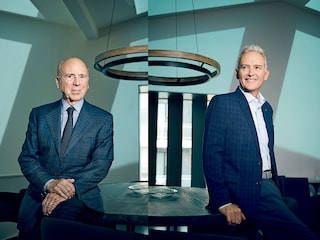
“Our compensation structure is one of the key elements of our success,” says Bill Rhodes, chair of the board since 2007 and AutoZone’s CEO and president from 2005 to 2023. “There are very, very few companies that are still 100 percent stock options in their long-term incentives. That’s what we are with our senior leadership team.”
Following a 2006 accounting rule change requiring companies to record options as expenses on their income statement, many S&P 500 companies have favoured compensation packages with restricted and performance-based stock units (grants of stock with no exercise price) over stock options (the right to buy a stock at the price on the date it was awarded). But AutoZone stayed the course and has granted options awards to eligible employees every year for the past 25 years equal to 0.9 percent of its total shares outstanding. Executives can also elect to take 25 percent of their annual compensation in AutoZone stock. “Our people want the risk. They want the leverage that comes with stock options,” says Rhodes, who has netted over a half-billion dollars exercising options and selling the stock (before taxes).
As it’s grown, AutoZone has restricted eligibility of stock options awards to about 400 higher-level employees, down from over 38,000 in the late ’90s. Today, store managers who drive AutoZone’s retail sales are incentivised with cash bonuses based on sales quotas. Store hands are supposed to ask people if they need help within 30 seconds of a customer walking into the store. They perform routine maintenance, like changing batteries or installing wipers, at no cost and on site. Hit your targets and drive sales and you’ll be compensated for it. Or better yet, one day you may end up in corporate—which means stock options whose value only seems to go up.
Employees can also buy up to $15,000 in AutoZone stock annually at a 15 percent discount to market price, through an employee stock purchase plan. The idea is to keep the sales force aligned, invested in AutoZone’s future and motivated to sell, sell, sell.
At corporate, the mantra has been buy, buy, buy back its own stock. AutoZone has purchased $38 billion of its shares since 1998 through May 2025, reducing its outstanding share count by over 90 percent from 152 million to 16.7 million as of June. (Nineteen ninety-eight is also when it started limiting stock options.) The company has bought back more shares over time (155.5 million) than it originally had outstanding (152 million). How is that mathematically possible? It’s because of the dilution from all those stock options the company awards.
The model has proven durable, thanks to AutoZone’s earnings moving in only one direction. Since 1987, revenue has increased every year (growing 11.5 percent annually), while operating income ($3.3 billion last year) and net income ($2.6 billion last year) have increased in all but three years. The company has been disciplined in its capital expenditure, opting for slow and steady earnings growth over breakneck expansion. It helps that the auto-parts industry cruises through recessions, as cash-strapped drivers opt to fix rather than replace their cars. “If you put financial engineering on top of a bad business you’re just going to go out of business faster,” Rhodes says. “If you have a really good business, putting financial engineering on top of that can optimise performance, or as I sometimes like to say, put it on steroids.”
But to keep its well-oiled machine chugging, AutoZone needs to keep growing. It holds $9 billion in long-term debt on which it must pay interest ($450 million last year), and it has accelerated share repurchases, averaging $3.6 billion in annual share buybacks from 2021 through ’24, compared to an average of $1.2 billion the previous decade.
Its biggest headaches are macro headwinds. For one, its beloved DIY customer—the fix-’er-up guy who comes into the local AutoZone store to be charmed by a motivated salesman—is “a bit of a dying breed,” says Phillip Blee, a consumer equity analyst at William Blair. In 1990, over half of Americans identified as car DIYers, but today, DIYers account for only a fifth of the total $400 billion automotive aftermarket. Not only have parts have gotten more expensive, cutting into the value proposition, but cars have become harder to repair as they have become more complex and computerised. AutoZone also faces growing competition for the diehard DIYers from the likes of Walmart, Costco and Amazon. “The big box retailers are some of the more near-term threats,” Blee says.
AutoZone increasingly sells directly to repair shops, both independents and national chains, a market that now accounts for an estimated 75 percent of the entire industry and 90 percent of its growth, according to William Blair. In this space, where customer service is less about face-to-face salesmanship and more about delivering parts faster than anyone else, its biggest rival, O’Reilly Auto Parts, has raced ahead, generating $7.8 billion last year from commercial sales, compared to AutoZone’s $5.9 billion.
Daniele sees that not as a failure but an opportunity. He says AutoZone is beefing up its distribution network with new megahubs that hold over 100,000 unique car parts for nearly any vehicle, from your sister’s new Toyota Camry to your neighbour’s beat-up Chevy Corvette. “We’ve worked on our strategy of expanding our supply chain. We’ve run it too tight before,” says the CEO, who ran the commercial business from 2015 to 2021. And AutoZone isn’t loosening its grip on DIYers; it’s just looking for them in different places. The chain plans to open 500 new stores in 2028, up from the 190 it has averaged the last five years, 200 of them in Mexico and Brazil.
AutoZone is nothing if not adaptable. Joseph “Pitt” Hyde III founded the company, then called Auto Shack, in 1979 after seeing the writing on the wall for his family business, Memphis, Tennessee–based Malone & Hyde, which sold groceries to independent mom-and-pop grocery stores and small chains in the South. He watched as Walmart—on whose board he sat from 1978 to 1983—gobbled up his market share. His idea was to take Walmart’s retailer-distributor model, combine it with a shiny supermarket aesthetic and bring it to a smaller industry with fatter margins. Auto parts, which combined fixed prices, inelastic demand and no clear national brand, struck him as a clear winner. He researched the industry for a year before opening his first store in Forrest City, Arkansas. Within five years he had 170 stores.
“I learned so much from Sam [Walton] about his whole productivity cycle,” Hyde recalls. “He was growing rapidly, and as he leveraged his central overhead he gained buying power. Rather than putting it on the bottom line, he reflected it in lower prices. And that’s what we instituted at AutoZone.”
Clear-eyed about the trajectory of his two businesses’ futures, Hyde took Malone & Hyde private with KKR in 1984 and spun out AutoZone (renamed after a lawsuit by RadioShack) two years later. “It was really modeled after Walmart: low prices, great customer service . . . a good old-fashioned way of doing things,” says George Roberts, KKR’s billionaire co-founder, which made $2.3 billion on its AutoZone stake. Hyde stepped down as CEO and board chair in 1996 after being diagnosed with prostate cancer.
Hedge fund billionaire Eddie Lampert, best known for merging Sears with Kmart, built a 30 percent stake in AutoZone between 1998 and 2001 and came to its board with ideas, including the share buyback programme. “He pitched for us to change our capital allocation,” recalls Rhodes, who was then SVP of finance. “We’ve continued to use that over the years and it’s gotten bigger and bigger.”
AutoZone’s smartest bet was its $57 million ($118 million in today’s dollars) acquisition in 1996 of vehicle diagnostics database Alldata, which employees use constantly to identify the exact car part any given customer needs (and how much it will cost).
As AutoZone enters its next chapter, Daniele is determined to uphold what made it so successful and so rewarding. “Our culture has modified and morphed a little bit, but the primary tenets are the same,” he says. “If you’re committed to the industry and committed to the culture, you can do anything at this company.” If AutoZone can keep its stock market magic alive and its flock faithful, he just might be right.