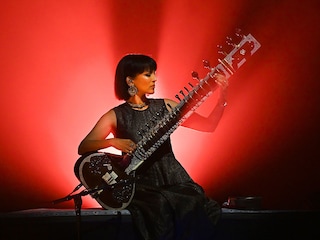
Sitarist Anoushka Shankar is grateful for securing two 2026 Grammy nominations—for her album Chapter III: We Return to Light and track ‘Daybreak’—but insists that she does not take such laurels for granted. The 44-year-old British-American musician now has 13 Grammy nominations, with the first coming way back in 2003. Ahead of her six-city tour in India starting January 30, she speaks with Forbes India about her three-decade journey, taking the sitar to a global stage and why streaming has hit a saturation point. Edited excerpts:
I mean this in the most grateful way, but nothing is the same as the first one. It doesn’t mean it’s not exciting. Of course, I am excited, I’m happy. But that first one was something very, very special. Because at that time, it didn’t seem like it was in my frame of reference. So, the first time that door opened, it was completely shocking.
In the sense that I feel a bit more part of the music world at large now. Obviously being nominated for the Grammys has luckily happened multiple times. That doesn’t mean I take it for granted. You never know what’s going to happen until we get the news. It’s still great to be recognised and to have these things come, but I guess it just feels a bit more part of my world now.
Q. What is special about Chapter III? Tell us about the music.
It’s been a three-year journey. It’s been a big, soul-led, deep project for me. At its heart, it’s about me writing from a place of finally having gone through difficulty, and being in a place of healing and strength and joy. And I have told that story through the music, allegorically using the symbolism of India, and sunlight and heat and power. I did that by working with two amazing collaborators. The jewel for me was working with Alam Khan for the first time, and we have such a strong musical legacy connection through our fathers and through their guru, who is Alam’s grandfather too. It’s weird to be with a new collaborator and play like that together. I think there’s real heart in the music. It sounds Indian, but it also sounds fresh.
Q. You've been a sitarist for 30 years now. How have you adopted to newer technologies and changes in the music world?
That’s been an ongoing thing. It’s hard to answer from then to now, because, especially the first decade or so of my career, I was playing purely classical music as I was taught by my father. And then in my 20s, I started writing and experimenting a bit more, and moving out of the purely classical space. So, the technology I’ve had to adopt has been kind of case by case—based on the music, the story, on what needs to be done. It doesn’t usually start with, ‘Oh, I want to try this technology’. It’s about ‘This is the art and how do we make it’.
So, for example, I didn’t set about consciously to use a pedal board over live looping and using all these effects until I had made an album called Land of Gold, which had certain sounds. It had all these layers of sitar on single tracks. I find it exciting that we can keep finding new ways to play and express. Especially playing the sitar… it’s lovely to take an instrument that people largely see only in one way—as beautiful as that way is—and just challenge people’s notions a little bit and expand the sonic palette and the kind of world people assume it exists in.
Q. You've taken the sitar and Indian classical music to a global stage. What has been the most heartening thing about the response to your music?
The most heartening responses are the ones that come from the heart. So, anytime I hear from someone in a personal capacity... for instance, this morning, I got a message from someone saying they gave birth to both their children—with my music. She said, ‘I’ve been listening to it through my pregnancy’. I wrote back to them and said, ‘In fact, the piece that you’ve chosen… I made it when I was pregnant’. So, there must be something. There is the possibility of real and true connection through music, even with strangers. That’s just one example. But that is an incredible thing—to make something that comes from our own experiences as artistes, and then to hear that it’s reaching people in really deep ways.
Q. Could you give us some insights into your musical process? How do you compose?
I try to create the conditions to help me feel as relaxed as possible. And as intuitive as possible. It does not suit me to feel very formal, pressured, intimidated. So, in those early days when we were still recording the tape, my first two records were made over a weekend where we booked the studio for two days. And that’s the time you had. Everyone made their records that way. But for me, as a young person, the freedom to have a home studio, to just be there, to be creative, to try things safely. Even when I’m working with people, I put a lot of effort into the kind of environment I create. So, feeling friendly with people or making sure there’s nice food and snacks. Actually, making people comfortable is an essential condition for feeling safe enough to create. And then all the magic can happen.
Q. You are on an India tour in January-February. How does it feel to come back and perform at a place where you’ve begun your journey?
It’s not just a place where I began my journey. It’s where my music came from. It’s where I learnt, it’s where I am from. So, it always feels different from anywhere else. It feels special. It feels like a real punctuation point to be back in India. The whole idea came to me when I was on a beach in Goa, and the final chapter of Chapter III was written, kind of inspired by some memories from India and my time here, and some of the music. So, it feels poignant to bring it back and tour here.
The 44-year-old British-American musician now has 13 Grammy nominations, with the first coming way back in 2003.
Q. What are your thoughts on streaming and artificial intelligence (AI)?
They are two different things. Streaming is one of those things that I think has had its journey. Initially it felt so exciting, just like early social media… the idea that you can find your friends from decades ago. The idea that any song you wanted to hear, and there it was. That was amazing and it changed the way we all listened to music. But just like social media hit a saturation point, streaming has hit a saturation point too. We’re all fed by algorithms. And the main issue is artistes are not getting compensated. So, while people felt it was freedom, it’s actually been like a noose around everyone’s neck, because artistes are making even less than they used to. And it was bad before. So, it’s been horrible in that sense. And AI is an entirely different conversation.
Q. When you say artistes are not being compensated, are there are copyright issues and other stuff involved as well?
Anyone can look at the numbers… if you pay a Spotify membership of however much a month, and you look at what percentage of that is going to record labels, what percentage is going to the streaming platform, what percentage is going to the people who place the music and do all the algorithms, and then what percentage is going to the artistes. Artistes are making .0000 something of each sum that they make. You would have had to have a song go x million, million, million times in order to make enough to buy a meal. It is ridiculous. So, no one’s making any money. And then you realise it’s not even representational. And artistes are not even paid equally. Certain artistes get more because the labels decide who gets more. So, someone like Taylor Swift gets a huge amount of money. But someone who is less famous or less successful with less numbers, doesn’t get the equivalent amount. They get a less percentage. It’s weird and messed up because it’s actually the artistes who are making it. And now they’re going towards AI…
Q. Is that a solution?
No. How is it a solution? Ultimately what are we making all the convenience for? Every step of the way, we get new technology and we’re told that this will free us up to do what we want. And yet we seem to get busier and busier, and more overwhelmed and more disconnected. And if you’re going to try and con us into thinking that art also can somehow be made by convenience by something else… I mean, what else would we do with the free time other than be playful and connect with each other? Art is fundamental. I won’t even get into that whole thing about whether AI can make art with a soul or not… you know, it’s a human experience that we’re trying to make sense of in art. And that’s what makes you cry when you’ve experienced it.
Q. You've spoken about dealing with polycystic ovary syndrome (PCOS), attention-deficit/hyperactivity disorder (ADHD), abuse and body shaming too. Do they take a toll on you? And how important is it for celebrities to address these issues?
I’m not a fan of saying what people should do, celebrities or not, because it’s down to the individual. But I do believe we should all do what we can. So, if part of what you can do comfortably and safely is to talk and to share, I think there’s real power in that. I’ve seen that in my own life. I know that identification is often a powerful first step before any other healing can occur. Just to know you are not alone. Or maybe to just learn something you haven’t thought about in your own life, but you hear someone else say it and you realise… all of that is powerful. Sometimes, yes, it does take a toll, but, on the whole, when I’m sharing with people publicly, it’s usually because I’m ready to do it. I’m not putting something on social media in the exact moment that I am truly struggling, because that is private. I’m not putting my bare yucky stuff out there.
Q. What is your advice to the next generation of musicians?
Listen broadly. Don’t be afraid to try things, so be playful, be brave. And be smart. The music businesses, sometimes for musicians, is more complicated than music. If you’re in a position to do so, work with people whom you trust, who can help you with the business side, or put a lot of effort into learning that side as well, so you’re not taken advantage of.
Q. Music has been an integral part of your life. Is that all-consuming or do you have other interests?
No, I’m not that kind of musician. A lot of my friends are like that, where music is all-consuming, but that’s not how it is for me. I don’t think I could do music if that’s all I had. For me, life is all-consuming. I get my inspiration from life. I get my experiences in life, and then music is where I can share and express and make beautiful things out of difficult things or whatever it may be. I also get a lot of inspiration from other art forms and from doing other things. I love dancing, I love watching dance, I love going to exhibitions. I have to soak up all of that stuff. And keep being challenged and growing with those ideas that other artistes have… that's essential.