The company is betting a similar pattern may unfold in EVs, a segment that has grown quickly off a small base but still makes up for only 5 percent of total car sales in India. Most buyers remain price-sensitive and anxious about range and inadequate charging infrastructure.
Maruti is positioning the e-Vitara—and the infrastructure around it—as its answer to those anxieties.
Range-First Strategy
At the launch on Tuesday, Maruti executives repeatedly returned to one point: Readiness matters more than timing.“We aim to enter with full readiness in terms of the product and the ecosystem,” managing director & CEO Hisashi Takeuchi said at an event. He said the car was engineered to minimise typical hurdles to EV adoption.
The vehicle promises an estimated 543 km on a single charge and has been tested in temperatures from 60° C to -30° C, across roads from “sand to snow”.
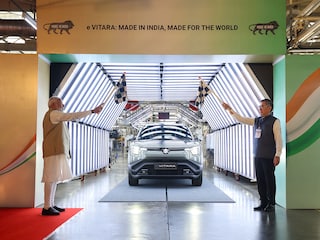
The model has already gone on sale in the UK and heads to Japan next month. It will be launched in India in 2026.
Maruti’s insistence on preparation extended well beyond the car. It has spent Rs250 crore on charging infrastructure across its dealer network and on its “e for me” app, which lets customers locate, pay for and access charging points, whether at home or at public stations, through a unified interface. The company has also made more than 1,500 of its workshops EV-ready and trained a 1.5-lakh-person workforce in handling high-voltage systems.
Partho Banerjee, senior executive office for marketing and sales, said this ecosystem-first approach was shaped in part by lessons from rivals. “Early adopters of EVs had a bad experience,” he said, pointing to after-sales problems, unreliable charging and range issues. Maruti deliberately moved slower, he added, because “this is the right way to launch a product”.
Also Read: Small cars will have to be discontinued without CAFE support: Maruti
Late Entry
Tata Motors remains the runaway early mover in the EV market, with multiple models already on sale and a substantial head start. Mahindra is racing to expand its battery-electric SUV lineup. Hyundai, after an early EV push, is now leaning heavily into hybrids, with only a fraction of its future models fully electric.Maruti, in contrast, has maintained a technology-agnostic stance. It sells internal-combustion engine (ICE) cars, CNG models, strong hybrids and flex-fuel variants, and will now add EVs to the menu. Banerjee said the company wasn’t chasing immediate market-share leadership. “For most customers, total cost of ownership is a bigger driver than tech,” he said, citing small-town contractors who buy EVs for running-cost savings rather than any enthusiasm for electrification.
Maruti’s EV Pitch
Whether Maruti’s entry becomes the EV sector’s tipping point will depend on whether India’s early bottlenecks—charging access, service reliability and customer trust—prove solvable at scale. Those are problems Maruti has built its pitch around: Its nationwide dealer network, 2,000-plus charging points, and integrated app are intended to create a sense of inevitability around EV ownership.The company’s Gujarat plant can produce 100,000 e-Vitaras annually, underscoring that Maruti expects demand to rise sharply once the market shifts.
The EV market may not tip overnight. But Maruti’s track record suggests that when the company finally commits to a category, India’s car buyers eventually follow. With EV sales still waiting for their critical mass, this might be the gravitational force the market has been missing.