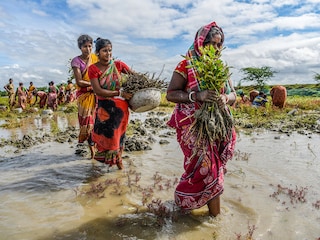
The central government’s plan to overhaul India’s rural employment guarantee scheme ran into resistance in Parliament on December 15, when the Viksit Bharat–Guarantee for Rozgar and Ajeevika Mission (Gramin) Bill, 2025 (VB-G RAM G) was listed for introduction but could not be taken up amid Opposition protests.
The proposed law, if passed, will replace the Mahatma Gandhi National Rural Employment Guarantee Act (MGNREGA)—a cornerstone of India’s rural welfare architecture for nearly two decades. What the government frames as a long-overdue modernisation has, instead, opened a deeper debate: Is India moving away from a legal right to work, or updating it for a changed rural economy?
What is MGNREGA, and why it matters
MGNREGA is a rights-based rural employment scheme, enacted in 2005 and implemented from February 2006. It guarantees every rural household in India a legal right to demand paid work from the state. Under the Act, any adult member of a rural household aged 18 years or above can apply for work (children and adolescents are explicitly excluded, in line with child labour protections). The government is legally obliged to provide up to 100 days of unskilled manual work per household per financial year. If work is not provided within 15 days of a written or oral demand, the state must pay an unemployment allowance, making the guarantee legally enforceable rather than discretionary.
MGNREGA is globally unusual for both its scale and legal design. It covers hundreds of millions of rural citizens and treats employment as their legal entitlement. It has also functioned as an economic shock absorber, such as during droughts, agrarian distress and economic downturns, such as the Covid-19 pandemic, when millions of migrant workers returned to villages and relied on the scheme for survival.
Government data cited in the Ministry of Rural Development’s VB-G RAM G FAQ shows that women will have accounted for over 56 percent of person-days generated under MGNREGA by the end of 2025-26.
What kind of work does MGNREGA provide?
The work itself is labour-intensive and local, such as building water conservation projects, irrigation channels, rural roads, flood-control structures and land development activity. Wages are notified annually by the Centre, linked to state minimum wages, with equal pay for men and women mandated by law.
How is MGNREGA funded?
MGNREGA’s rights-based design is reinforced by its funding structure. The central government pays 100 percent of wage costs, while states share material and administrative expenses. States are also liable for unemployment allowance and compensation for delayed wage payments.
What the budget numbers show
During the pandemic year 2020-21, the Budget Estimate of Rs 61,500 crore was revised sharply to Rs 1.11 lakh crore as demand for rural employment surged. Allocations remained elevated in 2021-22, before tapering off. In 2024-25, the allocation was raised again to Rs 86,000 crore, which the government describes as the highest ever at the Budget Estimate stage outside the Covid-19 period, and this level has been retained for 2025–26.
Critics argue that tighter budgeting undermines the scheme’s demand-driven logic; the government counters that funds are released based on assessed demand and utilisation.
Also Read: Employment woes deepen as workers move back to farm jobs
Why does the government want to replace MGNREGA?
In its official explanation for the new Bill, the government argues that MGNREGA was designed for rural India in 2005, and that the rural economy has since changed structurally. It points to a sharp decline in rural poverty from 25.7 percent in 2011-12 to 4.86 percent in 2023-24, alongside deeper financial inclusion, widespread digital payments and more diversified rural livelihoods. In this context, the government says MGNREGA’s open-ended, demand-based model has become outdated and inefficient.
Read More
Despite years of digitisation and reforms, the Centre highlights persistent problems under MGNREGA, including misappropriation, bypassing of attendance systems, non-existent works and poor asset quality. In 2024-25, misappropriation allegedly totalled Rs 193.67 crore, and only 7.61 percent of households completed the full 100 days of work.
What is the new VB-G RAM G Bill?
It proposes to replace MGNREGA with a new statutory framework aligned with the government’s Viksit Bharat @2047 vision.
Its key features include:
- A guarantee of 125 days of wage employment per rural household, up from 100 days
- A shift to normative funding and a centrally sponsored scheme, with a 60:40 Centre–state funding split (90:10 for north-eastern and Himalayan states)
- A focus on four verticals: Water security, core rural infrastructure, livelihood infrastructure, and climate-resilience
- Aggregation of all assets into a Viksit Bharat National Rural Infrastructure Stack
- Expanded use of digital monitoring, including biometrics, GPS tracking and real-time dashboards
- A provision allowing states to notify up to 60 days (aggregated annually) during peak sowing and harvesting seasons when scheme work will not be available
- Unemployment allowance remains mandatory if work is not provided.
Why stop work during peak agricultural seasons?
This provision has drawn sharp criticism, but the government argues it benefits both farmers and labourers, because of the following reasons:
- Ensures labour availability for agriculture
- Prevents artificial wage inflation that raises food production costs
- Encourages workers to shift temporarily to farm employment, which typically pays higher seasonal wages
Opposition uproar over MGNREGA overhaul
Opposition parties argue that the Bill changes the nature of the rural employment guarantee itself. Congress President Mallikarjun Kharge, speaking to reporters and in posts on X on December 15, said MGNREGA was conceived as a legal right to work, and accused the government of weakening that right by replacing it with what he described as a discretionary, mission-mode framework. He also questioned the removal of Mahatma Gandhi’s name from the scheme, calling it politically motivated.
Removing Gandhi's name from MGNREGA
Congress leader Priyanka Gandhi Vadra, in statements to the media and on X, asked why the government was replacing, rather than strengthening, a law that guaranteed employment as a matter of right, particularly when many rural households continue to depend on it. She also criticised the proposed renaming, calling it politically motivated and an attempt to erase Gandhi’s legacy from public policy. Senior MP Shashi Tharoor described the move as “unfortunate”, emphasising Gandhi’s symbolic connection to the original law’s ethos. Regional leaders like Manoj Jha and Derek O’Brien labelled the renaming an “insult” to Gandhi, while Ashok Gehlot called for the proposal to be reconsidered.
Shift away from central funding
Concerns have also been raised about the shift away from full central funding. While speaking with reporters outside the Parliament, Opposition MPs from Congress, the Trinamool Congress and the Rashtriya Janata Dal (RJD) said that moving to a cost-sharing model would disproportionately affect poorer states, potentially forcing them to limit workdays or divert funds from other welfare schemes.
RJD MP Manoj Jha, in comments to the press, said the new planning architecture weakens the role of gram panchayats. Trinamool Congress MP Derek O’Brien, speaking to reporters and posting on social media, similarly argued that MGNREGA was designed to be decentralised and demand-driven, and that shifting control upwards undermines that design.
What if the Bill isn’t passed?
With the Winter Session scheduled to conclude on December 19, 2025, the government has a narrow window to move the Bill, failing which, MGNREGA will continue under the existing law until Parliament takes it up again.