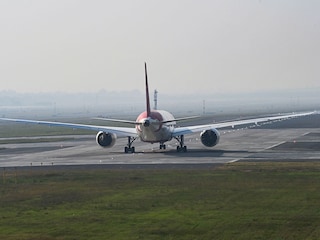
The Ministry of Civil Aviation this week granted No Objection Certificates (NOCs) to Al Hind Air and FlyExpress, giving both carriers the first formal regulatory approval required to start an airline. This comes close on the heels of the formal nod to Shankh Air, as Ram Mohan Naidu, the civil aviation minister, announced on X.
The clearances come weeks after widespread flight cancellations at IndiGo raised fresh questions about how dependent India’s aviation system has become on a handful of large airlines. IndiGo and the Air India Group together account for close to 90 percent of India’s domestic passenger traffic.
Who are the new entrants?
Al Hind Air is promoted by the Kerala-based alhind Group, a travel and tourism company founded in 1990 and headquartered in Calicut. The group has a strong presence across the Gulf and South Asia and is particularly known for its Haj and Umrah travel operations. The airline is promoted by Mohammed Haris T, founder general secretary of the Indian Haj Umrah Association.
According to a message on its website, Al Hind Air is preparing to make its debut as a regional commuter airline, with operations scheduled to commence later this year. It plans to begin services with ATR 72-600 turboprop aircraft, initially focusing on domestic routes.
The airline has said it is working with Cochin International Airport Limited to set up its operational base in Kochi, and that it plans to expand to international destinations over time.
The second new entrant, FlyExpress, is based in Hyderabad. Details of its fleet and route network have not yet been formally disclosed. Media reports suggest the airline is backed by promoters with experience in logistics, courier and cargo services and is likely to focus on connecting Tier-2 and Tier-3 cities. The airline remains in its pre-operational phase and must still secure its Air Operator Certificate.
Where UDAN fits in
The government’s push for new airlines is closely linked to the UDAN (Ude Desh ka Aam Naagrik) scheme, which subsidises flights on underserved and unserved routes to improve regional connectivity. Under UDAN, smaller carriers such as Star Air, IndiaOne Air and Fly91 have expanded services to smaller cities using lower-cost operating models and smaller aircraft. The civil aviation ministry believes there is still room for growth in this segment, especially as demand from non-metro cities continues to rise faster than overall passenger traffic. New entrants such as Al Hind Air and FlyExpress are expected to plug into this model rather than compete directly with larger airlines on metro-heavy routes.
What an NOC means
An NOC is the first formal approval an airline needs from the government. It indicates that the civil aviation ministry has cleared the airline’s ownership structure, financial background and security checks. However, an NOC does not allow an airline to start flying. That permission comes only after the airline obtains an Air Operator Certificate (AOC) from the Directorate General of Civil Aviation (DGCA). The AOC process involves detailed scrutiny of aircraft, crew, safety systems, training and operating procedures.
Several airlines in the past have cleared early regulatory hurdles but failed to sustain operations. Air Odisha, incorporated in 2011, began scheduled flights in 2012 but later struggled to sustain operations on awarded UDAN routes due to financial and operational challenges.
Why capital is the real hurdle
Aviation experts say regulatory clearances alone do little to address the biggest barrier to entry in Indian aviation, which is capital.
Mark Martin, CEO of Martin Consulting, an aviation advisory firm based in Asia, said airlines need far deeper financial backing than most promoters anticipate. “You need to have at least ₹3,000 crore to fund an airline,” Martin said. “The reason why airlines fail is because promoters don’t understand the financial outlay needed.”
While the DGCA requires airlines to demonstrate minimum paid-up capital to obtain approval, Martin said this only meets compliance thresholds and does not ensure long-term viability.
He added that India’s aviation market remains structurally hostile to new entrants, despite strong passenger demand. “With 1.5 billion people, it is appalling and shocking how messed up the airline ecosystem is in India. We can’t even sustain or support a new airline partner,” he further said, adding that granting NOCs to undercapitalised players risks repeating past failures rather than creating competition. Breaking monopoly or duopoly conditions would require large, well-capitalised corporate groups to enter aviation at scale. “If you want to take on Goliath, you need someone who is strong or big enough,” he said.
Duopoly debate at the centre of IndiGo chaos
India currently has nine scheduled domestic airlines in operation. That number has shrunk over the years following the collapse of carriers such as Jet Airways and Go First, both of which succumbed to financial and operational stress.
Read More
As a result, the market has consolidated rapidly. IndiGo alone accounts for over 65 percent of domestic traffic, while the Air India Group controls roughly another quarter. This concentration has raised concerns among policymakers and regulators over pricing power, consumer choice and operational resilience.
The Federation of Indian Pilots (FIP) has pushed back against claims that new airline approvals will break the duopoly. In a statement issued on December 25, the pilots’ body said it was incorrect to suggest that granting NOCs to Shankh Air, Al Hind Air and FlyExpress would weaken the dominance of IndiGo and the Air India Group. The FIP estimated the average life of a regional airline in India is at three to seven years, arguing that only well-capitalised corporate entrants can meaningfully alter market structure.
Lessons from Go First and Jet Airways
Go First, formerly GoAir, ceased operations in May 2023 after grounding nearly half its fleet due to faulty Pratt & Whitney engines. The airline estimated revenue losses of about ₹10,800 crore, as engine shortages and repair delays crippled operations. Despite being promoted by the Wadia Group and operating a 54-aircraft fleet, Go First filed for bankruptcy under the Insolvency and Bankruptcy Code and was eventually liquidated earlier this year.
In April 2024, the Delhi High Court directed the DGCA to deregister Go First’s aircraft, allowing lessors to reclaim them, though prolonged grounding meant many planes required extensive work before being flown out of India.
Martin said the government missed an opportunity to intervene. ““The government did nothing to support Go Air in international and NCLT courts. We lost a good airline, and the collapse only deepened India’s aviation duopoly,” he said, adding that a similar hesitation was seen during Jet Airways’ collapse.
Jet suspended operations in April 2019 after failing to secure emergency funding and was eventually ordered into liquidation by the NCLT in November 2024, following years of stalled revival attempts. Its failure was driven by debt, rising costs and aggressive expansion, rather than technical faults.
What comes next
The grant of NOCs to Al Hind Air and FlyExpress signals intent rather than outcome. For the airlines, the harder task lies ahead in securing aircraft, pilots, capital and regulatory clearance to actually begin operations.
For policymakers, the challenge is structural. As industry experts and pilots’ groups warn, breaking India’s aviation duopoly will require not just more airlines, but stronger balance sheets, policy reform and sustained support. Without that, new entrants risk joining a long list of failed airline launches rather than reshaping the market.