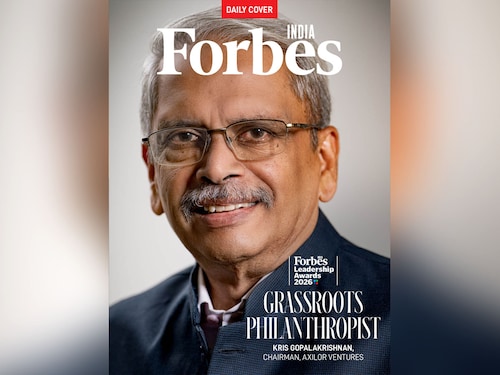
In 1977, Steve Jobs and Steve Wozniak launched Apple II, the first fully-assembled personal computer that not only sparked a boom in the sales of personal computers, but also stoked the imagination of a 22-year-old halfway across the globe. Senapathy ‘Kris’ Gopalakrishnan, then a student of computer science at IIT-Madras, was intrigued by the idea that a machine was trying to simulate the human brain—an organ that weighed a mere three pounds but was the most intelligent creation known to mankind.
Over the next three decades, Gopalakrishnan would go on to co-found and scale Infosys, India’s IT services bellwether, and hold various positions in the company, including that of the CEO, that gave him a ringside view of the growth of computing. But even when he stepped down in 2014, the mechanics of the human brain continued to fascinate him. It was perhaps no surprise that, when he began his second innings, as a philanthropist, it became the centre of his pursuits.
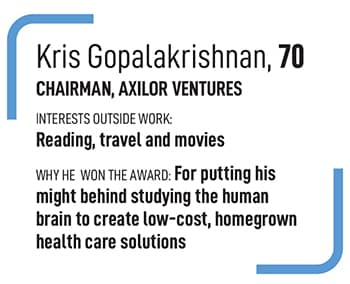
“The field of computer science came about as we wondered about how humans think, and if we can replicate that,” says Gopalakrishnan, 70, on a Zoom call from the office of Axilor Ventures, a business incubator where he now serves as chairman. “And I believe the next wave of disruption will come from a better understanding of how the brain works.”
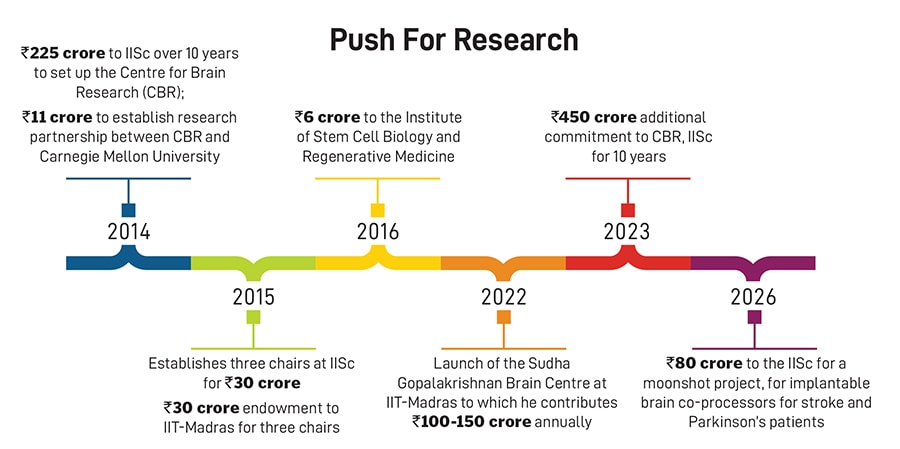
In 2014, the very year he moved on from Infosys, Gopalakrishnan announced a grant of ₹225 crore to the Indian Institute of Science (IISc) in Bengaluru over 10 years, leading to the creation of the Centre for Brain Research (CBR) that studies the brain with a two-pronged objective: Research neurodegeneration in the elderly and design new computing techniques inspired by the organ. The next year, he funded three research chairs at the institute for ₹30 crore. In 2023, he committed an additional ₹450 crore to it over the next 10 years, making him the biggest private individual donor at the institute.
Alongside, in 2015, he funded an endowment of ₹30 crore to IIT-Madras, his alma mater, to create three distinguished chairs to jumpstart brain research. In 2017, he challenged the researchers there to start an ambitious global project in human brain research that stands at the intersection of neuroscience, engineering and computing—to map the human brain at a cellular level, which can’t be seen even in a modern MRI. It required a technology platform that didn’t exist globally, and Gopalakrishnan co-funded it along with the office of principal scientific adviser, the Government of India.
In 2022, the Sudha Gopalakrishnan Brain Centre—christened after his spouse with whom he has also co-founded the Pratiksha Trust, through which he routes his philanthropy—was set up with long-term funding from him. Gopalakrishnan, whose real-time net worth as of March 10 is $3.2 billion (according to Forbes), continues to donate somewhere between ₹100 crore and ₹150 crore annually to the project.
“The brain is the most sophisticated creation of nature, and we still haven’t understood it properly,” says Gopalakrishnan. “And once I decided to do that, I thought it should have a social angle where we can leverage the understanding to figure out what causes diseases like Alzheimer’s, Parkinson’s, dementia etc. These are diseases that don’t have a cure and till we figure out what causes them, we won’t find one.”
![]()
Decoding The Brain
Between Gopalakrishnan’s two frontline philanthropic endeavours, researchers are confronting the brain from two opposite ends of life stages. At IIT-Madras, scientists have already released what is being called the most advanced map of the foetal brain—DHARANI, a micrometric-resolution, 3D image currently available for five gestational ages during the second trimester of human brain development, advancing 10 times the earlier work done by the US-based Allen Institute for Brain Science.
It is the first time that India has generated such high-quality maps of the human brain and has made them publicly available as a global resource.
“Driven by this technology platform, the Centre is now scaling this mission and developing detailed maps of human brains across the lifespan and different brain diseases. These are opening up new frontiers of research with applications in neuromedicine and AI,” says Mohanasankar Sivaprakasam, professor and head of the Sudha Gopalakrishnan Brain Centre at IIT-Madras. The project has been lauded internationally, with The Journal Of Comparative Neurology calling the centre “a new player at the high-stakes table of human brain map-making”.
![]()
The CBR at the IISc, on the other hand, is running longitudinal cohort studies to understand how healthy people turn into the diseased. Focussed on people aged 45 and upwards, and split into two groups—an urban cohort of 1,500 funded by the Tata Trusts and rural of 10,000 by Gopalakrishnan’s Pratiksha Trust—the CBR is collecting data, from blood samples to MRI and everything in between, to identify patterns and triggers that might explain how some individuals gradually experience cognitive decline.
“Kris is passionate about understanding the process of ageing of a healthy brain, what is the mechanism through which diseases like Alzheimer’s, Parkinson’s etc progress. The key to this is finding out biomarkers that help us identify diseases much before they can be clinically diagnosed. Our eventual goal is to build a national biomarker index for India,” says KVS Hari, director, CBR, and a professor at IISc. “In the next six to nine months, we will be developing AI models using the data we have collected so far. This is a first-of-its-kind project in India and unique because Western data, due to its Caucasian genomics and lifestyle, is different from ours.”
In early March, the Pratiksha Trust and the IISc formalised another tie-up of ₹80 crore for a ‘moonshot project’ to develop implantable brain chips that enhance or restore brain functions in epilepsy or Parkinson’s patients.
Patient Capital
Much of the research that Gopalakrishnan is committing funds towards is at a nascent stage without an immediate impact, or even so much as a promise of a tangible outcome. But it’s relevant in a country where, as Lancet puts it, the proportion of older people is increasing at about 40 percent every decade and is projected to reach 340 million by 2050, leading to a spurt of geriatric disorders induced by the ageing of the brain.
That’s what convinces Gopalakrishnan—who has lived in the realm of quarterly results during his stint in Infosys—about the long-term, audacious bets he has undertaken with philanthropy. “I have chosen to support world-class research without the expectation of a return in investment,” he says. “Basic research is long term, and I don’t want to put any unnecessary pressure on the scientists. Most neurological diseases don’t have cures and to suddenly say that we are going to find one for sure would be an overestimation of our capabilities.”
Funding towards research in India remains woefully inadequate. The recent Economic Survey revealed that the country’s spending on research and development (R&D) remained at a paltry 0.6 percent of the GDP. Contrast this with the 2.56 percent and 3.59 percent that the World Bank estimated China and the US spent on R&D in 2022, respectively.
![]()
“Our funding for research should be somewhere around 3 percent, maybe even 4 percent, of the GDP. The transition to a developed economy will only happen if we invest more in research and create our own IPs. From the time that you wake up to the time that you sleep, how many products do you use that are really owned by Indian companies?” says Gopalakrishnan. “I’m working with the government to increase funding for research, with academic institutions to take research from the laboratory to the market, and with the deeptech ecosystem to create more deeptech startups.”
Aside from pouring his own money into cutting-edge scientific research, Gopalakrishnan’s association with the projects has also given them visibility and credibility for national and global institutions to come on board. The CBR has among its collaborators the UK Dementia Research Centre, Gates Ventures, IISc, Nimhans and funders like the Alzheimer’s Association (US), Brain & Behavior Research Foundation (US), the Wellcome Trust (UK); while IIT-Madras, which is working with 25 global researchers from 10 countries, has received funding from the likes of Fairfax founder Prem Watsa, Premji Invest, Dr Reddy’s Labs, Hindalco and Fortis Healthcare.
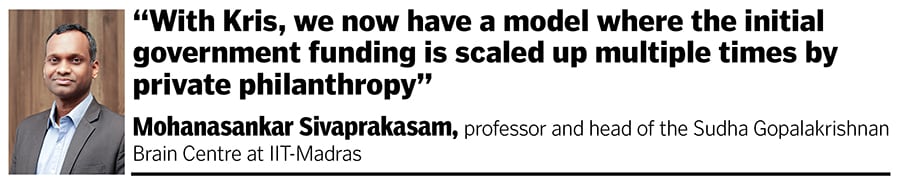
“Scientific R&D is usually largely dependent on government funding. Rarely do you see private money supporting high-risk, high-reward science in a big way. With Kris, we now have a model where the initial government funding is scaled up multiple times by private philanthropy,” says Sivaprakasam of IIT-Madras. “What stands out in Kris’s philanthropy is his courage and generosity to support world-class inter-disciplinary research despite being an outsider to the field.”
In a way, Gopalakrishnan is following the Bill Gates model of philanthropy—akin to the Microsoft founder’s funding of vaccine research—by investing in building capabilities to solve major global challenges. The outcome isn’t as direct as building a primary school or solving hunger, but building an ecosystem that, in turn, can create low-cost solutions. “We’re seeing a lot more families and philanthropists starting to see the importance of investing in scientific research. It’s about strengthening our capabilities as a country that can actually make affordable health care for the larger population,” says Neera Nundy, the co-founder and partner at Dasra, a non-profit organisation that connects funders with players in the social services ecosystem. “It is patient capital, but the outcomes can be larger and impact more people.”
![]()
Doing Good
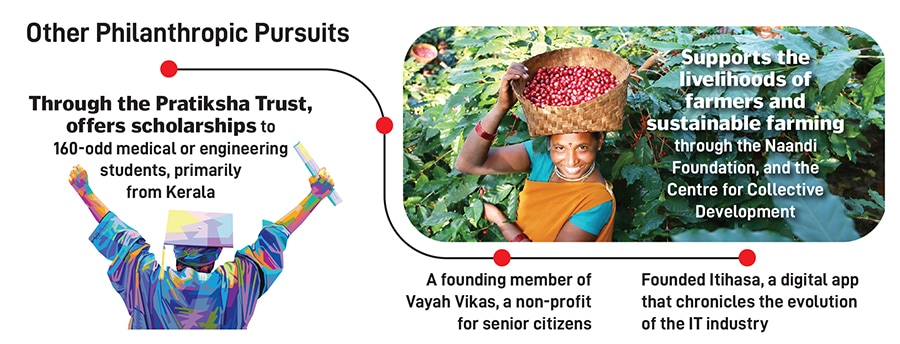
Aside from his focus on understanding the human brain better, Gopalakrishnan is involved in a number of smaller philanthropic initiatives. Through the Pratiksha Trust, he offers scholarships to 160-odd medical or engineering students, primarily from Kerala, his home state.
He supports the livelihoods of farmers through the Naandi Foundation—a non-profit that works for sustainable farming and where he is also a board member—and the Centre for Collective Development, which also works with small and marginal farmers. He is a founding member of Vayah Vikas, a non-profit for senior citizens, and has also founded Itihasa, a digital app that chronicles the evolution of the IT industry.
“When I had stepped down from Infosys, I needed to figure out what I would do with my life. I decided to support entrepreneurs, science and government initiatives, because the government has a huge influence on higher education and research,” says Gopalakrishnan. “If you have time and money, you need to figure out how to use time effectively to grow the money and then deploy it effectively. The first part is done through investments, like I do with Axilor, and the second through philanthropy.”
Going ahead, Gopalakrishnan wants to continue investing in brain research, and not spread himself thin. “The world is spending billions of dollars and we are nowhere close to that. The focus is to stay the course, grow the area and create an impact. There’s a lot more that we can do with the brain. Mental health is a big issue, there are other disorders like autism and schizophrenia that we still don’t know a lot about. Similarly, we need to develop better models of computing. Today, AI is driven by five to six companies, by one country, and the entire world is dependent on them. We need to develop more language models,” he says further.
The fact that private funding in philanthropy has increased comes as good news to Gopalakrishnan—according to the India Philanthropy Report 2025, authored jointly by Bain & Company and Dasra, private spending in the social sector has risen by 7 percent to reach $16 billion in FY24. Funding for startups, too, is going north. “We have become the third-best ecosystem for startups. I want to see similar results in research too,” he says.
Yet, despite his keen interest in studying the brain and the cheques he has written for it, Gopalakrishnan isn’t the one to micromanage the research. He is always available for suggestions, quick to respond to emails and messages and catches up once every quarter, say both Sivaprakasam of IIT-Madras and Hari of IISc, but never interferes. “Sometimes, researchers worry about interference and control when it comes to private funding, but it’s never the case with Kris. He never interferes or even questions us,” says Sivaprakasam. “He is continuously looking for ways to solve problems for us.”
Solving problems is something Gopalakrishnan not only does himself, but also advises other first-generation philanthropists. “There is a lot of work to be done. Philanthropic capital is a way to solve many problems in society. Leverage it,” he says.