Left to himself, Andre de Grasse would probably have been the next NBA sensation. But a fortuitous meeting with a friend brought him to the sprinting tracks. The rest, as they say, is history. The 32-year-old Canadian is now a seven-time Olympic medallist that includes two coveted gold medals—in 200 metres in Tokyo 2020 and the 4x100 relay in Paris 2024. In Mumbai as the international brand ambassador for the Tata Mumbai Marathon, the Olympic champion spoke to Forbes India about the twists and turns of his career, his first race on borrowed shoes, and challenging eight-time Olympic champion Usain Bolt. Edited excerpts:
Running is joyful, it brings that passion. As you saw, this marathon brought the city together. And people just love to run. Every day, when I get out of bed, I just love to go running. I love that adrenaline every single day.
A bus ride, to be honest, where I bumped into one of my friends. I was going home and he was going to track practice at the time. We had about five or six stops before we got off the bus, and we were catching up. He told me he was doing track and he had a coach who was helping him run races. I didn't believe him at first because I hadn't seen him in a while, and the last time I saw him, he never used to run. [When he said he runs] I joked and told him I could probably beat him in a race. And he told me ‘come and prove it’. Next day, I went to school and told the professor to sign me up for the race, and a week later I went to the meet.
Q. So you became an Olympic champion on a dare.
Yeah, literally on a dare. Funny thing is, at the meet I had no idea what I was doing—I didn’t have spikes, so I had to borrow them from a friend, I didn’t know how to use the starting blocks, and I didn’t know how serious people were when they ran. But when I ran, I ended up running pretty fast for my age group, in 10.90 seconds. Later that day, Tony Sharpe, an Olympian and a coach, asked me to join his track club. I was hesitant at first, but I still went, and then I got so good at it, he trained me for the next three-four weeks, and I was able to get a scholarship to go off to a college in America. I ended up taking the opportunity, and now I'm here.
Q. Every child that starts out wants to go to the Olympics. What separates the ones that make it versus the ones that don't?
A lot has to do with resources. I was fortunate enough to bump into that first coach who gave all the resources, like gear, spikes, plus coaching as well. Coaching is so important because a lot of people have talent, but you need the right coach and the right environment. Once I went off to the university, I had all the gadgets, the doctors, the physios to help me stay healthy.
But even at that moment I wasn't thinking about being an Olympian because there's so many great athletes there. The factors that differentiate the champions are those who work hard and have the mental resilience to be able to go out there and compete at a high level. A lot of people on my team were really good, but didn't work as hard. I made sure I ended up working harder than them, made sure I tried to beat them in practice, showed up on time—I took that job very seriously.
Q. There are hundreds of invisible steps before the finish line.
My coach would always say that while you can physically put in all the work on the track, recovery is just as important. Make sure that you're eating well, you hydrate, and sleep a lot, so that you can come back the next day and do it even better. I wrote down my goal on a board and I was very disciplined—so I wouldn’t go out with my friends late, or stay out partying. If I made a mistake in training, I would go back and try and fix that. Besides, I spent quite some time studying my sport, watching videos, and understanding what are the right things to do. When the world stopped for the pandemic in 2020 and there wasn’t much to do, I spent the time focussing on studying the sport.
Q. How does one prepare in the moments leading up to the Olympic final? What are the thoughts going on in your mind in the call room before you step out on the track?
Nothing. Because I just remember all the work that has been done. My coach would always say, there's nothing more to think about if you do all the work. We trained all these hours. You’ve done it in practice, now we just got to go out there and show the world. So, in the call room, I'm not thinking about the race anymore. I lace up my spikes, maybe take my last sip of water, put on my bib and let the crowd take me to the finish line.![]()
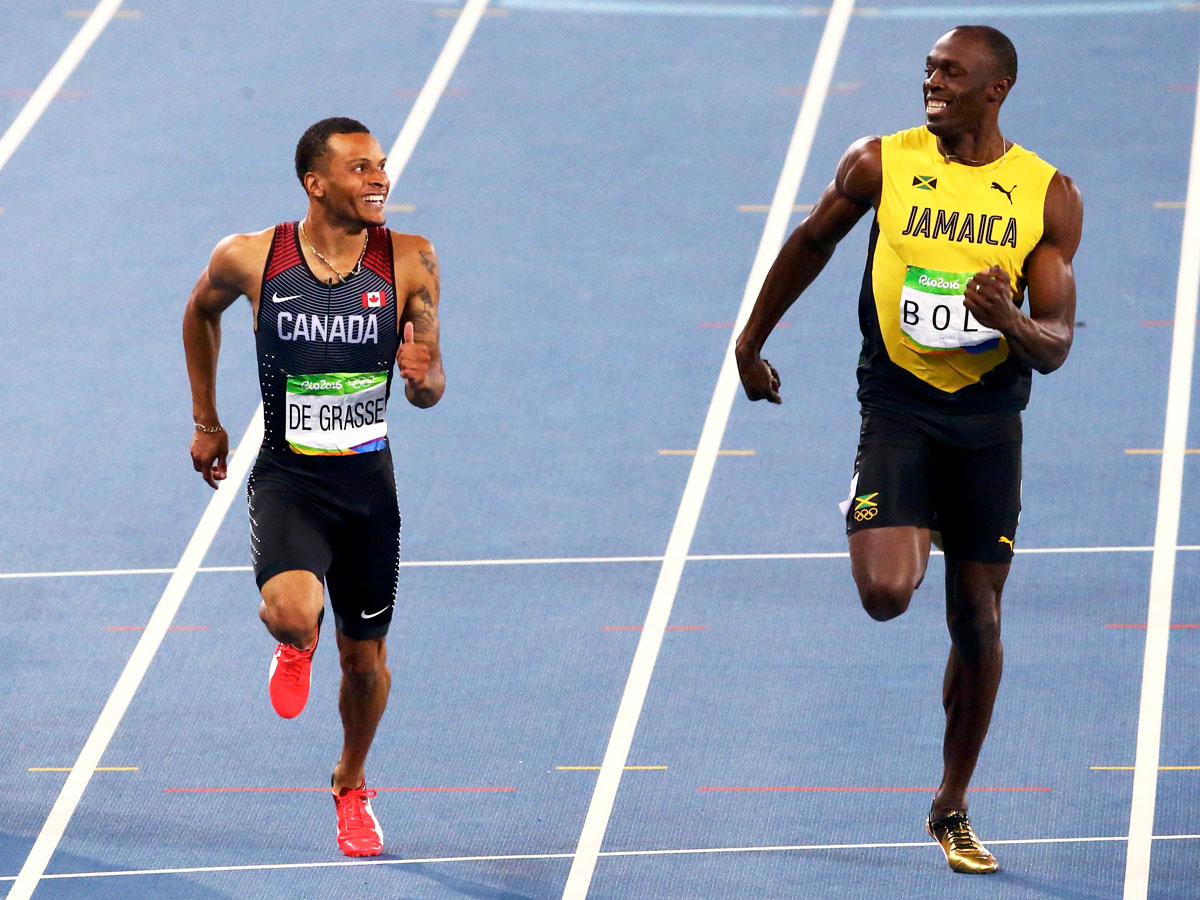
Eight-time Olympic champion Usain Bolt (right) shares a smile with Andre de Grasse in the last few metres of the 200m semifinal in the 2016 Rio Games. Photo by David Gray/Reuters
Q. One of the most abiding images of the 2016 Olympics is of you and Usain Bolt approaching the finish line of the 200m semifinal, looking at each other and smiling. In an intense competition like the Olympic Games, what brought on the smile?
I get asked this a lot and it wasn't planned. I didn't even know it was going on at the time because you're so focussed on your race. I didn’t even open my phone for social media. I think maybe the next day or the day after, that's when I saw it. The story goes thus—my coach had told me that to qualify you need to finish top two in the semis. He mentioned Usain was in my heats and he's on my inside, so I needed to run hard at least the first 150-160 metres and then check where I was. I did that and I didn't see anybody but Usain. And when I looked over to the left side, I saw him looking at me too. And it was just one of those moments where we both just started smiling—I didn't mean for it to happen, neither did he, but it was such a cool moment. After the race, he came up to me and said, ‘Hey kid, Why are you running so hard?’ And I was like, I'm ready for the finals, I'm ready to race you. That was the moment where I felt good about myself, I felt like I belonged and I was ready to challenge him.
Q. Do competitors become friends?
Not friends, but we're cordial, more like co-workers. If you're training with that person every day, they probably become your friend because you both want the same goal. But when you only see a person during a race, you're more like a competitor. We have mutual respect for one another. Some people can be friends, but most of the time I'm trying to beat everyone, so I'm not trying to be their friend.
Q. Bolt recently mentioned he doesn't think any of the current sprinters can beat his world record.
Yeah, I would think the same thing too.
Q. Why?
If I'm that person, I wouldn’t want anybody to beat my time. I don't blame him for saying that. He's the world record holder for a reason. So of course he wants to say that. I say that about my Canadian record. I was like, no one's going to beat my Canadian record. Maybe Bolt is right, maybe not, we'll have to wait and see.
Q. Two and a half years to LA28. You’ve spent many of your formative years in the city. Are you looking forward to racing there?
Of course. I went to school in LA—the track where they’ll do athletics in the Olympics is five minutes from my school; it’s the football stadium where I used to go watch all the football games. It'd be pretty cool for me to race there in front of all my family, my friends.
Q. Athletics in India has been gaining some traction of late. What do these rising stars do to reach the elite level?
Just keep training hard. It's important that they have good coaching as well, so coaches need to make sure they're also learning. I always thought, when I was coming up, that there wasn't as much good coaching in Canada. So I had to go to America. But now Canada has gotten so much better. Hopefully, that can be similar in India where the coaching gets better. And then it comes down to hard work and knowing how to have the resources to be able to do well. I see a lot of progress there. So I'm looking forward to seeing how Indian athletics comes along.