And, later, the pandemic was a huge inflection point. It gave people a lot of time to follow chess players, while sitting at home and trying to think of things to do. I always say chess would have missed the boat if the pandemic happened 10 years earlier, because we wouldn't have had the bandwidth to take advantage of it. In 2020, it was the perfect time.
This was also when streamers, content creators discovered chess, attracting people who were, maybe, curious but slightly distant from the game. In India, these would be people like [comedian] Samay Raina and Sagar Shah [International Master and founder of Chessbase India] and abroad American GM Hikaru Nakamura [who livestreamed games]. One nice offshoot of that interest is the Tech Mahindra Global Chess League.
In 2020, we played the Chess Olympiad online, and we won it jointly with Russia. One of the spectators was Anand Mahindra, who had tuned in because a lot of people were saying it's entertaining and dramatic. His idea was based heavily on his experience with the Pro Kabaddi League, and he wondered if we could do something like that with chess. At the end of that year, he called me and asked if I could join. And here we are, playing the third edition of the league in Mumbai.
On inflection points, I should also mention Gukesh’s victory at the World Championships last year, becoming only the second Indian to win the title. It was a big milestone.
Q. Chess isn’t really a team sport. What convinced you about the league format when Anand Mahindra came to you?
You're right. Chess is very much the sum total of individual games. There is no passing of the ball between team members. But I realised we could work on the team element because I have played in several European leagues. I've played in the Olympiad, which is the world team championship for countries, if you like. And it's always been entertaining. Even though we play on individual boards, the fact that someone else's board influences you, that you have to keep track of the state of the other match, that you are not only playing for yourself—I had experienced these elements.
But what was also becoming evident was that teams needed to be a bit more diverse than before. So, instead of having separate men’s and women’s, which was highly conventional, if you could mix it up a bit, with men, women and juniors in the same team, you get a lot of drama, a lot of unpredictability, and you can compare countries' strengths in a different way. ![]()
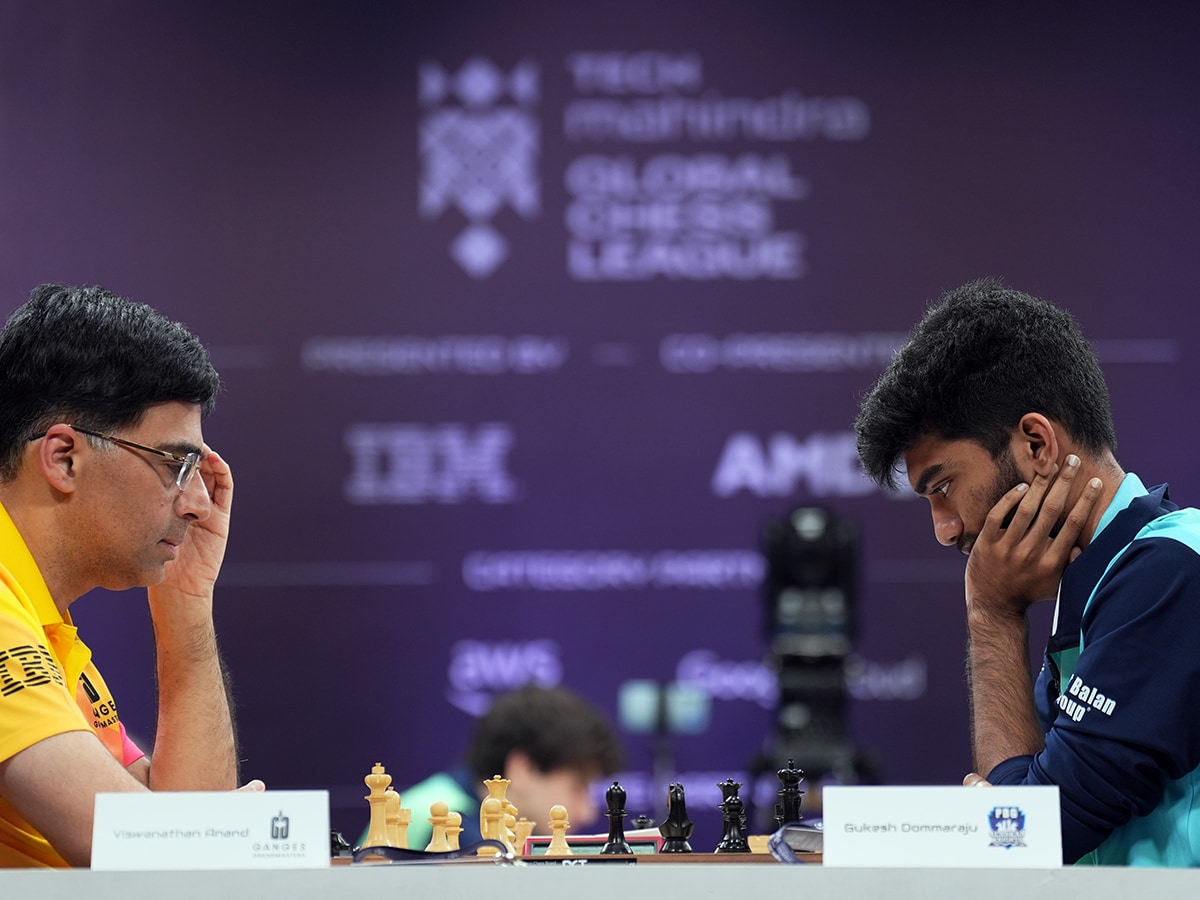
Viswanathan Anand of Ganges Grandmasters plays D Gukesh of PBG Alaskan Knights at the third edition of the Tech Mahindra Global Chess League in Mumbai. Anand defeated Gukesh in the match.
Photo by GCL
Q. How are players from this generation, many of whom you mentor as well, different from yours?
Within my career span, we have gone from thinking entirely by ourselves to thinking through computers. And now the amount of computer analysis and learning that happens makes the two games almost difficult to compare. When I look at games played in the 60s or so, it feels chess was a different sport to what it is now. Although, at the same time, the human element, the nervousness before a game hasn't changed at all.
This is a generation where most of the top players have not lived in an era without mobile phones and, obviously, without computers. They have not lived in an era without all games being live at all times. So, if I tell them the story of how I used to wait for three weeks for the magazine to arrive by post, or that I used to go to an STD booth to call my parents, it’s alien to them.
And, on the chessboard, they don't have this old baggage—that old knowledge was highly imperfect. It had a lot of assumptions chess players made based on the sort of material we had—we assumed this is how things must work, how these positions must be played. Now they start everything on move one and say there's no rule that this is possible or not. The only question they have is, ‘Can I make it work tactically?’ If you cannot find a move which shows me why I'm wrong, then I'm right. That's the mentality now. That wasn't the case when I was growing up or even for the previous hundred years.
The game has become so much more computerised, statistical, with very high-level analysis. But, luckily, the sporting element hasn't gone away.
Also Read: India's time in chess has arrived: Viswanathan Anand
Q. As artificial intelligence (AI) comes in, do you think it's going to be another different sport 10 years on?
I don't know how much more technical knowledge we can squeeze out of this, although there are things to be learnt. But, for the last 10 or 15 years, we have always assumed that things wouldn’t get much more different, but they have kept evolving.
[In chess,] at some point, we'll say these conclusions are probably going to be the same 10 years from now—we're not going to fundamentally disagree. But what will change is the way people pick up the game. AI will be able to explain to them much better. AI will almost be their coach. Even more, it can be the coach's assistant, the coach's coach. So, the coach will use AI to imagine what lessons they want to give them.
And the big difference will be that the age [of chess players] will start to drop even more. I got a rating at 12 or 13, and that was a good achievement, but nothing earth-shattering. I became a GM at 18. Back then, the youngest in history was 15. Now there are more than 10 players who are GMs at the age of 12. Recently, we saw a three-year-old boy who got a rating. Somebody asked me how do you place that in a chess context? I said, I have no idea. I have no understanding of what this is. It's like how, if you told me a newborn was discharged from the hospital and then began to explain a theorem, I couldn't place it in any context.
We see the broad trend. Now chess players come from every country, more and more countries have top players. And the sport is becoming more diverse by nationality. It's not dominated by one country, which once used to be the Soviet Union. In this broadening trend—both expanding the audience, expanding where talent comes from—AI will contribute hugely because it will make the presentation aspect of it much better.
Q. But where does AI intervention end and human intuition begin? Or does it?
It does. AI says a lot of stuff. But, first of all, the most highly trained humans in a field will ask AI the best questions. Second, if AI gives you 40 pieces of advice, they will be able to discard 35 and keep the five most useful ones. Humans will use AI just like a tool, and some will derive more benefit from it. But it's not enough that AI gives you a conclusion—it gives you an answer, but whether you can understand the answer, understand the details, is up to you. Because when you play, you'll have to implement the answer in a game. To implement it, you need to know the details. So that's really where human talent comes in.
At the same time, we can say the current generation is the strongest technically in history, simply because they've had the benefit of so much AI analysis thrown at them. The average level is very high. That's where AI will keep growing the game.
Second, a sport needs a much broader base. In chess, AI will help demystify the game for people who may never go much further than one or two casual games, but know the rules, enjoy the game, and like to dabble in it. In those areas, it's going to be useful to help spread the message. There's only so much that commentators can do, and AI can do it more often without getting tired.
Q. These days, we hear a lot of conversation about freestyle chess. [World No 1] Magnus Carlsen is now a big endorser of it. Will it overtake the classical format?
Not at all. The concept of Chess960, or what is sometimes called Fischer Random [named after late American GM Bobby Fischer who invented it], has been around for a long time. We used to have tournaments in Germany around 2005-2006. And hovered around the horizon. They're trying this alternative circuit. But for the moment, I don't know where it's going to go. I don't think it's going to replace chess yet, which is growing very strongly in all formats, like rapid and blitz, and not just classical. But, on the other hand, you never know what catches on, and you've got to be open to ideas. In fact, I recently competed in a 960 event against [American GM Garry] Kasparov in St Louis.
Q. Only R Pragganandhaa has qualified for Candidates 2026 [a tournament to decide who plays world champion D Gukesh in the next World Championships]. Is it a bit of a disappointment for you, given that we had three in the last Candidates?
Think about it this way. Out of the three players who were representing India in the previous Candidates, one doesn't need to play because he's above it. So, in a sense, that's two people above the Candidates level. Second, the number of players in the women’s Candidates has increased to three from two [Divya Deshmukh, Koneru Humpy and R Vaishali]. I'll take it. Obviously, if we had one more Indian, it would have been nice. But it's still an exciting tournament, and given the fact that we are guaranteed one Indian in the World Championship, that's pretty decent.