Beyond defence: HAL debuts SJ100, H-228 and Dhruv NG
State-owned Hindustan Aeronautics Limited is looking to scale up its civil aviation business as it expands beyond defence manufacturing
Last Updated: Jan 29, 2026, 11:03 IST3 min
Hindustan Aeronautics Limited (HAL) said it aims to increase the share of civil aviation in its overall business as it looks to expand beyond its role as a defence-focussed manufacturer to a broader aerospace player. The civil aviation segment is expected to account for about 25 percent of the company’s revenues over the next decade, up from around 3 percent to 6 percent currently, chairman and managing director DK Sunil said.
At the Wings India 2026 event, the state-owned aerospace company said it has a “multi-pronged civil aviation roadmap” covering fixed-wing aircraft, helicopters and regional jets. The domestic market will remain its primary focus, with selective overseas opportunities to be evaluated over time.
Civil aviation currently forms a small part of HAL’s business, the company said, with defence accounting for about 97 percent.
“HAL is at a defining moment in its civil aviation journey... our aim is to make civil aviation a meaningful part of HAL’s business. The target is roughly one-fourth of the business over time,” the defence major stated.
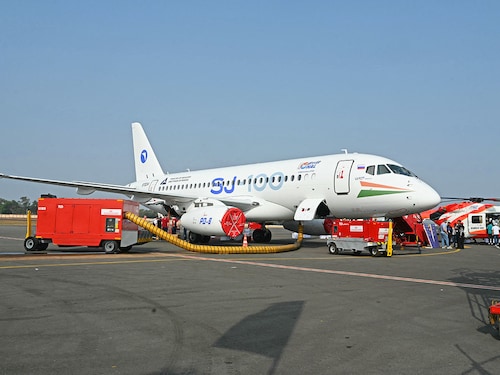
HAL showcased a range of civil aviation platforms at the event, including the Hindustan 228 commuter aircraft, the Dhruv Advanced Light Helicopter New Generation, the SJ100 regional jet and the Aurus business jet variant of the SJ100.
The SJ100 is a twin-engine regional jet designed to carry 75 to 100 passengers on short- to medium-haul routes. It has a range of around 3,530 kilometres and a maximum take off weight of 49,450 kilograms, making it suitable for point-to-point services connecting smaller cities. It is designed to operate across a wide range of climatic conditions, including extreme cold and high ambient temperatures.
More than 200 SJ100 aircraft have been produced globally and are operated by over 10 airlines, largely in Russia and neighbouring markets. HAL said the aircraft could help address India’s shortage of “suitably-sized aircraft” for regional routes.
The aircraft is being developed under a collaboration between HAL and Russia’s United Aircraft Corporation and marks HAL’s first passenger aircraft manufacturing programme since the Avro HS-748, which the company produced under licence between 1961 and 1988.
Under the agreement signed in 2025, HAL will assemble and integrate the aircraft in India, while United Aircraft Corporation will supply critical systems and oversee quality assurance. The aircraft is intended primarily for domestic operators, including those flying under the government’s Ude Desh ka Aam Naagrik (UDAN) regional connectivity scheme.
“The idea is to first deploy the aircraft through leasing, learn from real-world operations and then move into manufacturing in a phased manner,” HAL said. The company plans to begin with final assembly and gradually increase localisation over time.
The SJ100 has seen limited international adoption outside former Soviet markets, and Western sanctions on Russia have disrupted global supply chains for engines and avionics.
“India itself offers sufficient demand for this category of aircraft,” the company said, adding that international expansion would be considered once the programme stabilises.
HAL added that one of the key learnings from operating regional aircraft so far has been the shortage of trained pilots. Simulator availability has been a bottleneck, HAL said, adding that while the aircraft’s performance has not been an issue, training capacity has limited faster deployment.
The company currently operates one simulator and plans to commission another by the end of the year.
Alongside fixed-wing aircraft, HAL expects civil helicopters to be key in driving its growth, at least in the near term. The Dhruv Advanced Light Helicopter New Generation, which is nearing civil certification, will initially be deployed for offshore energy operations. The company is also targeting demand from tourism, medical evacuation and emergency response services.
“We see strong potential for twin-engine civil helicopters, particularly in the northern sector, where safety and reliability are critical,” HAL said. It added that production could be scaled up from the current 30 to 35 helicopters a year to about 45 annually. "30 is what we do. We can definitely put it up to 45 helicopters," HAL said.
First Published: Jan 29, 2026, 11:09
Subscribe Now