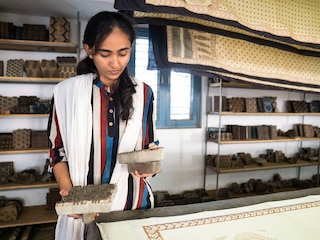
On the contrary. As a child, I was never keen on painting or craft. Just like most other women in the village, along with my mother, I too would help with tying for tie-and-dye (Bandhni) artisans in the village. It was manual labour which did not require any skill. I performed the task without any interest in it.
Q. Why have women kept away from the ancient craft of Ajrakh printing all these years?
That’s because Ajrakh is a tedious process involving many steps. The intricate and labour-intensive craft—comprising 14 to 16 stages of washing, dyeing and resist printing—has remained a male-dominated practice for centuries. The more complex the design, the more the steps.
Q. What was the turning point that made you take up Ajrakh printing that no other woman has ever attempted before?
The turning point came when I saw my father and my brother—who had recently returned from Somaiya Vidya Kala (SKV), an institution offering formal design and entrepreneurship education to traditional craft practitioners—experimenting with their practice. I saw them introducing freehand painting and adding new textures to traditional block printing. The novelty and freshness in the craft got me interested.
Q. Can you tell us about your journey into the world of Ajrakh and the beginning of your label?
My father made a separate table for me at home. This was around 6–7 years ago. I started by making a wall hanging. While Ajrakh involves printing designs using blocks, I broke away from the format and started with freehand painting. It took me eight days to complete one piece. The outcome was so promising that I realised that I had found my calling. I decided to convert this ‘art’ into daily wear in the form of stoles. Initially, my approach was a bit random, without the use of block printing. In 2021, on the recommendation of an acquaintance, I created an Instagram account to showcase my work and launched my brand, Elysian.
Click here for Forbes India 30 Under 30 2026 list
Q. How did you come up with the name Elysian? What does the venture do?
I saw the word Elysian on Pinterest. It’s a Greek word and it means creative/blissful. The design venture carries forward 32 years of expertise in the traditional craft of Ajrakh. With a deep respect for heritage and innovation, we create handcrafted textiles that merge age-old techniques with contemporary aesthetics. Each piece is thoughtfully designed, hand-printed, and dyed with natural processes. Through our work, we aim to celebrate artisanship, empower our craft community, and bring timeless art into modern living.
Q. When and how did you decide to go to Somaiya Vidya Kala?
In 2023. During one of her visits, Avantika Gandhi, the programme coordinator of SKV at the time, saw my work and recommended me for the design course. Moreover, my father, having gone through the course himself, wanted me to go through it.
Q. Was there a fee involved? What was the duration of the course?
The fee is negligible, and the institute invests a lot of money in training the artisans. It was a one-year course that culminated in a fashion show at Lakmé Fashion Week, where five artisan designers [including Khatri] got an opportunity to showcase our collections. In addition, our work was displayed in an exhibition.
Q. What did you learn at the Institute? How did you benefit by going to SKV?
I used to be extremely shy earlier, but after learning to make presentations at SKV, I found my voice and gained confidence. Apart from that, I completed six modules in design and business education, where I learned to develop cohesive collections, calculate production costs and pricing, understand high-end markets, and create products suited to contemporary consumer demands. SKV tore down all the barriers in my mind. Most importantly, I realised the value of innovation while staying rooted in my traditional craft.
Q. Did you gain any new clients by showcasing at the Lakmé Fashion Week? What did you gain from the exposure?
I received many enquiries for my collection through DMs on Instagram after the show. Many people came to know about my label.
Q. Can you tell us about your latest collection?
I have used dry branches as an inspiration for my collection. It comprises short kurtas and long kurtas. Using natural dyes, I have used the traditional colours of Ajrakh—a combination of indigo, black and red [all on a standard yellow base]. The designs are printed on 60X60 count normal cotton, kala cotton and tussar silk.
Q. What are your biggest milestones since starting out?
Since starting Elysian, key milestones include receiving the Crafts Council of Telangana’s Shri Gaurav Kilaru Sanmaan for Young Artisan Award, showcasing our work at Lakmé Fashion Week, building a growing community of craft lovers online, and reviving traditional Ajrakh techniques with contemporary designs.
Q. What are your future plans?
Over the next 12 months, Elysian plans to launch new Ajrakh textile collections that explore contemporary themes while preserving traditional techniques. We aim to expand our presence online and through exhibitions, collaborate with fellow artisans for limited-edition pieces, and introduce workshops to engage the community with the craft. Our focus will remain on creating handcrafted, story-driven designs that blend heritage with modern aesthetics. My goal is that my work should be known all over the world. I want to create such an identity that whoever sees my work anywhere in the world will know that it is my design.