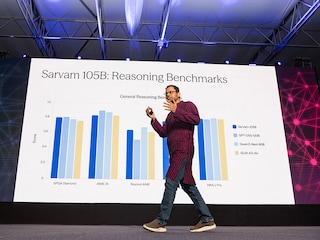
Sarvam AI stepped into the global frontier at the India AI Impact Summit in New Delhi, launching 30B and 105B parameter models trained entirely in India. These models—capable of real-time speech and deep reasoning across 22 languages—represent a shift toward 'Sovereign AI' that no longer relies on foreign base architectures.
Alongside its 30B and 105B models, the company highlighted its existing foundational suite: ‘Bulbul’, a text to speech system spanning 11 Indian languages and 39 voices; ‘Saaras’, a speech to text engine covering all 22 scheduled languages, 8 kHz telephony audio and code mixed speech; and ‘Vision’, its document understanding model capable of parsing more than 22 Indian languages, mixed scripts and handwritten text—together forming the linguistic infrastructure underpinning its LLMs (large language models).
These launches, unveiled under the government’s IndiaAI Mission, signal India’s entry into the frontier-model race long dominated by the US and China.
Both models were trained in India, on Indian data, optimised for Indian languages and designed for agentic behaviour—enabling autonomous reasoning chains, coding tasks and multilingual contextual operations. Sarvam’s leadership framed them as proof that India can now build sovereign, population scale AI infrastructure independent of foreign providers.
Underscoring that claim, the company detailed major public sector deployments: Powering UIDAI’s Aadhaar services with multilingual voice interaction and fraud detection; partnering with the Odisha government on a 50MW Sovereign AI Capacity Hub; and collaborating with the Tamil Nadu government and IIT-Madras to build Digital Sangam, India’s first Sovereign AI Research Park anchored by a 20MW AI data centre.
But Sarvam’s headline grabbing debut was just the beginning. Over the week, four other major AI models were unveiled or debuted, creating a five model cluster that marks the country’s strongest push yet toward sovereign AI.
Government Backed LLM
One of the most consequential launches after Sarvam came from BharatGen, the IIT Bombay-led consortium building multilingual government grade AI under the IndiaAI Mission.
Read More
BharatGen introduced Param2, a 17 billion parameter Mixture of Experts model supporting 22 Indian languages. It represents a six fold increase over its previous 3B model, reflecting the government’s ambition to standardise AI infrastructure across departments and states.
Param2 is meant to sit at the heart of public services—from education and governance to agriculture, providing a sovereign, multilingual foundation the government can deploy without relying on foreign models.
Voice for Indians
Where other companies leaned into text first LLMs, Gnani.ai addressed the reality that India is a voice-first nation. Gnani launched two speech native foundational models—the interface most Indians actually use.
The company unveiled Vachana TTS, a production grade system that can clone a person’s voice in 12 Indian languages using less than 10 seconds of audio. It scored 4.23 on the MOS scale, which is a standard industry test for how natural and human like synthesised speech sounds—the higher the score, the closer it is to real speech.
It also introduced Inya VoiceOS, a voice to voice model that doesn’t convert speech into text first but works directly on speech signals, allowing it to handle overlapping dialogue, mid sentence corrections and even retain emotional tone. Together, these tools reflect one of the most India centric launches of the week, aimed squarely at a country where hundreds of millions of people interact with technology primarily through voice.
Education Focus
Tech Mahindra—notably the only major IT services firm selected under the IndiaAI Mission—unveiled a major upgrade to its earlier Project Indus model: An 8 billion parameter Hindi first educational LLM, showcased at the Summit on February 20.
Built using NVIDIA’s NeMo and NIM tools, the model is designed to help students grasp complex subjects, starting with physics. To make up for the lack of high quality Indian language data, Tech Mahindra also created around 500 million “synthetic training tokens”, essentially computer generated examples that help the model learn when real data is scarce.
This marks one of India’s first serious attempts at building an education focussed sovereign LLM aimed at improving learning outcomes at a national scale
Health care Foundation Model 5
Fractal Analytics debuted Vaidya 2.0, a health care focussed AI model that surprised many by becoming the first system in the world to score above 50 on the “hard” version of OpenAI’s HealthBench test. This is a stringent evaluation designed to check whether an AI can handle the toughest medical reasoning questions, far harder than standard diagnostic prompts.
In practical terms, this means Vaidya 2.0 performed better than both GPT 5 and Google’s Gemini Pro 3 on challenging medical tasks. Built specifically for real-world clinical conditions, the model supports everything from emergency triage and symptom interpretation to helping doctors navigate diagnostic workflows. Unlike general-purpose AI models, Vaidya 2.0 is tailored for health care systems in the Global South—environments where resources may be limited, patient loads high, and transparency in medical decision making is crucial.