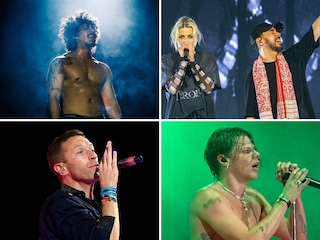
There’s a particular kind of electricity that runs through a crowd of 70,000 people when the first notes of ‘In the End’ ring out. You feel it in your chest before you hear it—tens of thousands of voices rising as one, belting out lyrics they’ve carried with them since school corridors and pirated MP3 days. All around you, are fans who’ve travelled on overnight buses, cross-country flights, and half-day train rides just to be in Mumbai and Bengaluru, to watch Linkin Park—live, in front of them, after years of believing this moment might never come. For the next 90 minutes, nothing exists except this shared memory being made in real time: Strangers swaying together, teenagers discovering the band for the first time, adults reliving a piece of their childhood.
And this isn’t an exception—it’s a defining pattern.
Every time an international act touches down in India, whether it’s Coldplay painting stadiums yellow, Imagine Dragons turning arenas into echo chambers of catharsis, or Guns N’ Roses pulling in generations of loyalists, the response is the same: An overwhelming, disarming wave of Indian love. At Lollapalooza 2026, even Yungblud (Dominic Harrison)—now a Grammy winner—broke down mid-performance, choking up as he told the crowd, “…I promise to come to India every single year till I’m dead, because the love that I have received here has been crazy.”
But it’s not just about global superstars anymore. India’s homegrown artistes—Sunidhi Chauhan’s powerhouse vocals, Diljit Dosanjh’s Punjabi, stadium-filling swagger, the explosive energy of Hanumankind and Divine (Vivian Fernandes) at Rolling Loud—are drawing the same frenzy. Fans across generations are willing to pay high ticket prices, wait in long queues, and turn up at patchy infrastructure simply for the joy of singing back songs that feel like part of their identity.
Over the past few years, the value of India’s live events market has accelerated rapidly, surpassing the Rs 12,000-crore mark in 2024, according to an EY-Parthenon and BookMyShow Live report titled ‘India’s Rising Concert Economy’; it also projected the market to grow at 19 percent CAGR over the next three years. In 2024 alone, the country saw 70 to 80 concert days, drawing crowds of over 10,000 per event. Industry reports suggest that over 5.6 lakh Indians travelled across cities for concerts in 2025, turning live music into a form of experience-led tourism.
“The resounding reception of artistes and content formats over the last few years across live events in India has placed the country at the top of the choice pool, for international promoters who are keen on bringing world-class entertainment to the largest democracy in the world,” says Naman Pugalia, chief business officer, Live Events, BookMyShow. Multiple international artistes on tour such as Green Day, Shawn Mendes, Aurora, Yungblud and others performed in India for the very first time, at festivals like Lollapalooza.
For artistes too the experience has evolved over the years. Singer-songwriter Ankur Tewari, who recently played at Lollapalooza in Mumbai, tells Forbes India, “I can proudly say that the backend was at par with concerts across the world, right from the artiste village and hospitality to equipment and stage managers.” If there is one thing he would change, it would be audience behaviour. “More people watch your act through their screens, despite being in front of you. I miss the eye contact.”
India’s concert economy is being built by first-time audiences, “driven by aspiration and community. Live events are not routine purchases; they are planned social occasions that people travel for and experience collectively,” says Rahul Ganjoo, CEO, District by Zomato. Unlike in the West, where live entertainment or festivals are dominant, in India it is still nascent, thus making it a more “thought-through, going-out” experience.
Ganjoo notes that although Indian audiences are becoming more invested, concerts remain “social experiences, not calendar fixtures”. Artistes can build followings across multi-city tours, with fans willing to travel and show up repeatedly, but “the loyalty is fluid, not fixed”. The distinction, he says, lies in how fandom manifests itself.
“The era of the local gig is evolving into music tourism,” says Jigar Sheth, chief revenue officer, Nodwin Gaming. The ‘India’s live events economy’ whitepaper commissioned by the Ministry of Information and Broadcasting in 2025 notes that nearly half a million fans travelled inter-city for live music events in 2024–25. “Our data shows that fans are willing to travel over 500 km and pay up to three times the local hotel rates if the IP is strong enough,” adds Sheth.
Arghadeep Barua, a musician from Guwahati, often travels across the country to watch his favourite bands perform. The day Lollapalooza announced that Linkin Park was part of its lineup, “I booked my festival tickets and then flights to Mumbai; it’s Linkin Park, I had to come,” he told Forbes India at the festival. He began listening to the band in Class 6, and its music has stayed with him ever since. “Artistes like Linkin Park and Pearl Jam have had a huge role in my growth as a human being, not just a musician.” Over the years, he has travelled for performances by U2, Coldplay, and most recently Dream Theater in Kolkata. “I like to travel, not just for performances but also for musical inspiration.”
While Indian audiences are traditionally more price sensitive compared to Western ones, Pugalia feels they are increasingly willing to invest in VIP packages, exclusive merchandise or early-access passes: “This shift is driven by a growing appetite for international-quality entertainment, a younger demographic with higher disposable income and a strong digital influence shaping experiential choice.” Price sensitivity is real, but, Ganjoo notes, “people are willing to pay when an experience feels rare, culturally significant, or impossible to replicate. A Rs 5,000 ticket isn't evaluated in isolation, it's weighed against the value of the outing: The artist, the venue, the company, and the memory being created.”
Like in sports, the concert and live music industry is driven by fandom. “Concerts become cultural moments rather than standalone performances. What’s clearly shifting is that Indian fans today want to participate not just consume. Official merchandise, limited-edition drops and curated fan experiences have become essentials to the business of fandom,” says Jinal Ajmera, founder, Myfandom, a direct-to-consumer platform that sells official merchandise for large concerts. “Artistes are evolving into long-term emotional brands, much like sports teams.”
Beyond the metros
“Tier 2 cities such as Jaipur, Kochi, Shillong, Indore and Lucknow are now regular stops for large-scale live experiences,” says Rajan Navani, founder and CEO, JetSynthesys, indicating that live experiences are no longer a big-city phenomenon, with demand getting geographically diversified.
The financial ripple effect of these events in tier 2 cities is significant. For instance, according to the EY-Parthenon and BookMyShow report, Coldplay’s Ahmedabad concert in January 2025 had a total economic impact of Rs 641 crore, including a direct boost of Rs 392 crore to the city’s economy through accommodation, transport, local restaurants and retail. The event also generated Rs 72 crore in GST revenue for the Government of India. About 35 percent of Coldplay’s audience in Ahmedabad came from non-metro cities, the report says.
To realise the full potential of the live entertainment events in tier 2 and 3 cities, there needs to be more public private partnerships (PPPs) that can catalyse infrastructure development. “Establishing dedicated PPP facilitation units, offering tax incentives and creating fast-track permit mechanisms can accelerate collaboration between private organisers and government bodies,” says Pugalia. He adds that single-window clearance portals and improved inter-departmental coordination are crucial enablers.
Also Read: We're investing heavily to position India as a destination on global music circuits: BookMyShow's Anil Makhija
Bottleneck beneath the boom
When three-time Grammy winner Ricky Kej attended an Ed Sheeran concert in Bengaluru last February, he was impressed, at least initially. Entry was smooth and swift, with the singer reaching his seat within 15 to 20 minutes, a rarity for large live events in India. However, the experience unravelled after the final set: Exiting the venue took nearly 2 hours, underscoring the continuing logistical gaps. “You know a concert is taking place in India just from the traffic outside the venue. In the US or Europe, you wouldn’t even guess 18,000 people are inside,” says Kej.
The constraint in India’s concert economy isn’t the lack of artistes or audience; the real limitation sits at the intersection of infrastructure and execution. “The harder challenge is the on-ground hardware; infrastructure gaps across venues, logistics, hygiene, crowd flow, and traffic management add significant complexity, with most locations still far from plug-and-play and requiring extensive, one-off setups,” explains Ganjoo.
As a performer, Kej concurs. “India lacks large indoor, weatherproof stadiums. That’s a huge gap. Another big gap is the absence of ‘plug-and-play’ venues. At every concert, you have to build the infrastructure from scratch. Abroad, perfectly tuned sound systems are built into the venue. Here, the artiste has to bring everything and mostly we’re just doing jugaad. Installing sound properly is an art, but we often get just a few hours to do it.”
These gaps are not the responsibility of organisers and private players alone. Says Navani of JetSynthesys: “Large concerts need to be treated as city-level economic and cultural events, with tighter alignment between local authorities, venue owners, law enforcement and private operators. Clearer planning frameworks, standardised protocols and shared accountability will be critical as the industry matures.” He believes that if India wants to sustain the momentum we’re seeing in live experiences, infrastructure and governance will need to evolve in step with audience demand.
Platforms like BookMyShow and District have been investing in improving infrastructure for festivals like Lollapalooza and Rolling Loud. Pugalia says, “Before every show at the Mahalakshmi Racecourse [in Mumbai] we clear tonnes of debris and revitalise under-utilised areas, transforming the venue before constructing the entire festival infrastructure. In Bengaluru, we have made similar strides, hosting large-scale events at venues such as Embassy International Riding School, Nice Grounds, Bhartiya Mall of Bengaluru and others.”
BookMyShow has invested in India’s first all-black-steel VerTech stage, with a loading capacity of 50 tonnes, compared to the typical 15-tonne capacity of most Indian stages. “It is crucial for meeting the production demands of A-list international artistes who require advanced set-ups,” says Pugalia. Despite the country boasting numerous state-of-the-art cricket and football stadia, their use beyond sporting events has remained underutilised. “We are collaborating with sports associations to optimise stadium usage for large-scale entertainment while ensuring minimal disruption to their primary purpose.”
District has partnered with Terraform to create District Arena @ Terraform in Bengaluru. Spanning 16 acres with a capacity for over 17,000 fans, it's designed specifically for live entertainment with world class production infrastructure, dedicated artist facilities, and efficient crowd management. The venue has already hosted artistes like Arijit Singh, Anirudh Ravichander, and Bryan Adams.
Chasing the break-even moment
India's concert economy is still in an audience-building phase, though momentum is accelerating. Ganjoo believes the market has moved beyond early experimentation, with clear signals of growing consumer intent and willingness to invest, but ecosystem-wide profitability remains a work in progress. “The shift toward sustained profitability will come as three things mature: Infrastructure, execution quality, and frequency,” he says.
Pugalia agrees, adding that “one of the challenges lies in managing the significant upfront investments needed for large-scale events.” BookMyShow has built a diversified revenue model that spans ticketing, on-ground services, merchandise and strategic brand partnerships.
Margins remain thin. Ganjoo explains how artiste fees, marketing, logistics, and on-ground execution add up quickly, and ticket revenue alone rarely covers costs for newer or scale-led shows. “The economics will improve as the model becomes repeatable. When you can reuse infrastructure, streamline operations, and build consistent programming schedules, costs stabilise and margins expand,” he says.
Festivals that focus on building a community will have a much longer shelf life, while standalone concerts with big headliners will continue to sell out. “The shelf life of a festival depends on the quality of experience it offers and how you build on it year after year. The easiest way to scale is to keep adding bigger artistes, which guarantees a larger draw, but then you are only as good as your last big headliner, and that is exactly the model we want to avoid,” says Roshan Netalkar, founder and director of Echoes of Earth, often called India’s greenest circular music festival and hosted in Bengaluru.
“We sell about 50 percent of our tickets even before the lineup is announced, which really speaks to the strength of the community and the overall health of the festival,” says Netalkar. But, he adds, it took them almost four years to become profitable, “and by the sixth year we started doing really well. After the pandemic, there was a big boom, and today our revenue is growing in double digits, with roughly 60 percent coming from ticket sales and 40 percent from sponsorships.”
In the current state of the market, cultural credibility does not automatically equal financial reward. For instance, the Magnetic Fields festival, hosted in Rajasthan, has a loyal audience and strong ticket demand, but Munbir Chawla, co-founder and music and partnerships director, Magnetic Fields says, “festivals of this nature, especially ones that prioritise quality, sustainability and responsible production, cannot rely on ticketing alone. Brand partnerships remain essential, but we are selective and work with partners who align with our values.”