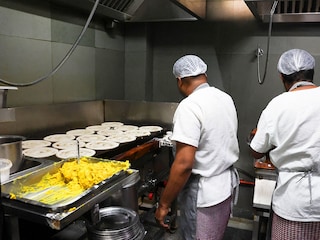
As petroleum prices see-saw across the world, following the US-Israel attacks on Iran, a different kind of fuel shortage is sending commercial kitchens in India into a tizzy.
Restaurants in the country’s biggest cities are finding it difficult to procure commercial LPG cylinders, their main source of cooking fuel. In Bengaluru, Chennai, Delhi, Mumbai, and Pune, restaurants are complaining of delayed deliveries and uncertain supplies of LPG cylinders.
“The restaurant industry is predominantly dependent on commercial LPG for its operations. Any disruption therein will lead to catastrophic closure of the majority of restaurants,” said the National Restaurant Association of India (NRAI) in an official statement on March 7, flagging the seriousness of the situation. The restaurant industry contributes more than Rs 5 trillion in revenue to the economy every year, and employs over 8 million people.
Restaurants play a significant role in urban food consumption. Corporate employees, students living in hostels and paying guest accommodations, and migrant workers living in shared accommodations are some of the categories of people who depend on restaurants, mess facilities, cloud kitchens, and online food delivery platforms for their daily meals.
Without stable and secure commercial LPG supplies, restaurants in India could soon have to reduce their services or close shop altogether, NRAI said. Reportedly, in Mumbai alone, 20 percent of hotel operations have been closed due to this shortage, while others have reduced their operational hours. Some restaurants have even taken to deleting slow-cooked dishes from their menus in a bid to save fuel.
During the Covid-19 pandemic, food services were classified as an essential activity to ensure access to cooked meals despite mobility restrictions. That logic still holds today, according to the representatives of the industry. “The government has clarified that there is no ban on the supply of commercial LPG cylinders for the restaurant industry. However, the ground situation is different, with suppliers expressing an inability to supply the same. This is severely impacting the restaurant industry and supply of food as an essential service for citizens,” the NRAI wrote on X.
India depends heavily on imports to meet its LPG requirement, and is particularly vulnerable to supply shortages. The country is the second-largest importer of LPG in the world, and requires 33.15 million metric tonnes per year of the cooking gas for consumption. More than 50 percent of this requirement is met through imports from the Gulf countries, mainly Saudi Arabia, Kuwait and Qatar, and more than 80 percent of this trade passes through the Strait of Hormuz, one of the critical waterways in the world that enables petroleum products from West Asia to be shipped to other parts of the world.
With the US-Israel-Iran conflict tightening supplies and transportation of petroleum products, India has prioritised uninterrupted supply of cooking gas for households, thus affecting supplies to commercial establishments, which are taking their own steps to cope with the situation.
For instance, Mumbai’s Gypsy restaurant has cut down its menu. “We may take off items that require prolonged use of gas. For 40 years, our Schezwan sauce has been made in-house, but if the problem persists, we might have to look for alternatives—perhaps even bottled schezwan sauce,” Aditi Limaye Kamat told The Indian Express, adding that despite their decades-old relationship with their gas agency, fresh supplies have not arrived.
Aashita Relan, founder of Royal China, Delhi says, “At Royal China, our culinary essence relies on high-pressure wok cooking, a technique where consistent fuel supply is non-negotiable for authentic execution. The recent Rs 115 hike in commercial cylinder prices, coupled with a tightening supply chain, places immense pressure on operational overheads just as the industry is seeing a robust post-season recovery.“
Sagar Daryani, president of NRAI, says many South Indian eateries have reduced the number of dosas they serve, as preparing them requires a constant gas flame, unlike idlis, which can be steamed using relatively less gas.In Pune, restaurants and mess services are running on whatever cylinders are left in their kitchens, awaiting further supplies of LPG. In Bengaluru and Chennai, hotel associations have raised concerns about the possible effects of LPG shortage in the coming days. The Bangalore Hotels Association warned that hotel and restaurant operations across the city could be affected from March 10, saying, “Since the gas supply has stopped, the hotels will be closed from tomorrow… common people, students, and medical professionals who rely on hotels for daily meals will be affected.”
In Tamil Nadu, restaurant associations have warned of the possible shutdown of restaurants in the coming days if the shortage is not addressed.
Although the government authorities have claimed that there was no restriction on the supply of commercial LPG cylinders, industry leaders are demanding more affirmative action. In a letter to Hardeep Singh Puri, Minister of Petroleum and Natural Gas, the Federation of Hotel and Restaurant Associations of India (FHRAI) flagged “widespread disruption at the ground level” in the supply of commercial LPG cylinders.
"In light of these challenges, we request the government to issue a formal clarification confirming that no such restrictions apply to the hospitality and food service sectors. We further pray for a clear mandate to be issued to all oil marketing companies to ensure the seamless distribution of commercial cylinders," wrote Jaison Chacko, FHRAI secretary general, in the letter.
“We are closely monitoring the government’s shift toward prioritising domestic supply, but for high-volume establishments in the capital, a stabilised ‘green channel’ for commercial energy is essential,” Relan adds.
An industry on edge
According to Daryani, around 80 percent of restaurants in India depend on LPG cylinders as their primary cooking fuel. Small, neighbourhood eateries, roadside dhabas and family-run restaurants, which operate on thin margins and depend entirely on LPG cylinders, are among the worst affected.
“Organised restaurant chains, cafes and cloud kitchens are also facing uncertainty as they rely heavily on commercial LPG for daily operations,” says Daryani, who is also the co-founder and CEO of Wow! Momos. “While 70 percent of Wow! Momos’ outlets function on electric induction, 30 percent depends on gas, and is facing a major crisis.”
A smaller segment of restaurants depend on piped natural gas (PNG) in metros. Although they have some buffer, when compared to LPG supplies, they remain concerned about the global energy market situation and fear that their gas supply could be impacted as well. PNG is supplied by gas distribution companies such as Indraprastha Gas Ltd (Delhi), Mahanagar Gas Ltd (Mumbai), and Adani Total Gas, which source natural gas from domestic gas fields, on and off shore. Restaurants are also trying to shift to electric cookers, but it is not an easy task for most. Some are trying to stretch existing cylinders by reorganising kitchen operations.
Restaurant owners in a number of cities have reported a rise in the number of LPG cylinders being sold in the black market, at rates that are much higher than official ones. “Over the past few days we’ve started getting calls from informal suppliers offering LPG cylinders at almost double the usual price. When your regular distributor says there’s no stock, some people try to take advantage of the situation. But paying such inflated rates is simply not sustainable for small restaurants like ours,” says a restaurateur in Delhi who wished to remain unnamed. Restaurant associations have urged the authorities to take necessary measures against the hoarding and informal sale of LPG cylinders.
Meanwhile, the government has taken measures to ensure the smooth supply of LPG for domestic use. The Centre has invoked provisions under the Essential Commodities Act, 1955, which allows the Centre to regulate the production, supply, and distribution of LPG in order to ensure smooth and uninterrupted supplies. It has also issued directives to oil marketing companies to ensure the same. Refineries have reportedly been directed to increase the LPG production by diverting petrochemical feedstock meant for other purposes. In addition, the waiting period for booking LPG cylinder refills has been extended.